

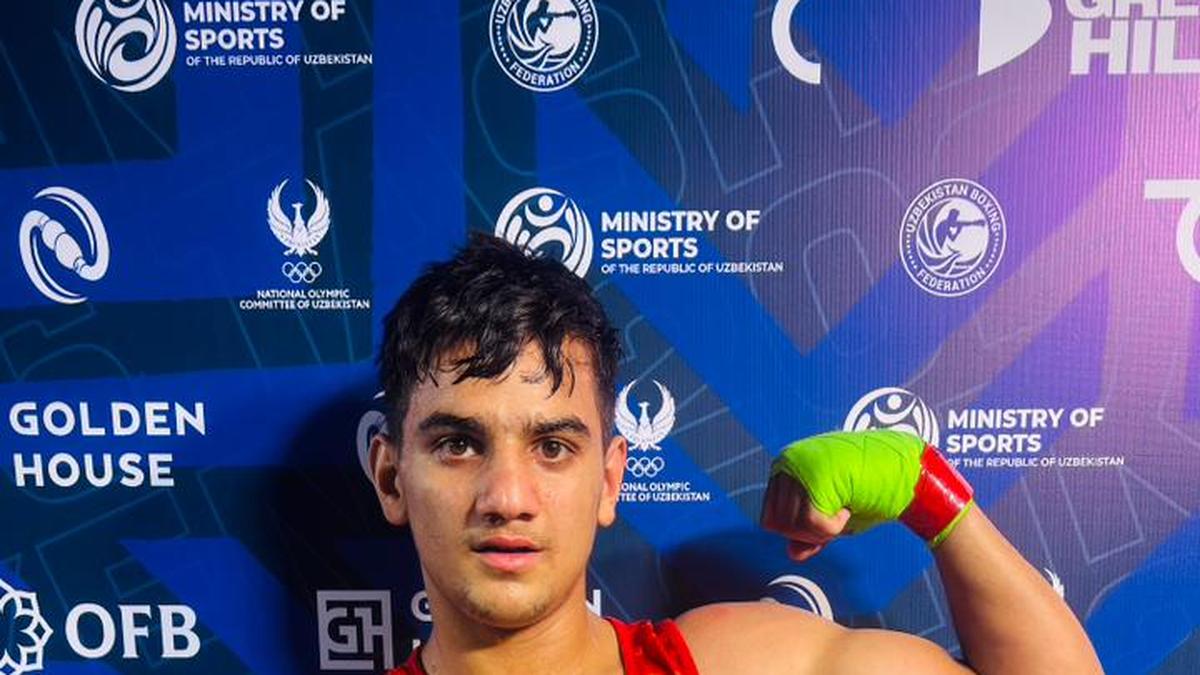
If I weren’t boxing, I would probably be on drugs: Asian U-15 champion Mohammad Yasser
Last Thursday, Mohammad Yasser made history when he stood atop the podium after defeating Uzbekistan’s Abdullah Karimjonov in the final of the boys’ 58kg category at the Asian Under-15 Boxing Championships in Tashkent. His gold was the first international medal of any kind won by a boxer from Jammu and Kashmir.
Since his return to India, Yasser has been moving from one felicitation to another. People want to congratulate him. They want to know what he wants next.
What Yasser wants is simple: to get back to training.
“It’s already been five days since I trained,” he says. “I don’t like missing so many days of practice. It doesn’t feel right.”
The sports stadium in Kheora village, on the outskirts of Rajouri, is where he wants to be — back to punching bags, sparring sessions and a routine that has shaped his life over the last four years. Boxing is all Yasser cares about. And while he may have made history in Tashkent, it is at that modest stadium in Kheora that he believes his life truly changed. “ Boxing se meri life badal gayi, (boxing changed my life)” he says.
Today, Yasser might be one of the most promising young boxers in the country. But four years ago, when he first walked into a boxing gym and laced on a pair of gloves, he wasn’t dreaming of medals. Boxing had only one purpose then – to keep him away from drugs.
Yasser speaks matter-of-factly of his journey to boxing. For many years, life was hard. In 2019, when he was eight, his family’s house was demolished for a road building project. His father died shortly thereafter. Yasser remembers being told it was out of the shock of being made homeless. The family – his mother and two younger siblings – was shifted to temporary government accommodation in Kheora.
ALSO READ | No churma, no problem: Sakshi drops a weight category to make first CWG, Asian Games team
Conditions were not much better. The roof leaked, and the neighbourhood was a drug-infested one. “There is a lot of drug use where I stay. People openly sell and use drugs. When I was young, I used to sit with those people, but when my mother found out she beat me so that I would stay away,” he recalls.
With no source of income, his mother would work in other households. While she could take her youngest child – a daughter – with her, Yasser and his brother were expected to fend for themselves. Schooling was not expected, and in any case, he could not afford books or uniforms
Instead, his mother would take her two sons near the stadium so that at least they could be in public, ensuring enough eyes on them, hoping they will be safe.
Violent neighbourhood
Safe, though, was only a matter of relativity. “I was getting into fights all the time. I’d do odd jobs for 10 or 20 rupees. I’d roam around the stadium, but I never thought of going in. I saw boys playing cricket there, but I knew I couldn’t afford to play. I was just a typical loafer child,” Yasser recollects.
All that changed in April 2022, when 26-year-old Ishtiaque Malik was recruited as a coach on contract through the Khelo India program.
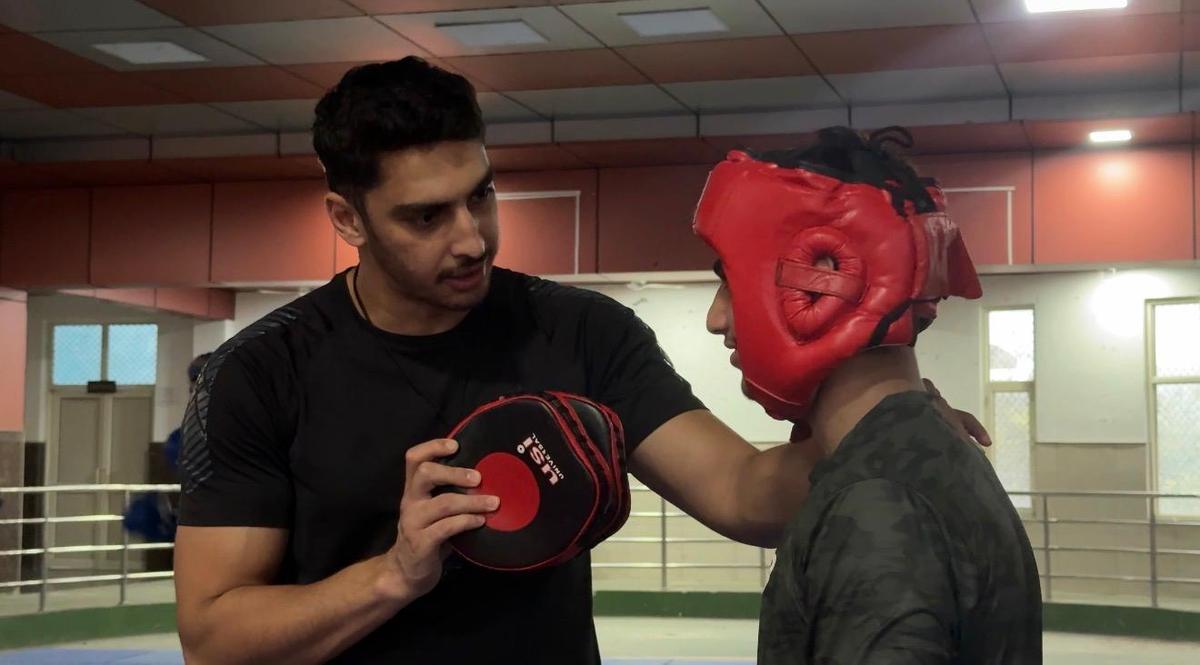
Yasser (right) and his brother were Ishtiaque’s (left) first couple of students. They also became the ones he was most invested in.
| Photo Credit:
Special Arrangement

Yasser (right) and his brother were Ishtiaque’s (left) first couple of students. They also became the ones he was most invested in.
| Photo Credit:
Special Arrangement
Although he came from a family of professionals and office workers, Ishtiaque had always been a sports nut. He’d picked up boxing in boarding school in Himachal Pradesh and then, on his own initiative, enrolled himself at Bhiwani’s famous Bhiwani Boxing Academy – considered one of the finest boxing academies in India. He was good enough to even earn a place in the Indian national camp for the youth World Championships but just as his career was set to take off he suffered a back injury that ended it.
Looking for a job, Ishtiaque saw an opening in Kheora, where an indoor stadium opened in 2019. Coaching appealed to him. “When I had been a boxer, I often felt like the odd one out because there were so few boxers from Jammu and Kashmir. There were a lot of basic things, like making a passport, that no one told me about because no boxer from Jammu and Kashmir had ever needed one. But I also felt a bit hurt that people in Rajouri didn’t even know what the sport was about. When I became a coach, I felt I had the chance to create a boxing culture right at my home,” he recalls.
While the academy had opened, Ishtiaque says he didn’t get too many students to join. “No one knew what boxing even was,” he recalls.
‘Destined to be forgotten’
That’s when he caught a glimpse of two scrawny boys in dusty clothes roaming around the stadium. “You know how there are kids on the street that people look at but don’t really care about. No one wants their children to be around them. Their destiny is to be forgotten. That’s who Yasser and his younger brother, Fareed, were. I called them and asked them if they wanted to learn boxing,” says Ishtiaque.
Yasser and his brother were Ishtiaque’s first couple of students. They also became the ones he was most invested in. “They initially agreed because they weren’t doing anything else anyway. But I also realised they were desperate for some direction in life. When I found out where they had come from and the environment they were living in, I felt I had to do something for them,” he says.
Yasser’s mother at first didn’t approve of her son’s boxing training. “She thought they would get into the wrong company and get into trouble by fighting. Then one day, I sat with her and explained her children’s position. I said that they were not going to school anyway regularly. They were surrounded by people using drugs and selling them. The only place they would be completely safe was when they were training. And if they were good enough, they might even be able to create a future for themselves. After that she finally decided to let him train,” Ishtiaque says.
At the stadium, Yasser threw himself into practise. Facilities weren’t all in place – the stadium still doesn’t have a ring installed, and there’s only one heavy punching bag for all the trainees. Training in itself was hard and often bloody, but he enjoyed it. “People tell me that boxing is a dangerous sport. It’s about punching and also getting punched. But for me, my life was dangerous. Boxing kept me safe. What I liked the most about boxing is that if you work hard, you can make your future,” Yasser says.
Alongside his training, Yasser says he also works part-time to make ends meet. “After my evening training ends at 7 pm, I go to the home of three medical students who are studying at the Government Medical College. They pay me 2500 rupees each month to cook their meals and I can eat a portion of that as my own dinner,” he says.
Coach and ally
When money is tight though, Yasser knows he has an ally in his corner. “When I started my training, I didn’t have any money to buy shoes or a boxing kit. There were many days when I didn’t even have food to eat. Ishtiaque sir bought me my kit and when he knew I didn’t have food he’d make sure I got enough to eat. He was like my own father,” Yasser says.
Ishtiaque, for his part, doesn’t think there was anything unusual about what he did. “I think this is what a coach is expected to do. If I couldn’t even pay for Yasser’s kit or his food, how could I even expect him to continue to train,” he says.
Yasser’s hard work and dedication would start to be rewarded last year. After winning the state Under-15 title, he travelled to the Indian Under-15 championships in Noida in August last year, where he won the national title. A subsequent call-up for the selection trials for the Asian Championships saw him win all his bouts and make the Indian team.
Yasser isn’t the only boxer from the Rajouri academy to make a mark at the national level. “We started with just seven trainees in 2022, and now we have around 30 who train every day. Five boxers from our academy qualified for the nationals last year, but four of them lost in the quarterfinals, just one win away from a medal. There was one other boxer who travelled for the selection trials but he also didn’t make the final,” Ishtiaque says.
Ishtiaque adds that although others are equally talented, Yasser has something that makes him special. “His best quality is his mental strength. There might be other boxers who are skilful or more stylish, but very few have the same will to win as he does. He knows where he has come from and he feels that weight of responsibility,” says Ishtiaque.
That desire to win is what Yasser also believes carried him through the Asian Championships. “I was a little scared before I went there because it was my first international tournament and I knew there were going to be many strong countries taking part. But I thought I’ve come so far, I can’t go back without a medal. I kept pushing myself and I finally ended up winning the gold,” he says.
While he might have made history for his state, Yasser says he’s not going to be satisfied with a U-15 continental title. “I’m only 15 right now, but I want to continue to win medals. In the next four years, I want to win a junior world title, and after that my dream is to stand on the top of the Olympic podium,” he says.
These are lofty ambitions and Yasser knows his path won’t be easy. But he also knows what the alternate would look like. “If I wasn’t a boxer, most likely I would be using or selling drugs on some street. I would be nothing. As a boxer my destiny is in my own hands,” he says.
Published on May 20, 2026