

You’ve got to have that inner fight: England hockey star Sam Ward on playing despite horrific facial injury
There are days when sports careers are shaped by years of hard work, and others when everything changes in a fraction of a second.
Sam Ward doesn’t dress it up. He doesn’t soften the moment that changed everything. He calls it exactly what it was.
“It was pretty tough at the time. You’re dealt a bad hand,” he said at the ongoing Hockey India League (HIL) on Wednesday.
The moment came in 2019, during Great Britain’s Olympic qualifier against Malaysia, when the British forward was struck full in the face by an 80 kph shot from teammate Harry Martin. The impact left him with facial fractures and cost him 70 per cent of vision in his left eye.
“I got struck by a ball on the head,” Ward said simply. The damage was so severe that surgeons had to remove his entire face to rebuild it.
“I had my face taken off. My whole face. They cut, like, the whole way over the top of the head. There’s a scar straight through. They take your face off and rebuild it,” he explained.
“Four or five (metal) plates. Thirty-one screws. All still there. They don’t want to go back in to take your whole face off again,” he said.
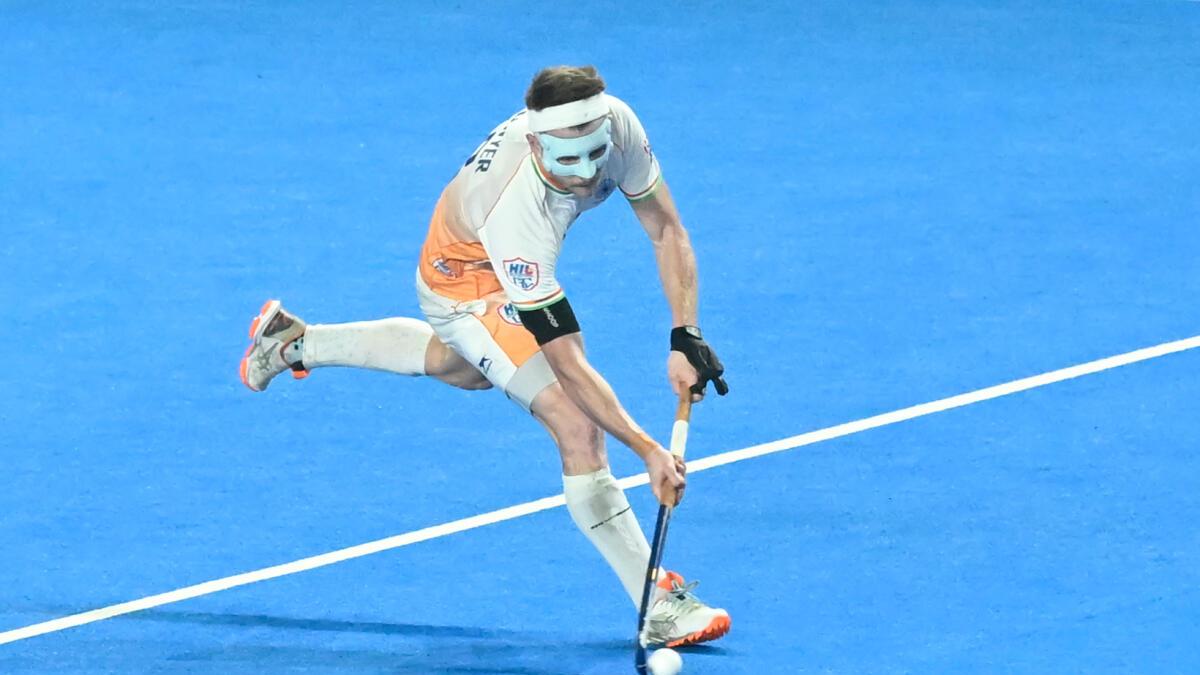
That is why a mask has become part of his playing identity. “It’s to protect the good eye. You don’t want to go blind completely.”
When he first understood the extent of the injury, retirement felt inevitable.
“When I first found out, yes,” Ward admitted. “Even three months after, I was planning to retire.”
International hockey, once central to his life, suddenly seemed distant. Yet, beneath the trauma and uncertainty, something else stirred—an inner fight that refused to let go.
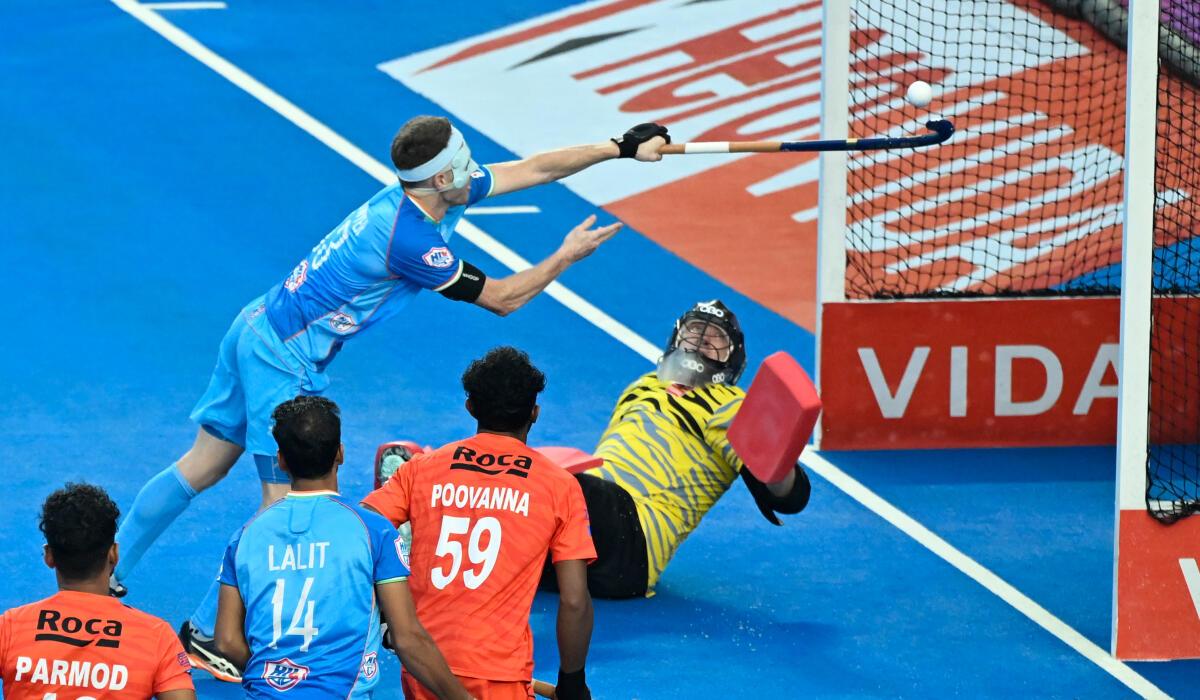
Sam Ward of HIL GC scores a goal against Shrachi Bengal Tigers during the Hero Hockey India League.
| Photo Credit:
R. RAGU

Sam Ward of HIL GC scores a goal against Shrachi Bengal Tigers during the Hero Hockey India League.
| Photo Credit:
R. RAGU
“There’s some kind of inner desire. To play sport at the highest level, you’ve got to have that inner fight and want to be the best you can,” said the 35-year-old.
Coming back meant relearning how to see the game—quite literally. Losing vision meant losing depth perception, a skill vital in a sport played at blistering speed. Ward had to retrain his brain almost from scratch.
“So, one of your eyes is more dominant. That will pick up the depth, and the other one sees. And obviously, as soon as you lose the depth side of it, which I did, then you’ve got to kind of retrain the brain, and it kind of refocuses and sees things coming at different speeds and stuff.
“You’ve got to retrain the brain for depth perception. I had to stop a lot of hockey balls. Lots of trapping. Even just catching, just seeing balls,” he explained.
Slowly, the brain adapted. “It was pretty hard work,” he said. “It took a long time. But it was worth every inch.”
Throughout the recovery, support became his safety net. England Hockey, Great Britain Hockey, and his club, Old Georgians, stood firmly beside him, ensuring he had access to every medical appointment and every possible resource.
“They just looked after me. They made sure I got everything I could, so I could give it my best,” he said.
The fightback didn’t just bring him back to the field—it took him to the top. In February last year, Ward surpassed Ashley Jackson (137 goals) to become the highest goalscorer for England or Great Britain, a milestone that underlined not just his longevity, but his ability to evolve after trauma. That evolution has carried him to the HIL, where he plays for HIL GC.
“I’m pretty honoured and lucky to be out here. It’s one of the biggest franchise competitions in the world. I think it’s obviously great for growing the game in India. It’s an incredible place to come. We’re looked after well, and it’s pretty special to be here,” Ward said.
Hockey here moves to a different beat, and Ward is relishing the change. “I think it’s quite an exciting counter-attacking style of hockey over here, and to be able to come out here and play like that is exciting and different. There’s a lot more structure, I would say, in the English league.”
Learning from the local talent in the league has become part of his own growth. “I think the biggest thing is that we learn a lot from the Indian players—their ability, their basics, how they trap and hit the ball are pretty incredible. Playing with them every day only helps us get better and better,” he said.
Ward’s journey into hockey itself was unconventional. As a five-year-old, he played for Leicester Ladies Hockey Club, which created a mixed junior section.
“I was fortunate. They had a junior section, but they were a ladies’ hockey club. They let me play as a five-year-old, and created a mixed section called ‘Banana Bunch’. I was member one, with my sister as member two.”
He has even played in a skirt. “That is true,” he said, laughing. “I like a bit of humour.”
Even his rise to international hockey defied the usual pathways. Ward didn’t play for any of the international youth teams. He “left school at 16” and “spent five years selling cars” at a Volkswagen dealership, playing club hockey alongside his job.
“I got picked for England while selling cars. I was playing for Beeston Hockey Club at the time and scoring loads of goals. They picked me from there,” he said.
Fitness, initially, was a challenge. The solution was straightforward and unforgiving. “They put me in boot camp and made me run up and down hockey pitches for a while to make sure I could be as fit as possible.”
Looking back, Ward doesn’t romanticise his return from injury. He acknowledges the doubt, the fear, and the very real possibility that his career could have ended in 2019. But standing on the pitch today—mask on, vision reset, hunger intact—he represents something rarer than talent.
He represents choice—the choice to continue, to adapt, and to believe that even when one way of seeing the world is lost, another can still be learned. And as long as that inner fight remains, he’ll keep playing.
Published on Jan 08, 2026