

WTT Star Contender: Jancarik’s title marks global debut of Table Tennis High-Performance Centre in Chennai
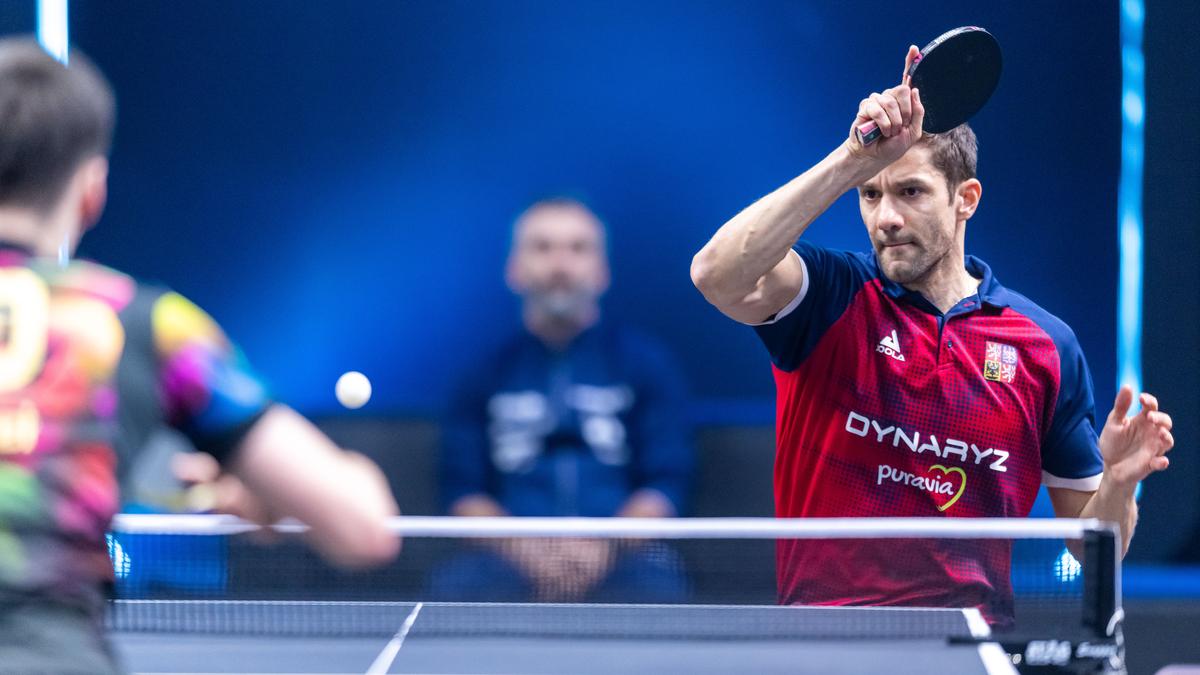
The World Table Tennis Star Contender in Chennai — featuring nine men and 14 women ranked inside the world’s top 50 in singles — produced a new and unexpected men’s singles champion in Lubomir Jancarik, the first Czech to claim the title.
Throughout the tournament, his consistency and tactical intelligence stood out. The 38-year-old does not rely on a single overpowering weapon. Instead, his strength lies in an all-court game built on balance and control. He possesses a wide variety of serves but favours the backhand sidespin, has a deft and effective short game, and is comfortable in extended exchanges.
He adapted seamlessly to each opponent’s strengths and weaknesses, rarely overplaying and seldom losing control. In many ways, he was the ultimate disruptor of the home challenge, defeating four Indians en route to the title — Yashansh Malik, Manav Thakkar, Manush Shah and G. Sathiyan.
For the Indian contingent, a deep run proved elusive. In singles, none progressed beyond the quarterfinals. While 10th seed G. Sathiyan went down to Jancarik in the quarterfinals, qualifier Nithya Mani exceeded expectations by advancing to the women’s singles round of 16 before falling to Cheng I-Ching.
In the end, India’s standout performance came in mixed doubles, where Harmeet Desai and Yasashwini Ghorpade fought their way to the final before losing to Eduard Ionescu and Bernadette Szocs.
Jancarik’s triumph propelled him up 134 places to World No. 40, according to the latest rankings released on February 16. The victory earned him $17,000 in prize money (₹15.48 lakh) and 600 ranking points — rewards that reflect the magnitude of his achievement given the quality of the field.
An overwhelmed Jancarik admitted he was still processing the moment in the immediate aftermath of his win. “I am not really realising what just happened at the moment. I think the energy of India and the people — I like it here, that’s it. I am blessed. Nobody expected I would win the tournament,” he told Sportstar.
He also pointed to broader changes back home. Table tennis in the Czech Republic is gradually improving after the appointment of new coach Salvador Uribe of Mexico, he added. “The sport is getting more and more popular. And the important thing is that after the arrival of Uribe, we are slowly getting the structure [in place]. I think the future will be better,” said Jancarik.
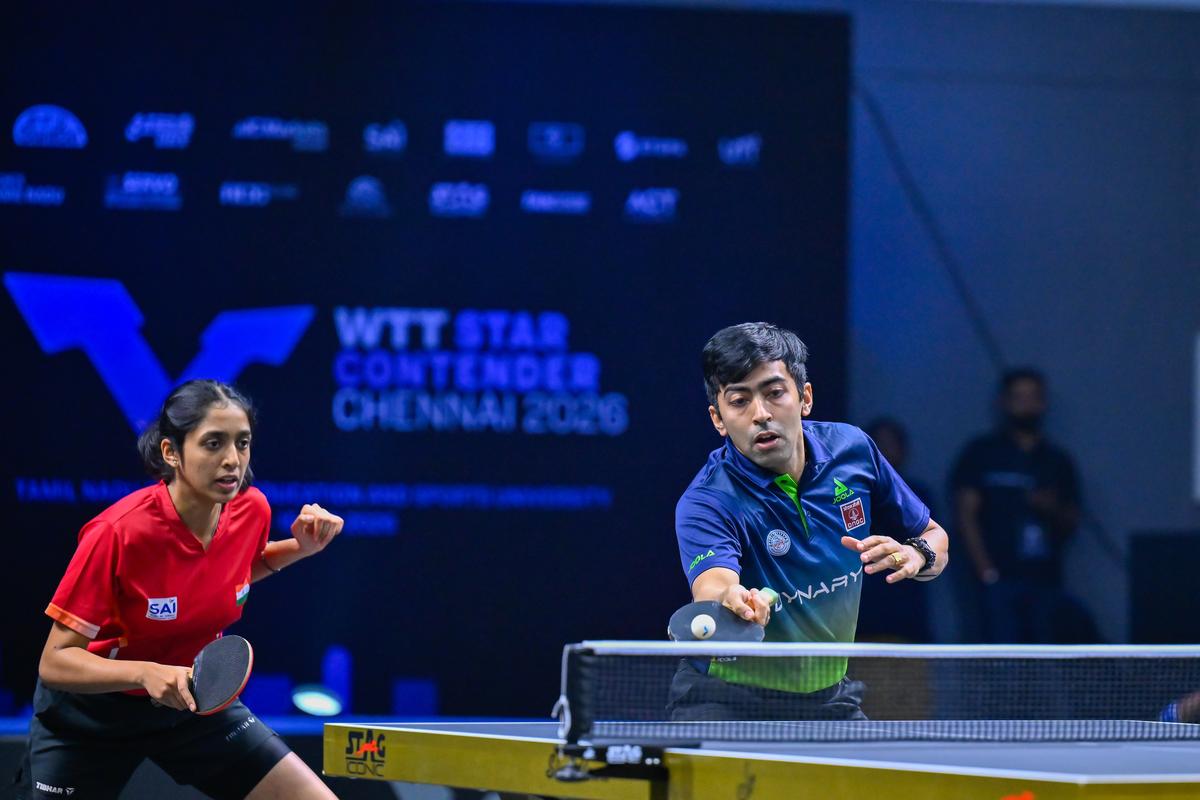
Mixed mastery: India’s standout performance came in mixed doubles, where Harmeet Desai and Yasashwini Ghorpade fought their way to the final before losing to Eduard Ionescu and Bernadette Szocs.
| Photo Credit:
Special Arrangement

Mixed mastery: India’s standout performance came in mixed doubles, where Harmeet Desai and Yasashwini Ghorpade fought their way to the final before losing to Eduard Ionescu and Bernadette Szocs.
| Photo Credit:
Special Arrangement
The tournament was the first major international event to be held at a new High-Performance Centre (HPC) for table tennis established by the Sports Development Authority of Tamil Nadu (SDAT) in collaboration with India’s star paddler Sharath Kamal.
The facility, inaugurated last November, marks a significant step forward for the sport in the State. It is located at the Tamil Nadu Physical Education and Sports University (TNPESU), a vast 125-acre campus on the southern outskirts of Chennai whose infrastructure includes football and hockey fields, a cricket ground, an athletics track, courts for kabaddi, kho-kho, ball badminton, tennikoit, handball and volleyball, a velodrome, and a state-of-the-art biomechanics and sports science laboratory.
Sharath said the HPC reflects the next phase of the sport. The 43-year-old insisted he wanted it to be not just a competitive venue, but much more. “In collaboration with the Table Tennis Federation of India (TTFI), I also intend to host national training camps for both juniors and seniors. The goal is to make the Centre a regular hub for elite preparation,” he said. One of its most important objectives, he elaborated, is to develop players from Tamil Nadu who can rise to the highest levels of international sport and win medals on the world stage.
The HPC, he said, will provide top-class, holistic training for paddlers. “Our focus will be on technical excellence, tactical intelligence, physical conditioning, mental and psychological preparation, sports science and recovery, athlete education and life skills, and long-term athlete development.”
During the tournament, meticulous arrangements were made to ferry players and officials to and from their hotels. The logistics ran like clockwork, but spectator turnout was minimal. With a seating capacity of around 700, the venue was largely filled by family members and friends of players and officials. There is optimism that once metro rail connectivity to the area is established in the coming years, larger crowds will attend major tournaments at the venue. That said, in terms of quality and organisation, the event signalled promise for Chennai’s growing stature in table tennis. Sharath is expected to play a pivotal role in it. As Somnath Ghosh, Sreeja Akula’s coach, said: “He is the face of TT in India.”
With the WTT Youth Contender (October 23-26) and WTT Feeder (October 28 to November 1) scheduled at TNPESU, awareness of both the sport and the venue is set to grow further.
Published on Feb 25, 2026