

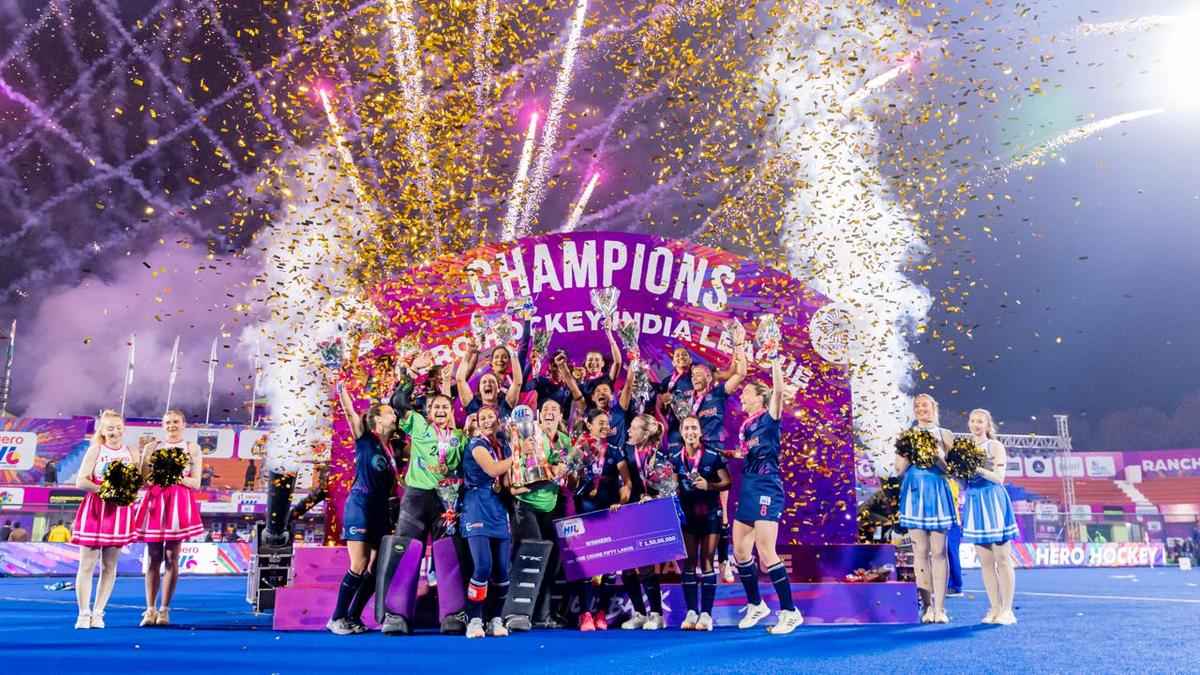
Women’s HIL 2025-26 review: Plenty to like, much to fix
For a tournament still finding its feet, the four-team Women’s Hockey India League (HIL-W) moves remarkably fast. So much so that by the time fans begin settling into their seats, it already feels like time to pack up and leave.
Ambition, when rushed, tends to trip over its own stick. Make no mistake, there are no qualms about the hockey itself. From the opening hooter to the final presentation ceremony, spectators are treated to compelling, end-to-end action. However, scratch just beneath the surface and the league starts to feel like a work in progress, being asked to behave like a finished product.
The buildup, as with last year, to what is currently billed as the world’s only commercial hockey league for women, was not particularly encouraging. The promise of expanding to six teams this season remained what it had been in 2024: a mere promise.
Matters, in fact, deteriorated further with the defending champion, Navoyam Sports-owned Odisha Warriors, choosing to pull out of the 2025-26 season. Cracks had begun to show immediately after the conclusion of the league last year, when the team defaulted on salary payments, exposing the lack of robust financial modelling. Eventually, Hockey India had to intervene and pay the players from the winners’ prize pool, raising uncomfortable questions about revenue security.
“There are at least two other franchises that had delayed payouts until May last year. Many were initially paid only a small percentage of the whole sum. The players were constantly being given assurances that the teams were having emergency meetings with sponsors. It was a frustrating wait,” a source tells Sportstar. This is not only highly unusual for a professional league but also a red flag for financial credibility, especially in relatively low-paying women’s sports.
ALSO READ | Retired India forward Vandana Katariya ‘available’ to make international hockey return
Yet, if one were inclined to argue that professional women’s sports outfits are not viable commercial enterprises, cricket’s Women’s Premier League would suggest otherwise. Five teams, a viewer-friendly format that includes an eliminator-style playoff ahead of the final, and consistent team identities have ensured franchise stability. Even newer leagues outside India, such as the United States’ Women’s Elite Rugby of 2025, have consciously adopted multi-city engagement to help develop seasonal narratives.
HIL-W breaks that continuity. There are no carryover storylines to keep the casual hockey fan invested. The core of the Warriors, for instance, turned out in the green of the Ranchi Royals this year. While playing on home turf helped attendance, such churn ultimately becomes a roadblock for the league’s long-term growth.
Broadcasting plans were in place, but player-centric storytelling was conspicuously absent. Several international stars from the previous season, including Yibbi Jansen, Charlotte Englebert, and Freeke Moes, were nowhere to be seen.
Indian men’s hockey, over time, has produced personalities who double up as symbols of the sport itself. The women’s team, though competitive, currently lacks that shorthand: a single name that instantly anchors the team in the public imagination. Navneet Kaur’s longevity, Udita Duhan’s defensive authority, and Lalremsiami’s presence on the wing offer obvious entry points for sustained projection.
READ OUR OTHER STORIES FROM HIL-W 2025-26 – HERE
Despite the league allowing up to nine Indian players to start in the playing eleven, only one Belgian coach was willing to depart from convention, leaving the likes of Lola Riera, Juana Castellaro, Cristina Cosentino, and Priscila Jardel on the bench during a match against the Shrachi Bengal Tigers.
Sofie Gierts, heading the eventual champion SG Pipers, explained the thinking: “Look, we are in India, and it’s called the Hockey India League for a reason. We want Indian players to shine, and we want them to live their dreams. It’s our responsibility to put them in front. The Indian players are amazing.”
Then there were the recurring issues. The league’s social media strategy, meant to drive emotional investment, was underwhelming. There were no meet-and-greet opportunities at popular hubs such as Nucleus Mall or the Mall of Ranchi near the venue, no contests to win signed merchandise, and no paid hospitality offering.
At times, the women’s league felt like an afterthought. From the official communications partner having no on-ground presence, to a team relying on a local photographer to distribute fan jerseys to random passers-by for photo opportunities, to a franchise PR manager unaware of where the team hotel was, the anecdotes bordered on the absurd.
Interviews with players suggest that the league’s reputation in other hockey-playing nations remains mixed. “Everyone says ‘planning’ in India isn’t really ‘planning.’ Things change often, and that happened on the second day itself. We were supposed to train in the evening. And in the morning, our coach texted us saying we’re playing a game at 2 pm. So, things like that are really funny, but the girls are saying that it’s improved since last year. Like the bus is now coming every time, on time. Apparently, sometimes they were kept waiting, and the bus never came,” says Netherlands forward Sosha Benninga, who was initially sceptical about coming to the country after hearing stories of players being made to travel on sleeper-class trains.
Watch Sosha Benninga’s full interview here:
There is clearly more thought required before HIL-W can convincingly call itself a professional league rather than a well-intentioned event. For now, the tournament can take comfort in drawing sizeable crowds even on weekdays, despite the biting cold, largely on the strength of a solid advertising campaign.
Published on Jan 12, 2026