

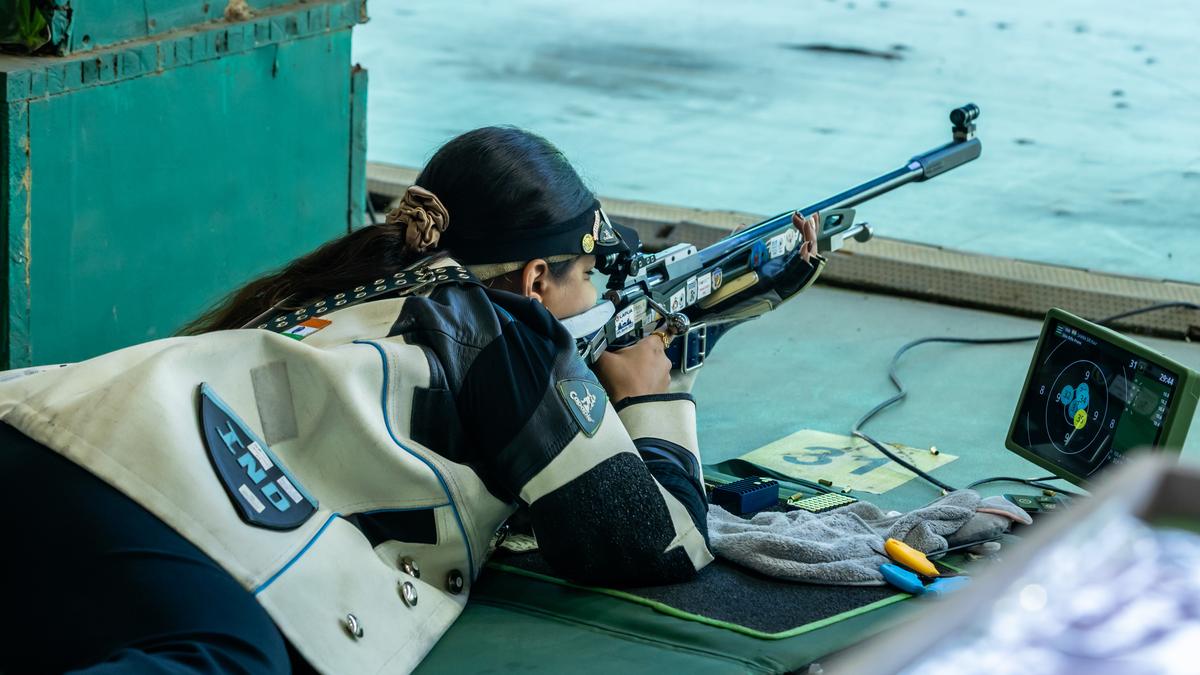
Shooting Asian Championship: Sift Kaur Samra counters dip in main event form with silver lining in secondary
Having taken her final shot of the competition, Sift Kaur Samra got up, checked her score and looked up at the digital scoreboard of the shooter to her right, to compare how she’d done. Competing in the 50m prone event – in which shooters lying flat on the ground fire six series of ten shots each at a target 50 meters away – Sift had shot 623.2.
Her neighbour Yelizaveta Bezrukova of Kazakhstan had finished two decimal points in front with a score of 623.4.
At that point, Sift reckoned she’d not performed all that well. Indeed, with the exception of her final series in which she’d shot 105.9, she’d shot middling scores in the first five series.
“When you are shooting the prone event, you can’t just get up and look at what everyone is doing. So, when I saw that the first competitor next to me had scored more than me, I thought everyone else must have done the same,” she’d tell Sportstar later.
Sift though had happened to glance at the only shooter who had scored more than her amongst the 12 taking part in the event, managing to come in second and win a silver medal (medals in the 50m prone are determined by qualification scores).
As it’s a non-Olympic event, there’s usually little spectator interest in the 50m prone. But for Sift, this silver is an important one.
“I wanted to get some confidence,” she adds.
ALSO READ | Asian Championship: Amanpreet wins gold as India completes clean sweep in 25m centre fire
It’s hard to imagine Sift Samra needing to build her confidence. Her main event is the 50m rifle three position event which is part of the Olympics. The 24-year-old is one of India’s most successful shooters in the format and the defending Asian champion too, shooting high score with ease. At the 2022 Asian Games in Hangzhou, she shattered an elite field to win gold. Prior to rule changes by ISSF at the start of 2026, the world record in the final stood in her name.
Form slip
But more recently, Sift has looked far more human. She shot one of her lowest ever scores (574) at the Paris Olympics where she entered as a genuine medal prospect. Last year she started well with gold at the Buenos Aires World Cup and then the Asian Championships in Shymkent, Kazakhstan but then ended 48 th in qualification at the Cairo World Championships.
Her dip in form extended to domestic competition as well, failing to medal at the national championships. She then didn’t make the final at either of the two selection trials (finishing 12th out of 29 participants and 12th out of 23 participants in the two trials) at the start of the season.
Sift acknowledges the disappointments she’s facing and the poor results that have stacked themselves on top of each other.
“Of course, I’m also a human. Some of these results are unpleasant experiences. Losing in Paris was a bad experience but unless we taste failure, we don’t enjoy winning. That’s how I look at it.”
She reckons there was an element of eventuality to her loss of form.
“On the one hand, it’s just a part of sport. You don’t wake up the same way every day in the morning. That’s how it is in shooting as well.”
While she’s faced difficult days, Sift says she’s been lucky to have plenty of support.
“The people around me – my family and coaches have been very supportive. It would have been difficult if they hadn’t been. They know I’m not doing well. Everyone tells me the same thing. They say there’s always a time in a sportsperson’s life like the one I’m going through. So, I try to work through it. I’m lucky that there’s never been a single voice around me that’s said that maybe I’m done as a shooter.”
Retooling technique
But that doesn’t mean that there are no changes to be made. “Every tournament doesn’t go the same way. You try your best, but it’s clear that there’s something else you need to be doing.”
According to Sift, that meant a return to training.
“I think there are a lot of variables for reduced performance. One of the main things I feel was because I was competing a lot and as a result wasn’t getting the training I needed. There were some things that I had to change but I wasn’t doing it. So, it was time for me to concentrate a bit on my training.”
It’s not just Sift who felt that way. After her performance at the selection trials last month, senior coaches in the national camp – Manoj Kumar and Deepali Deshpande suggested she stay behind rather than head back home to Faridkot, Punjab.
“They’re all very concerned about me. But they feel I just need to get the right kind of training. It’s a little strange of course that people are worried about me,” she admits.
Coach Manoj Kumar agrees that in the past he might not have suggested Sift stay behind but felt her current struggles demanded it.
ALSO READ | Pipped to the gold in 50m 3P at Asian Championships, Niraj Kumar targets turnaround
“Sift is a shooter who normally likes to shoot her own way. She doesn’t like making changes to her style of shooting. But we felt that she would benefit from working a bit closely at the National Center of Excellence (at New Delhi’s Karni Singh Range). So, I convinced her she needed to come here,” he explains in a chat with Sportstar.
He says he might not have insisted as strongly as he did if he wasn’t dealing with Sift.
“I didn’t want to leave her by herself because she’s too good a shooter to just lose. She is a quality shooter who has picked up some faults in her shooting. But I knew she had the quality to bounce back once again,” he says.
Sift says these faults are in her technique and posture specifically in the kneeling event.
“I don’t like admitting it because you start thinking about it too much. But I’m working a lot on improving that position,” she reveals.
Gradual buildup
Manoj explains that the errors had been building for a while.
“We are trying to get her posture as balanced as possible. When she started her shooting there may have been small errors but because she was already shooting really well, you let the shooter decide whether they want to continue in that manner. But even in victory your posture isn’t technically correct. And over time these errors add up. When you are young you manage to overcome all these issues but as you get older you have to consciously take steps to correct it.”
“These are fine adjustments,” says Manoj. “We are working on reducing the amount of movement when she’s loading and unloading the rifle in the kneeling position and trying to get her more balanced throughout the position.”
It’s early days still but he says the signs are promising.
“Just before the Asian Championships she shot a 200/200 in training in the kneeling position which is something that she hadn’t done for a very long time,” he adds.
It’s hard work but it’s unavoidable.
“When I started my career, my father was always on top of things and making me shoot. I was shooting the entire day from morning to evening. That was the basis of which I ruled for 4 years. If I have to rule again, I need to get back to that grind. This is almost like a return to my childhood. But i need this. My body is telling me I need to train. I can’t rest right now,” Sift chimes in.
It’s only due to the focus on rebuilding her technique, that Sift decided to skip the three-position event at the Asian Championships in Delhi.
“There’s no point shooting competitively because it’s difficult to make all the changes you are working on. I only shot the prone event so that I’d still keep a feel for competition. I see this as a training competition,” she says.
Her main goals are later this year – the Asian Games where she hopes to defend her gold medal and the World Championships which will be a qualification event for the 2028 Olympics.
There’s no certainty Sift will even qualify.
“The quality of shooters in India is at another level. I can’t just touch 590. I have to shoot well above it. I have to get better not just in kneeling but in all three events. I have to really fight to qualify for the Asian Games and the World Championships. It’s not complicated though. I have to consistently score 590-plus scores. It’s not going to be easy, but I’ve shot these scores before. I need to find that quality which will let me shoot these scores again,” she says.
Published on Feb 13, 2026