

Records tumble, ceiling rises for Indian track-and-field at Federation Cup 2026
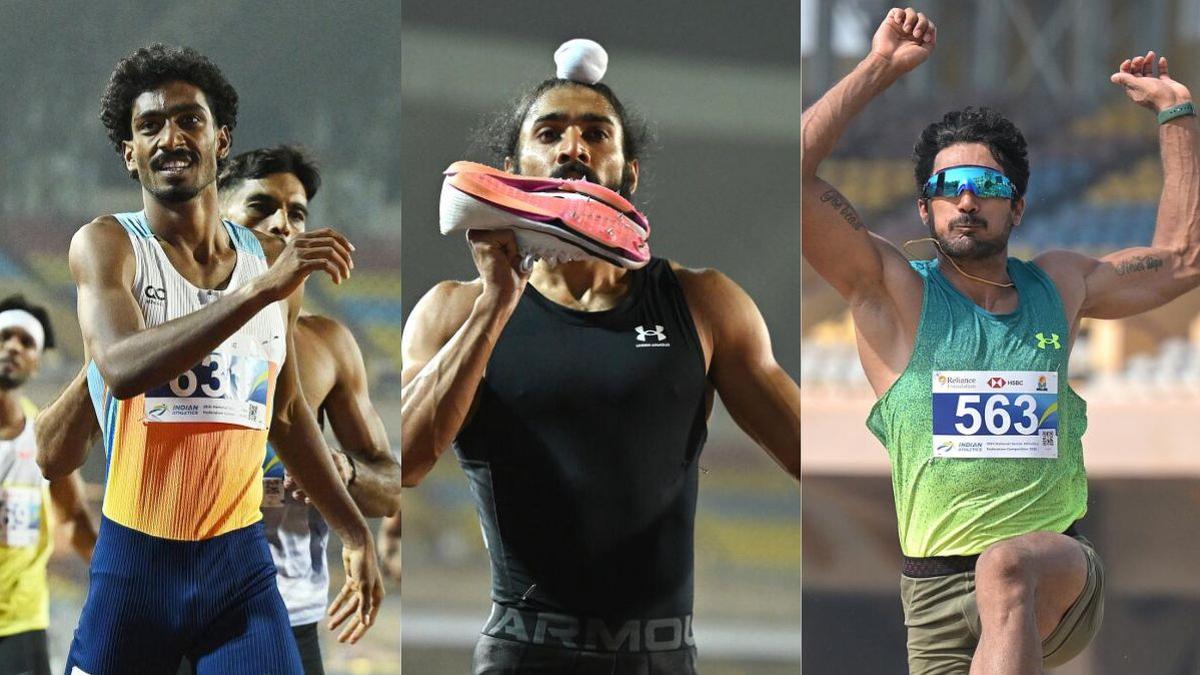
Under an endlessly inky night sky in Ranchi on Saturday, the ceiling of what was once considered possible was raised in one of the most remarkable days in Indian athletics history. In the space of a surreal hour at the Federation Cup, three of the defining landmarks of track and field were crossed, revealing a tantalising glimpse into both the level and the potential of the sport in India.
At 7.10 pm, Gurindervir Singh stormed to a 10.09-second finish in the 100m to become the fastest Indian of all time. Half an hour later, Vishal TK stopped the clock at 44.98 to become the first Indian man to break the 45-second barrier in the 400m. Then at 8.10 pm, Tejaswin Shankar scaled one of the defining peaks of track and field, becoming the country’s first decathlete to cross 8,000 points, totalling 8057 points.
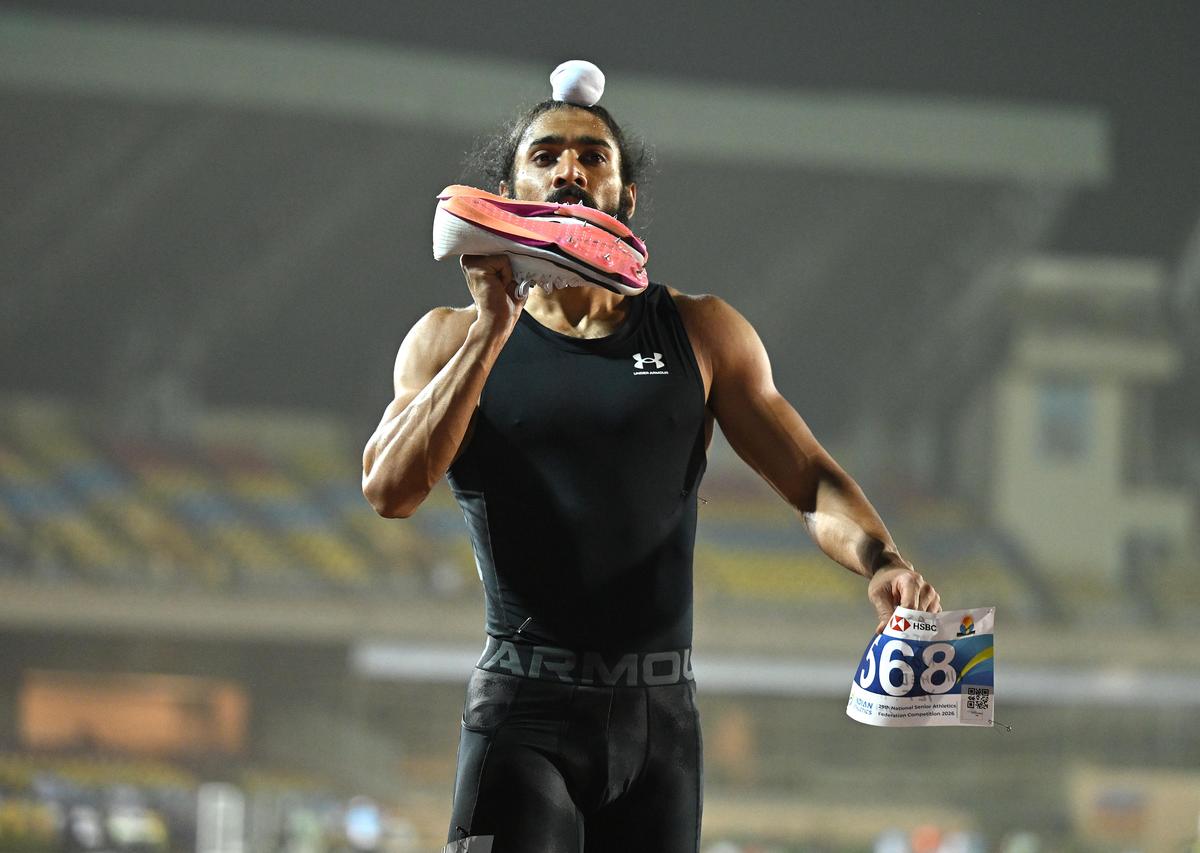
Gurindervir Singh celebrates winning the men’s 100m at the Federation Cup in Ranchi on Satuday.
| Photo Credit:
Ritu Raj Konwar

Gurindervir Singh celebrates winning the men’s 100m at the Federation Cup in Ranchi on Satuday.
| Photo Credit:
Ritu Raj Konwar
While each of the performances was a watershed moment in its own right, they didn’t come out of nowhere.
Gurindervir’s mark was, in fact, the third time the Indian 100m record had fallen in the space of a day. Running in the semifinals of the event on Friday, the 25-year-old from Jalandhar had erased a hundredth of a second from Animesh Kujur’s then record of 10.18 seconds, which he had in fact taken from Gurinder last year. Less than five minutes later, though, Kujur had reclaimed his record with a time of 10.15 seconds.
On that day, Gurindervir had eased up some 20 meters before the finish, which had stopped him from running even faster and which had left open a window through which Animesh had burst through. It was clear that a fire had been lit under Gurindervir.
There was nothing left to chance on Saturday. He had stayed off social media. He kept to himself in the hours before the race, his ears plugged with ear pods so that he wouldn’t be disturbed in the warm-up area. He had kept his mind laser-focused on the race he had to run. When the starter’s pistol fired, he performed flawlessly: Gurindervir got off the blocks fast, went clear off the runners in every other lane by the 40m mark, kept his foot on the gas pedal all the way through and bent forward at the finish line.
As he blitzed past the finish line, the flash timing on the digital board at the Birsa Munda Stadium showed 10.07 seconds. A few seconds later, the time was corrected to 10.09. The gold standard of the 100m is the 10-second barrier, and at long last, the Indian record was less than a 10th of a second away from that magical number.
Even this number is special. As he crossed the finish line, Gurindervir tore off his chest bib and flung it on the track. He screamed his lungs out in exhilaration. He pulled off his cleats and hurled them on the track, then picked them up and kissed them. He hugged his coach, James Hillier from the Reliance Foundation. He held up the reverse side of his bib, on which he had predicted how he would run and also written his bet for the future. “10.10 seconds. Task is not finished yet. Wait, I am still standing,” he had written on it.
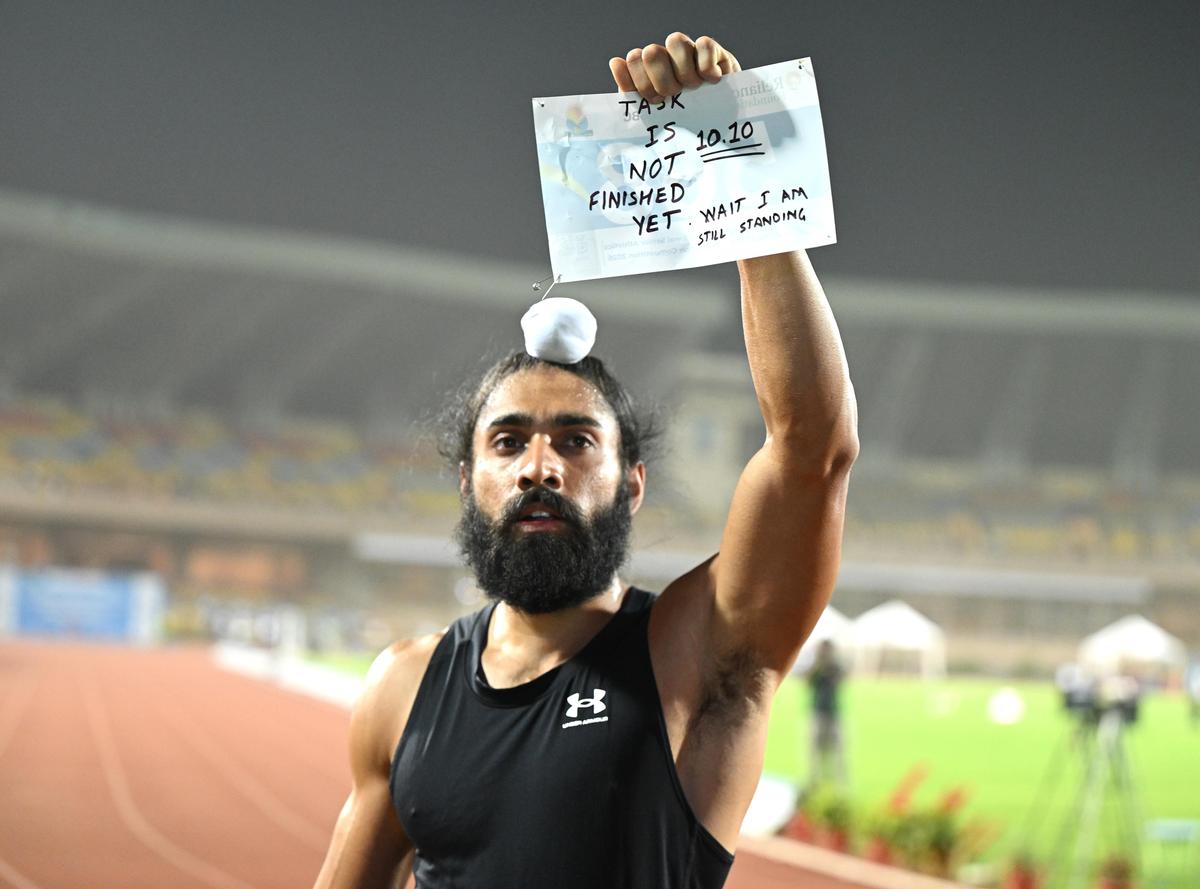
Gurindervir holds the note aloft that underlined his resilience to keep going and finally break the record. However, he maintained that he was not done yet.
| Photo Credit:
Ritu Raj Konwar
Gurindervir holds the note aloft that underlined his resilience to keep going and finally break the record. However, he maintained that he was not done yet.
| Photo Credit:
Ritu Raj Konwar
This was his moment to thumb his nose at his naysayers, and Gurindervir, who has had his share of them, made the most of it. “When I started running, there were people who told me not to waste my time. They said that Indians don’t make good sprinters. But I want to tell them they are wrong. Indian genes tagde hain,” he said.
Gurindervir wouldn’t be the only one to have manifested a record. The excitement had barely begun to settle when it was the turn of Tamil Nadu’s TK Vishal to make the night his own. The 21-year-old was already the national record holder in the 400m event, having clocked 45.12 last year.
‘Lets get the 44’
But Vishal, who only began running the 400m a couple of years back, had long been tipped to do far greater things. On top of that bucket list was to run a sub-45-second 400m. In terms of track and field scoring standards, it’s considered about as difficult as running a 10.06-second 100m and is one of the benchmarks for excellence in the event. On Saturday morning, Vishal’s coach, Jason Dawson, reminded him of this. “Let’s go and run 44 seconds,” Dawson told him.
Vishal would do just that. In a field in which an unprecedented five runners had clocked below 46 seconds in the semifinals, he steadily pulled away from his chasers and then stormed clear of the pack in the final straight.
As he whooshed past the finish line, Vishal didn’t celebrate right away. He waited for the digital board to confirm what he had hoped for — 44.98. It flashed. That was the sight for him to pull off his own running bib in which he had written ‘44 coming home’. That gesture was for the cameras. To release his own emotions, he screamed ‘Yes!”. He sought out his father Thennarasu, who had travelled from Tamil Nadu as he does for every competition his son runs in India, and wrapped him in a bear hug.
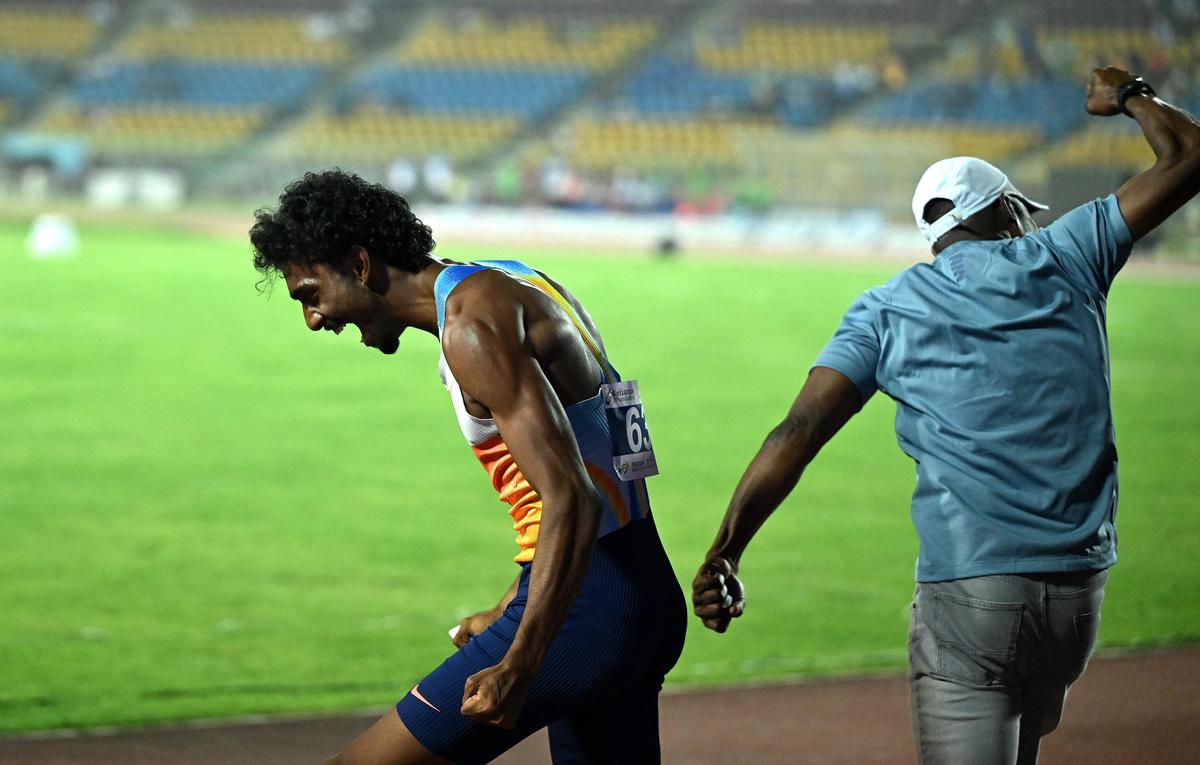
Vishal TK finally has his moment after seeing the digital board — his hard work and the promise of ‘44 coming home’ is finally fulfilled.
| Photo Credit:
Ritu Raj Konwar
Vishal TK finally has his moment after seeing the digital board — his hard work and the promise of ‘44 coming home’ is finally fulfilled.
| Photo Credit:
Ritu Raj Konwar
When he saw coach Jason, he leapt into his arms. “We did it!” yelled Vishal, in between shouts of “Let’s go India!” by the Jamaican-born Jason.
It was an emotional high point, but the day wasn’t done just yet. Just a few minutes later, Tejaswin Shankar lined up for the start of the 1500m. The 26-year-old had already held the Indian decathlon national record of 7826 heading into the Federation Cup. He had also scored a wind-assisted total of 7947 points earlier this year. But 8000, he would also admit, carries an aura of its very own. Fewer athletes have an 8000-point decathlon to their name than a sub-45 400m.
Scaling mount 8000
Tejaswin had been asked before the competition why he was risking participating in the decathlon. He’s also the national record holder in the high jump and since the purpose of the Federation Cup was to serve as a qualification event for the Commonwealth Games in July, surely it might have been easier for him to take part in the high jump – the qualification standard of which had been set relatively modestly – compared to the 10 events of the decathlon, in which he had multiple chances of failure.
For Tejaswin, though, the answer to the question was a simple one. He had always competed for the challenge, and the 8000-point decathlon was the ultimate challenge for him.
The event came with rewards but also with risks. That’s how Tejaswin had yo-yoed through the two days of competition. He started the first day with three personal bests – in the 100m, long jump and the 400m. His best high jump of 2.25 was the best he’d ever recorded in a decathlon event and was in itself better than the Commonwealth Games qualification standard.
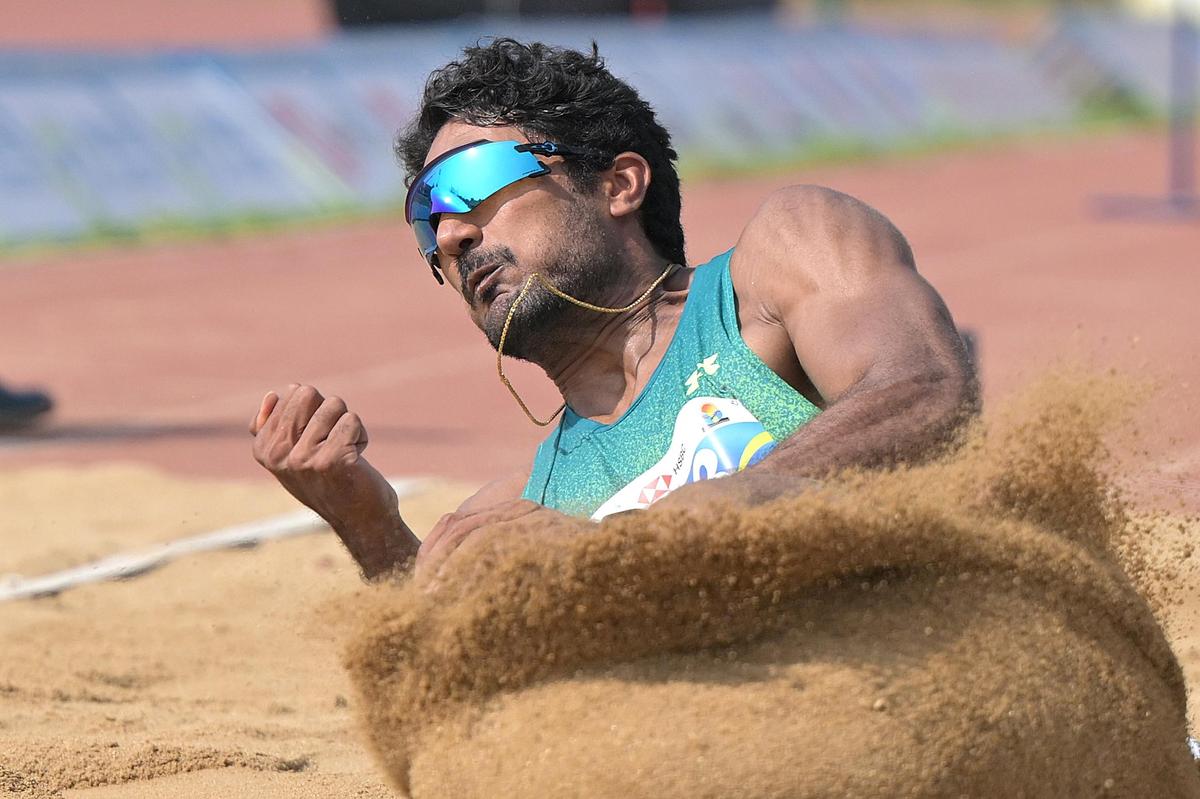
After Gurindervir and Vishal’s performances, though, it was unlikely that Tejaswin would settle for anything less than a place in history of his own, and he did just that on Saturday.
| Photo Credit:
Ritu Raj Konwar
After Gurindervir and Vishal’s performances, though, it was unlikely that Tejaswin would settle for anything less than a place in history of his own, and he did just that on Saturday.
| Photo Credit:
Ritu Raj Konwar
On Saturday morning, though, things hadn’t gone nearly as smoothly. He suffered an awkward fall in the pole vault – typically one of his weaker events – and ended up suffering a cut on his left shin.
He had an uncharacteristically poor javelin throw event, which had taken his chase for the 8000 from a near certainty to one that would be decided by his final 1500m race. After Gurindervir and Vishal’s performances, though, it was unlikely that Tejaswin would settle for anything less than a place in history of his own, and he ran another personal best to do just that.
Sign for the future
While the spotlight might have been on Tejaswin as it had been on Vishal and Gurindervir earlier that evening, there was something more significant than individual glory in all their performances. Each of them had broken a national record but in doing so had raised the standard of the rest of the field as well.
While Tejaswin crossed 8000, three other competitors crossed 7000 points – a first at an Indian decathlon. Second-place finisher N Thowfeeq, who is just 22, scored 7530 points, placing him third in the all-time Indian lists and just short of what would have been a medal at the 2022 Asian Games (7568 points).
“He’s (Thowfeeq) just 22. He’s got so many events he can get better at. There’s nothing stopping him from improving to 7800 or even 8000 himself. That will mean that I can’t just assume that I can win a domestic competition by scoring 8000. I’ll have to improve to 8200 or 8300 myself. This is what you are seeing in Indian men’s javelin. (Olympic champion ) Neeraj Chopra single-handedly raised the standard of the event in India. I’m hoping we can see that happen across events,” Tejaswin would say.
The same phenomenon was seen in the 100m and the 400m as well. “There was a time when 10.29 (which was what bronze medallist Pranav Gurav ran) would have been enough to win gold at an Indian domestic meet. You might even have won gold back then with a 10.50. Now that just won’t do,” said Gurindervir’s coach, Hillier.
Vishal pointed out that for the first time, five Indian runners had run under 46 seconds in a race – the fifth-place finisher clocked a time of 45.85. This, he said, was a sign of things to come at the world level, especially in events like the relays. “Indians are coming. We are hungry for medals on the world stages. We are going to compete. We don’t see any others and are going to be scared. We are going to say, ‘Hey, the Indians are here. we are going to come for you,” he said.
Published on May 24, 2026