


Noah Lyles: The ‘World Athlete of the year’ award is kind of a joke now
Even though he competes in the sprints, one of the few events in track and field that has never suffered a shortage of outspoken personalities, Noah Lyles stands out as someone who’s probably the brashest of his generation.
He enters the track with flamboyant pre-race routines and Yu-Gi-Oh cards, wins races wearing fingernail polish, a glitzy, multicoloured chain-link necklace and Dragon Ball Z socks, and celebrates his wins by cheekily calling out giant American domestic sports leagues for their claims of being ‘world’ champions.
He’s more than just a flashy personality, though. Lyles is the reigning Olympic 100m champion, and a couple of months ago, he won a fourth consecutive gold medal in the 200m at the World Championships to become the only man, apart from a certain Usain Bolt, to accomplish the feat.
Lyles is a long way from his element in Pune, where he is flagged off the Bajaj Life Pune Marathon on Sunday. Lyles thinks he was in high school the last time he ran any race longer than a minute. However, the longer race sees a more contemplative American.
Ahead of the race, Lyles speaks to Sportstar about what his legacy looks like, the accomplishments that others don’t notice but which mean the most to him, and the vulnerabilities his brash personality hides.
You are here in India to flag off a marathon. What’s the longest you’ve ever run yourself?
The longest I’ve ever run has probably been about four miles. It’s what we used to do for conditioning in high school. Between November and December, we would come for practice, and our coach would say, ‘Go run four miles.’ We had different routes—triangle, square and circle. The triangle was three miles, the square was four miles, and the circle was like 5 kilometres or so.
I hated running those four miles. It’s just too boring. My ADD kicks in too quickly. I’d be running, and almost immediately I’d start thinking about anything and everything that’s not running. In fact, I don’t like running beyond 60 seconds.
Which means that technically you could do the 400 as well?
Yeah, I could. And I mean, I ran a 400m last year too, but I don’t see it happening for me to run a competitive event. If it does, it will happen after the Los Angeles [Olympics]. But I really don’t like the training. It’s not the race. It’s the training. That’s the hard part.
What’s your favorite part about the 100m?
I think the 100m is more of a glory race. As my brother would put it, it’s about being the show pony as opposed to being the workhorse. It has all the glitz and glam. It has all the excitement and fireworks. But of course, with that also comes the hard part of when you’re not on top, it really sucks.
How do you cope with that?
I see losing as part of the journey. It’s a lot more fun when you have one or two losses, because then you get to say, ‘OK, this is where I need to get better. This is how I’m going to improve. I’m going to give it my all. I’m going to lock in.’ Sometimes, when you’re winning too often, you get a little complacent.
Whether you’re trying your best or not, it’s going to be hard to constantly push yourself by yourself. And yeah, it’s almost like how in a story you need to lose to have character development. That’s exactly how I see it.
This year, you were nominated for another World Athlete of the Year award, but of course, Mondo [Duplantis] won it. Do you ever think maybe it’s harder for you to win these things because you need to do well in a lot more events?
Um, I don’t know. There’s a lot more politics to these awards than you think. I don’t think that Mondo doesn’t deserve athlete of the year. I mean he breaks the World Record every year.
Personally, I didn’t even think I was going to get nominated this year. I started out and got injured in the middle of it. I had some great 200m timings. It wasn’t until they nominated me and I actually looked at my season that I realised, ‘Wow that wasn’t too bad. Why wouldn’t I get nominated!’
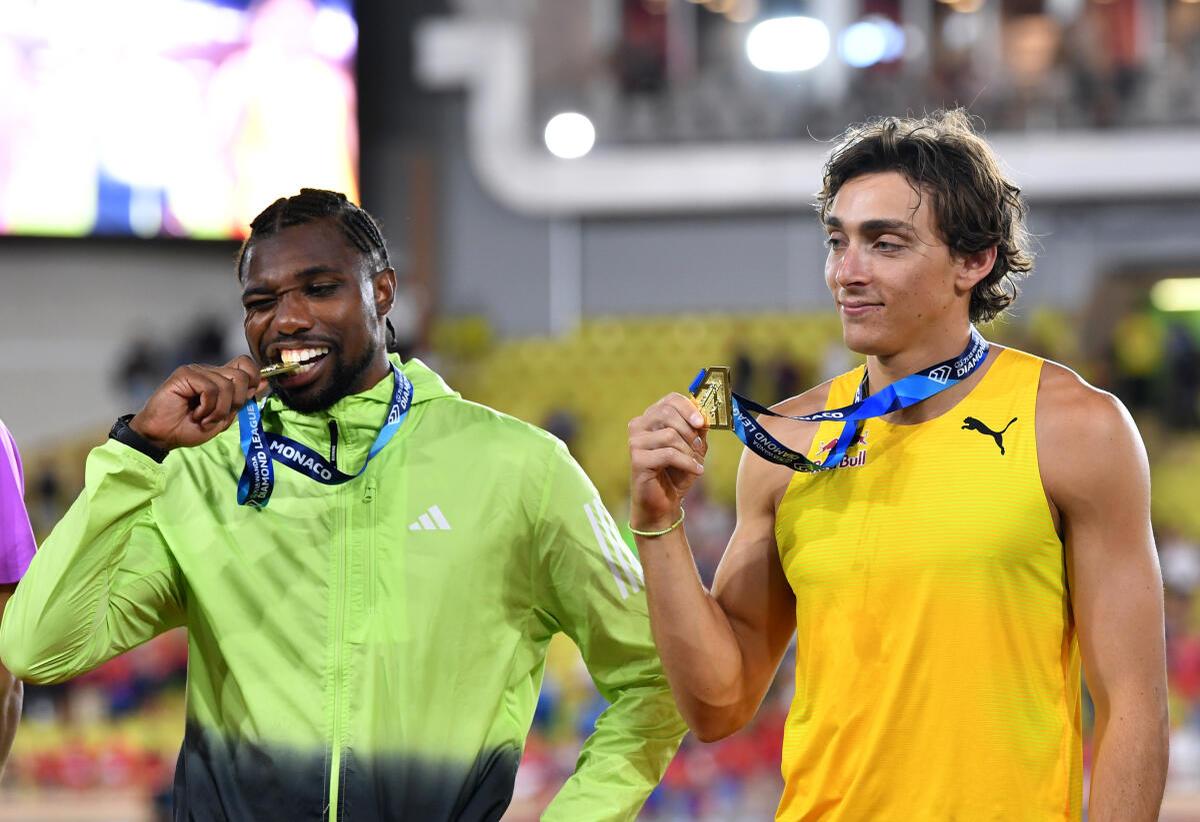
Gold medallists, Noah Lyles of the United States and Armand Duplantis of Sweden pose for a photo following the Herculis EBS, part of the 2025 Diamond League, at Stade Louis II in Monaco.
| Photo Credit:
GETTY IMAGES

Gold medallists, Noah Lyles of the United States and Armand Duplantis of Sweden pose for a photo following the Herculis EBS, part of the 2025 Diamond League, at Stade Louis II in Monaco.
| Photo Credit:
GETTY IMAGES
But the World Athlete of the year thing is kind of redundant because I mean Melissa (Jefferson-Wooden who swept gold in the 100m, 200m and 4x100m at the 2025 World Athletics Championships) wasn’t even nominated. At this point, this award is kind of a joke.
You have this aura of confidence around you. Does that follow you in everything you do in life?
There’s plenty I’m insecure about. Just don’t ask me to read. I have dyslexia, so reading was never one of my strong suits. Spelling too. Don’t ask me to spell either. Reading and spelling were definitely not among the more fun things for me to do. Right now, you are looking at the finished product and something that’s taken a lot of growth over many years. Going through most of my childhood, confidence was the last thing I had.
I was very insecure. I had been bullied early on. I used to take medication, so my teeth were really yellow and I would get bullied for that. All I felt at that time was just that I was good at just a couple of things—drawing and running. And going to school, I didn’t find what I was good at either at first. It was just constantly being in spaces where I wasn’t confident.
Now, you can say that I have this air of confidence about me, and it’s only because now I’m able to find out what I’m good at and excel in that space. A lot of my mental health journey has been trying to develop that. And a lot of the time, when I talk to kids and people, I tell them that sometimes you just have to go through a really rough time to get to that final destination of what you are supposed to be.
You’ve spoken a lot about your challenges with mental health, and it’s hard to think of a sport where it would be harder to face these challenges than the sprints.
I mean, it’s such a crazy sport. It’s like, there’s just fractions of a second that decide everything. Everything’s decided sometimes before you get it on the track. The way I keep things level around me is by having a very close circle. The people in my circle are people who know me, and I trust that they know me. So, if I’m behaving erratically, I trust them to call me out and say, ‘Hey, you need to fix this behaviour.’ And I’m like, ‘OK, if I’m hearing it from you, that must mean it’s true.’ At the same time, if I’m looking for a safe space, they are that safe space.
It’s thanks to them that I know my worth and value. I know who I am, and I don’t look for validation in other places.
How much of what we see of you on social media or TV is a dialled up to 10 version of you?
It’s maybe a dialled up to 12 version of me. When I’m in my safe space, it’s a pretty heavy dial down. Some people get shocked at how relaxed I can be at times, especially in my own home. I’m pretty quiet at home. I might be playing video games. I might be laughing with friends. I don’t have to be a 10 there. At practice, though, I’m very driven. I might not even talk a lot because I’m hyper-focused on trying to get everything out of practice to make it better. Then, when we get to the races, I get to be the showman. I get to let out that personality, that excitement that I’ve been building up.
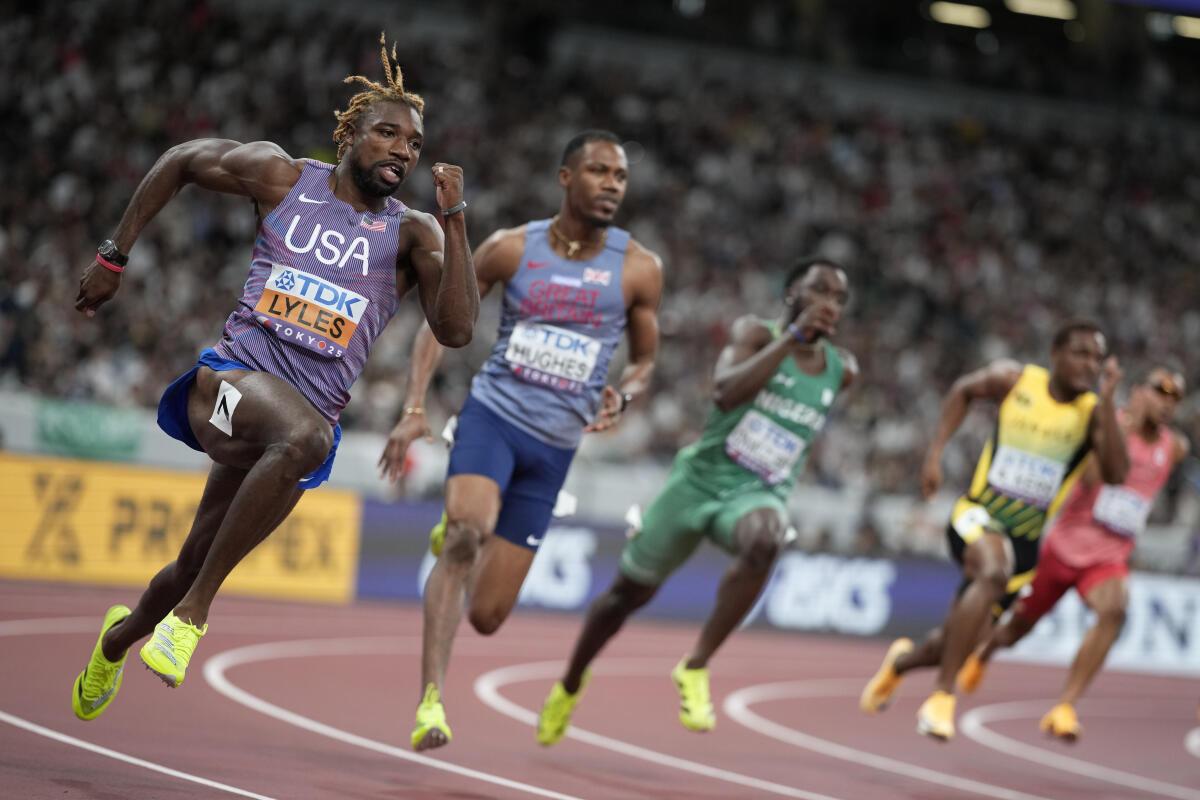
Noah Lyles competes in the men’s 200 meters heats at the World Athletics Championships in Tokyo.
| Photo Credit:
AP
Noah Lyles competes in the men’s 200 meters heats at the World Athletics Championships in Tokyo.
| Photo Credit:
AP
But that’s the misconception people sometimes have about me. The funniest one is when people expect to be in my private life as I am on the field. But that exuberance is very specifically for the sports setting. I might still carry my confidence outside it but it’s not over the top because that’s no longer what’s required of me.
But I’ll have people come and meet me for the first time, and they’ll come with the energy that they see in me when I’m on the track. They’ll go ‘Oh my gosh, it’s Noah Lyles!’ They’ll be screaming at the top of their lungs and trying to hug me and I’m thinking ‘Woah! You’re a stranger to me. I don’t even know you. You need to take a step back!’
They’re wondering where all that energy has gone, but that’s just for track meets. It’s not for the public. I want everyone to use their inside voice then! If you come and meet me for the first time, I want you to introduce yourself with your name.
Do you feel some of that is almost like a character that you have to play at times, or it’s not a character, it’s just like a different part of you which comes out?
It’s not that I’m playing a character, but it’s a different part of me. People have asked me this when I was younger and I’ve been clear that it’s all me but dialled up to a higher level but only in those settings.
What’s something you realised this year that others might not consider an accomplishment but which means a lot to you?
Something that means a lot to me has been watching the growth of the 200m as a competition. It’s something that has made me very emotional. When I first came into the sport, Bolt had just left. [Justin] Gatlin was on his way out. Yohan [Blake] was up and down. We had this drought in the 200m. That was my favourite event. I had come in, you know, watching, you know, those runners. So, when I came into the sport, I wanted to make the event great. I didn’t feel it was up to the level I wanted to see. So, for the next five years, it was part of my mission to just run fast and force everyone else to catch up to me.
For a while, it didn’t look like anybody was going to come with me. And then I start to see the times drop, the averages drop. And all of a sudden, we’re hearing that 2025 had the fastest national championships in the 200m ever. We just had the fastest semifinal times at a World Championships. We just had the fastest Olympic finals we’ve seen in this event. That has been very enjoyable to watch.
When I was young, the mentality was that you were there to win everything. Then you start having your competitors, and you start seeing new people coming in. I’m now at the age where the new people who are coming in watched me, and now they’re fans. They’re asking for advice, and I’m almost put in a role model position in the middle of my career. And that’s something that I actually really enjoy because I want to see everybody run their best.
Track and field has this perception of being a very individualistic sport where no one really cares what the others are doing. You seem to really care about the sport.
This sport is my passion. It’s my love. I was born into this sport. My parents were runners. My aunts and uncles and godparents were runners or Olympians or Olympic coaches. I was born into the track and field world. It’s what I love. I want to see it at its very best.
People drop this word a lot, and you are just 28, but still, are you already thinking about your legacy?
I’ve thought about that since I first turned professional, and probably even before that. I don’t think my legacy is going to stop at any point just on the track. Everyone thinks they are eventually going to retire from the sport, but I don’t think I’m going to be that way. I’m still going to have involvement. I’m still going to be pushing for new avenues and new spaces for track to reside in and trying to create new opportunities for the athletes behind me to be in. I think that would add to the legacy I created while I was on the track.
You have a pretty major legacy already on the track—four straight world gold medals in the 200m, Olympic 100m champion—that’s pretty sizeable.
It’s one of those things where it comes with the territory. You say you want to be the greatest, and you start winning, and all of a sudden, you’re looking behind you, and you have four World Championships gold medals in the 200m, or you are the third fastest man ever, and you’ve won the Olympic title. Earlier this year, I got to show up at a WWE event, and they said, ‘We want you to bring your medals.’ And I’m like, ‘All of them?’ And they’re like, ‘Yeah.’
That was the first time I’d put in that much effort putting them on and when I started counting I started realising—‘Seven, eight, nine! Goodness, this is going to hurt my neck!’ In my head, I know I’m halfway done with my career and I think I’ve already achieved things that the greats haven’t all achieved.
A few weeks back, Tyson [Gay] came to the track where I was training, and he was doing a bit of coaching. He was joking with my coach and shouting, ‘Who’s the baddest man in the sport?’ And I turned around, and I said, ‘You’re looking at him.’
I’m sure that was in a lighter tone, but with one notable exception, you seem to get along pretty well with a lot of your competitors!
It’s a lot easier to get along with the ones that aren’t in the USA because I’m usually fighting with the ones in the USA for the three positions in the USA trials. But I don’t think I’ve ever been enemies with anyone for the most part. I feel like I can learn something from anybody and I enjoy learning things from people even if we are not friends.
Christian Coleman is a great example. I studied Christian’s start and acceleration very closely. I studied Trayvon Bromell’s top-end mechanics. Even when you go further back, I used to study Yohan (Blake) and Justin (Gatlin) because I wanted to know how they perfected their craft. Because sprinting is a work of art. And I want to know everything about that story. Perhaps someone will want to use me as an example as well.
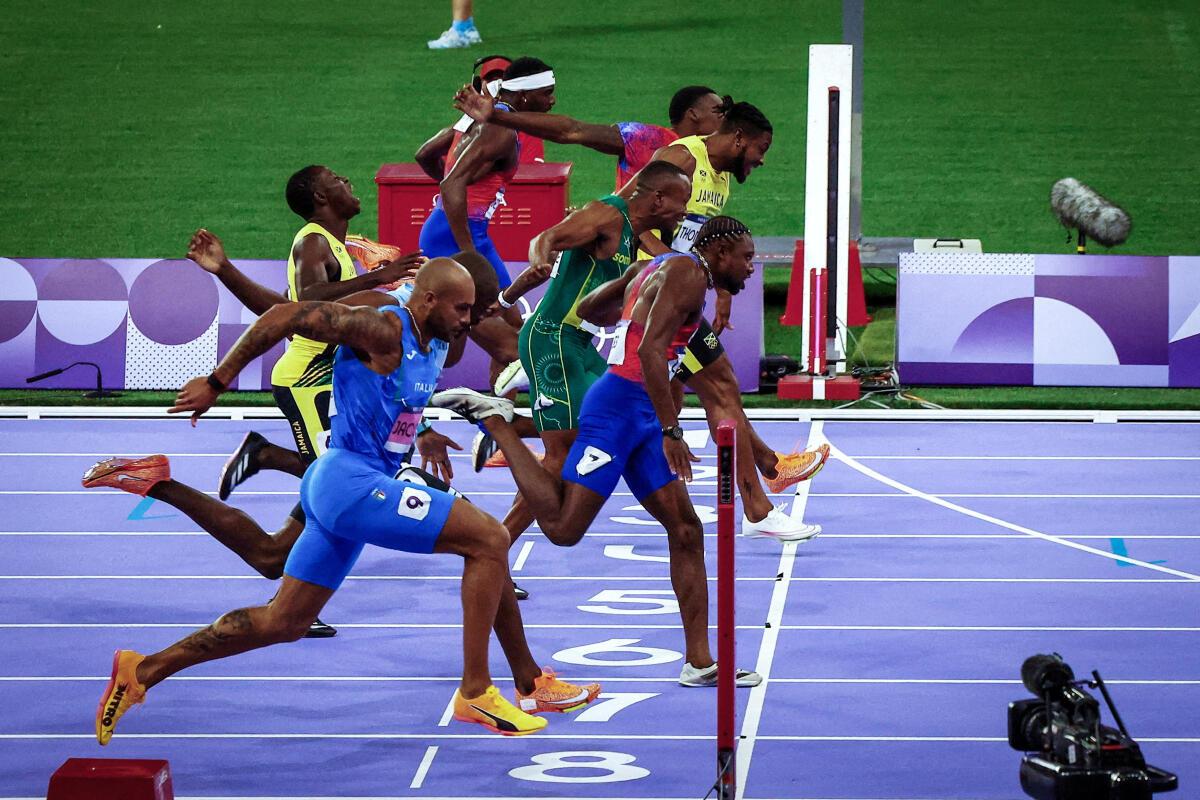
Noah Lyles crosses the line to win gold in the men’s 100m final at the Paris Olympics.
| Photo Credit:
REUTERS
Noah Lyles crosses the line to win gold in the men’s 100m final at the Paris Olympics.
| Photo Credit:
REUTERS
You see your career as halfway through, but if it were to end tomorrow, what would you be most proud of?
I think I would be most proud of the fact that I was authentically myself. It’s also only recently that I’ve been able to get to the point where I’ve been able to see people whom I’ve inspired. I now have the new generation coming in and saying, ‘Hey, you know, I watched you, and you inspired me to run.’ These are my first few years of hearing that. And it’s very surreal to hear.
I never started my journey thinking I wanted people to be inspired by me. I wanted simply to be the best. I wanted to reach something that nobody had reached, and along the way, I looked back, and I saw that people were following the path that I was going through. Now I think, ‘Wow, I need to make better routes. I need to make sure that the paths they are taking are safe and that they aren’t going to go through all the same struggles as I did.’
One of the challenges you’ve had to face is the fact that it’s not just enough to be good on the track. Carl Lewis says the challenge for athletes today is to balance all that with social media and commitments.
See, the thing is that I love running, but I also want to be able to put the sport in a better position than it was in. It’s always fun to see when athletes become world champions for the first time. You can always tell what type of world champion they’re going to be by how they handle the first few days of winning the title. As soon as you become world champion, the next day you have to go to your sponsors’ house, and you have to do media for three or four hours. You are up early signing autographs. That’s what a World champion has to do. And when you see the energy they put into this, you get an idea of what type of world champions they are going to be.
Is this going to be somebody who is constantly trying to push the envelope, or is this somebody who might fold or crack under the pressure because so much is demanded of them?
I think we have to prepare athletes for more. It’s not just about winning on the track, but it’s about being an inspiration. It’s about carrying that mantle no matter how heavy it gets.
Published on Dec 14, 2025