

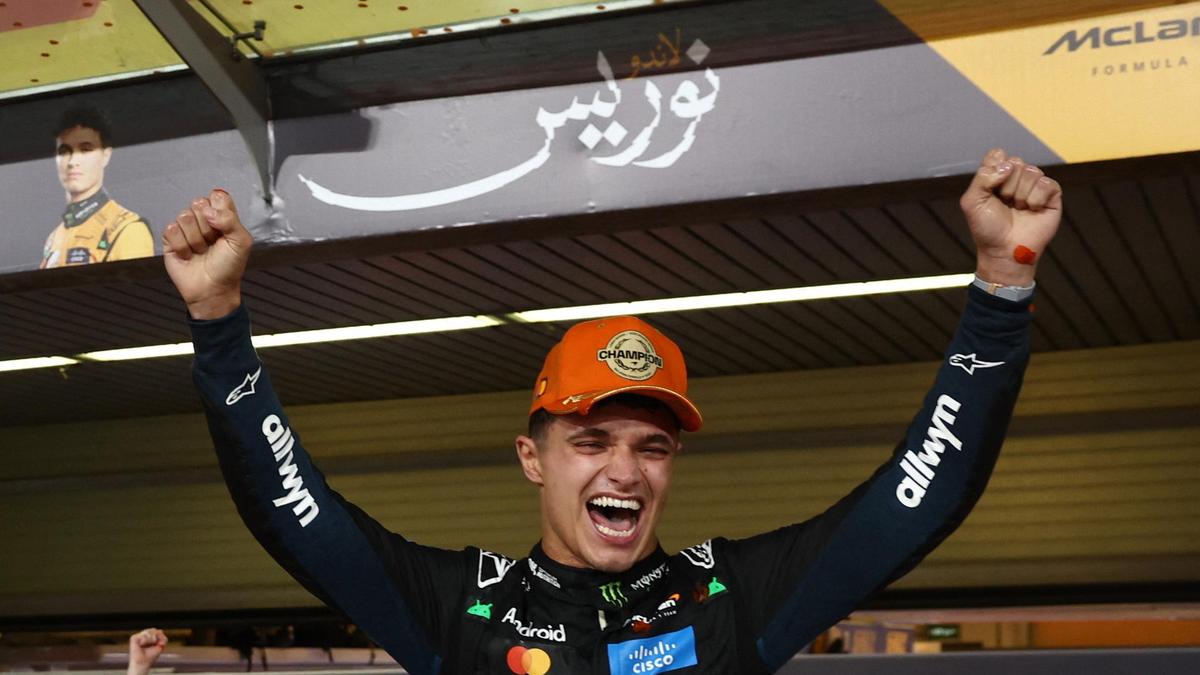
Inside the three-way battle that made Lando Norris an F1 champion
A weekend that demanded perfection. A series of bold overtakes, where the smallest misstep could have cost everything. And a champion’s drive, unyielding when the stakes were highest. After 58 laps of pursuit around the storied Yas Marina circuit, Lando Norris claimed his place in history as Formula One’s new king.
Heading into the finale with a razor-thin lead over Max Verstappen and Oscar Piastri, Norris knew steady laps mattered, but composure under pressure mattered more. A gritty third-place finish, when fourth would have spelt disaster, secured McLaren its first drivers’ crown in 17 years.
It was also the culmination of Norris’ 16-year dream, sparked in karting tracks, sharpened through turbulent junior formulas and finally realised under Abu Dhabi’s floodlights. It capped a rare trifecta of a home win at Silverstone, a tour de force in Monaco, and the world championship in a single season.
The emotion within the cockpit and across the paddock was palpable. The gruelling 24-race journey reached its end in a victory shaped by family sacrifices and personal setbacks, weaving together the strands of a story long in the making.
The path to glory in 2025 was not without hurdles. Tense moments with his teammate, simmering dynamics within McLaren, and the resurgence of an unexpected yet anticipated rival tested him at every turn.
ALSO READ | Lando Norris to drive with No. 1 on McLaren in F1 2026
Those challenges pushed the 26-year-old to adopt a sharper, more resolute mindset, a marked contrast to the jovial, easygoing youngster once celebrated as the sport’s rising talent. In his seventh year in F1, he finally lived up to that promise, an achievement that had often felt distant.
Fleeting heights
Four races at the top, five at the end. That was all of Norris’ time leading the championship, despite entering the season as the favourite. For 15 races in between, it was his teammate and rival, Piastri, who carved out his own ascent.
The Australian emerged transformed after the heartbreaking season opener at home, sharpening his precision and resolve. His blend of aggression and adaptability fuelled a growing narrative: the grid might be witnessing its next world champion, perhaps at the expense of the man who had long carried McLaren’s hopes.
Norris’ slump after Australia strengthened Piastri’s case, as the 24-year-old’s rapid rise made the Briton’s winless streak more glaring. Barring the curtain raiser, only a string of podiums kept Norris’ fragile advantage intact.
The Bahrain Grand Prix became his third consecutive weekend without the highest points haul, and he knew his position was under threat. His confidence faltered, and he did not shy away from voicing the doubts gnawing at him.
The next outing in Saudi Arabia marked the start of Piastri’s dominance and Norris’ misery, as the former claimed his third triumph in five races and seized the all-important lead.
Narrow margins
Piastri, in only his third F1 season, produced a tenacious first quarter of the campaign. A driver whom few tipped to contend for the title was outshining his far more experienced teammate nearly every weekend. He went from an intriguing contender to a genuine favourite for the crown, but his next-door rival was never far behind.
Winning Monaco, widely considered the sport’s crown jewel, offered a glimmer of hope for Norris. His first victory in some time cut the deficit to just three points, enough to keep belief alive.
But Canada shifted the dynamic. In Montreal, the two collided: Norris crashed out, and Piastri salvaged 12 points. It exposed the first public crack in the so-called papaya rules, McLaren’s debated approach that allowed drivers to race freely without team orders.
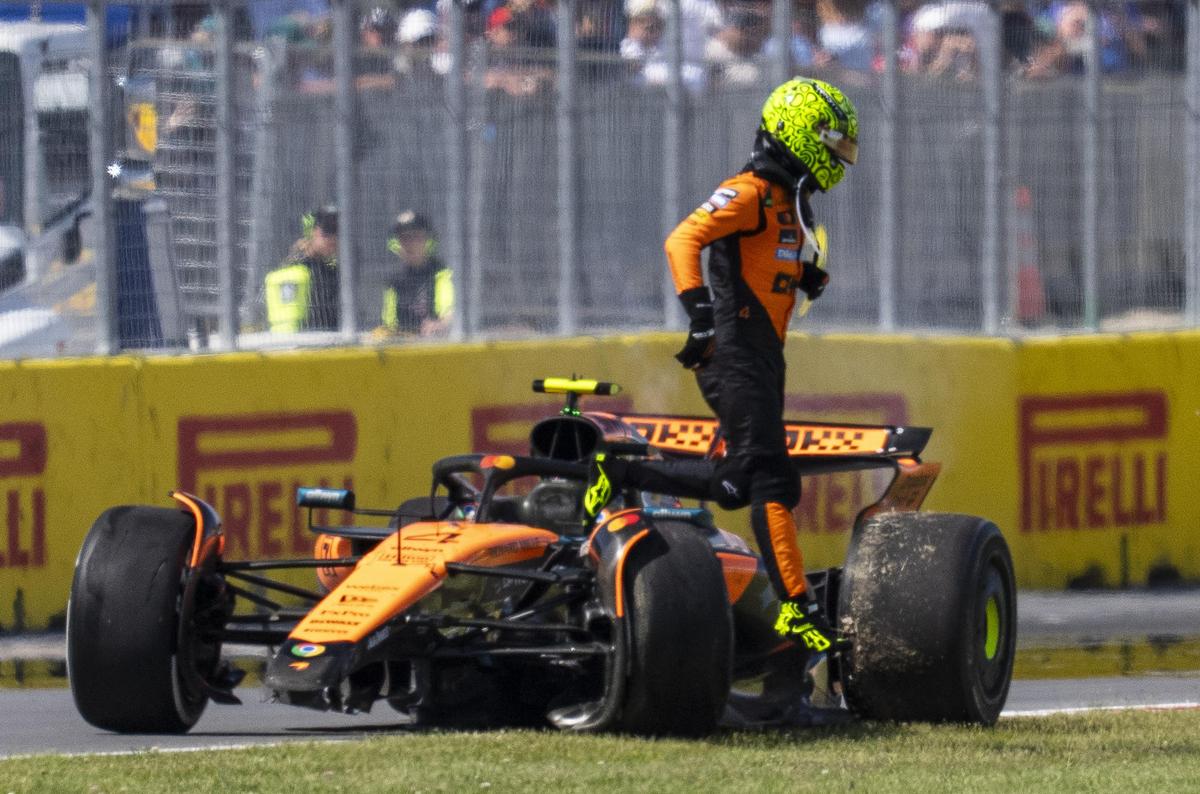
McLaren’s Lando Norris walks away from his car following a collision with teammate Oscar Piastri during the Canadian Grand Prix.
| Photo Credit:
AP

McLaren’s Lando Norris walks away from his car following a collision with teammate Oscar Piastri during the Canadian Grand Prix.
| Photo Credit:
AP
Norris, however, bounced back, clinching three of the next four races, including a surreal home Grand Prix at Silverstone. It was another lifelong goal accomplished, but the ultimate prize remained out of reach.
At Zandvoort, he approached the weekend full of promise, but a sudden reliability issue forced him to retire, extinguishing the momentum he had built. He sat alone on the grassy banks of the orange-clad track, watching in dismay as the gap to Piastri stretched to its widest point.
Fault lines
It was becoming clear that the competition between the teammates would not settle easily. McLaren held firm to its principle of healthy racing for as long as it could, an earnest attempt to keep two evenly matched contenders in harmony. But by the Italian Grand Prix, that balance gave way.
A botched pit stop for Norris forced McLaren to assert itself: Piastri was instructed to cede second place, stunning him and everyone watching. The team had declared its number one driver, and it was not the championship leader.
The decision struck a nerve with Piastri. Sudden insecurity and a perceived lack of support sent his form into decline. He never voiced disapproval, but the youngster’s dejection was unmistakable. His freefall began with a crash at the next race in Azerbaijan, where Norris, despite the chance to strike, could not fully capitalise.
Amid the shifting tides, the hegemony atop the leaderboard that the two teammates once held comfortably began to feel precarious. An unlikely contender surged back, winning three of the four races from Italy, and in doing so, Verstappen roared back into contention.
Cli’Max’
Following the Dutch Grand Prix, Verstappen was a distant third in the standings, 104 points behind Piastri. It had been a strangely subdued campaign for a driver who had left the field gasping in previous seasons, with only two wins from the first 15 races.
Some traits, though, have always defined the Dutchman: he is never far from the fight, and pressure often brings out his best. With renewed pace in the Red Bull and the poise of a four-time world champion, he emerged as a threat with nothing to lose.
At the US Grand Prix, Verstappen claimed maximum points from the sprint and main race. His surge was no longer a faint prospect but a gathering inevitability. This purple patch coincided with Piastri’s final day in the lead and marked the moment Norris’ momentum started to shift.
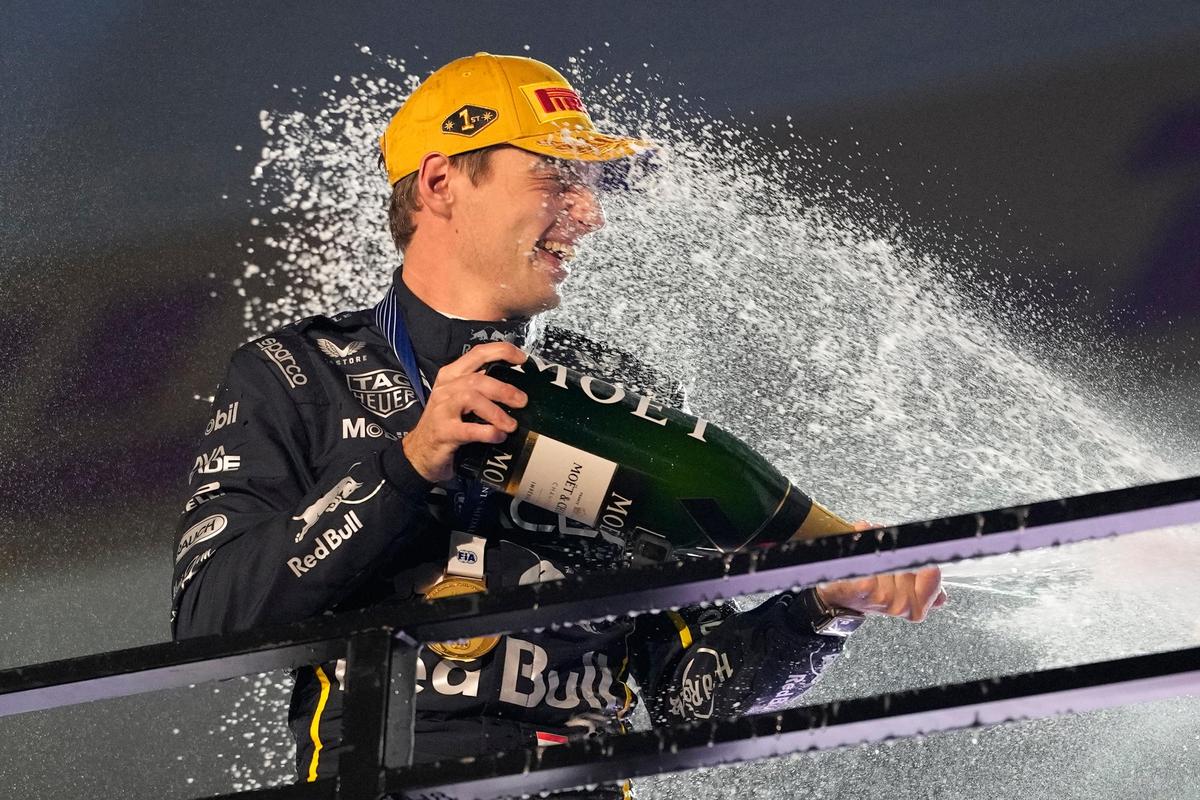
Red Bull’s Max Verstappen celebrates after winning the Las Vegas Grand Prix.
| Photo Credit:
AP
Red Bull’s Max Verstappen celebrates after winning the Las Vegas Grand Prix.
| Photo Credit:
AP
The South American leg of the season saw Norris rediscover his long-lost mojo, excelling in Mexico and Brazil to reclaim the top spot. Piastri’s penalty in Sao Paulo widened the gulf, while Verstappen’s pit lane-to-podium masterclass brought him closer to the two.
Against the shimmering backdrop of Las Vegas, all the frontrunner needed was a win to seal his place, but nothing came easy. He lost prime position to Verstappen, and McLaren suffered its biggest debacle of the season: a double disqualification for breaching a technical regulation. It stripped Norris of second and Piastri of fourth, altering the tenacious story in one brutal stroke.
Final reckoning
Few expected a three-way battle this year, not even the latest entrant himself. With only two races remaining, momentum sat with Verstappen, who had won the first of the concluding triple-header and was now just 24 points shy of Norris.
At the penultimate Qatar race, a catastrophic strategy call hit both McLarens hard. Piastri fell from an elusive victory to second, Norris dropped from second to fourth, and winner Verstappen vaulted to second in the standings, turning the chase into a knife-edge clash.
The finale arrived with permutations and echoes of past contests looming large. Only 12 and four points separated the top three, with the last 25 remaining. All eyes were on the hunters and the hunted.
Qualifying was intense. Verstappen claimed pole, Norris second, Piastri third. But attitudes diverged: Verstappen seemed content with a shot, Piastri nearly resigned to falling short, and Norris reminded himself quietly that the pinnacle was within reach.
Norris knew better than to tussle with Verstappen, a man who had repeatedly edged him in wheel-to-wheel fights. On the first lap, the Briton took the safe route, but was overtaken by a determined Piastri. Third was still enough, but he had to defend it with everything he had.
RACE REPORT | Norris wins Championship after finishing third in Abu Dhabi Grand Prix
With gutsy moves, he threaded past backmarkers, even two in a single turn. Anticipating that Yuki Tsunoda would play the team game for his Red Bull senior, Norris pushed every limit to climb back. By the final laps, he knew he had done enough.
When the chequered flag fell, the release was instant. The tears, the weight, the years of effort converged at once. New fights will come and new mountains will rise, but for this moment, he stands exactly where he long dreamed of being.
Published on Dec 11, 2025