

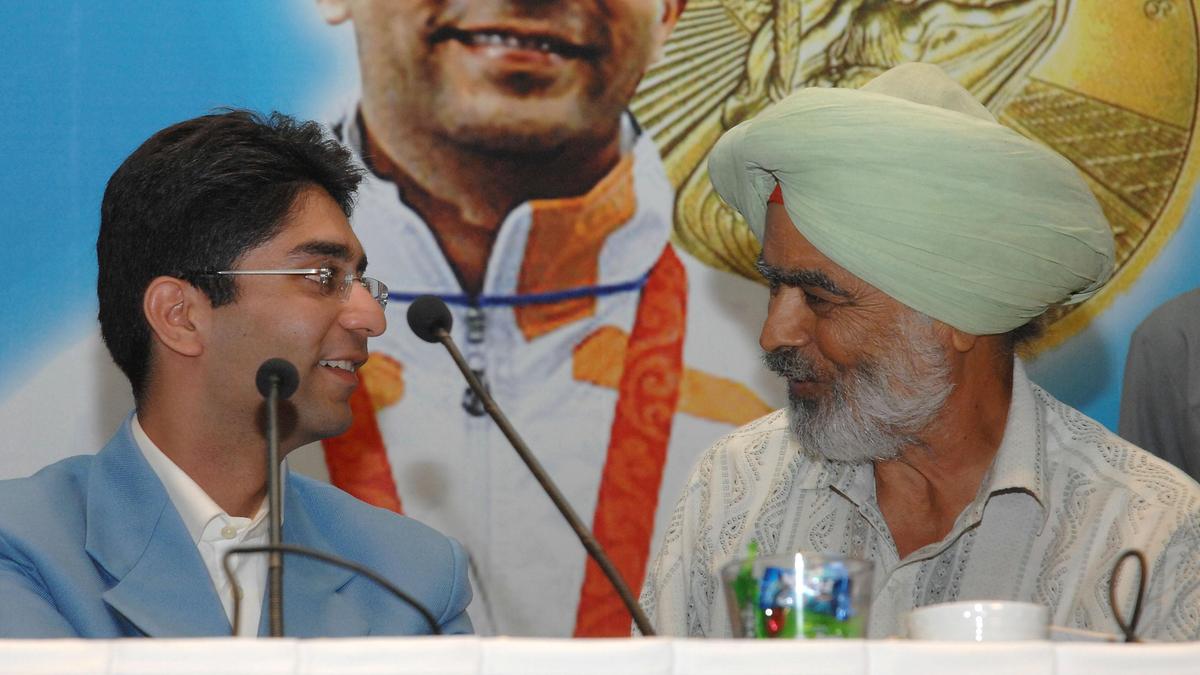
‘He entered my life at formative stage, quietly shaped the person I became’: Abhinav Bindra on late coach Lt. Col. J.S. Dhillon
Just before he headed out for the Rio Olympics in 2016, Abhinav Bindra invited his first coach, Lt. Col. J. S. Dhillon, to his home range in Chandigarh. Bindra, the 2008 Olympic champion in the 10m air rifle event, had already decided to call time on his career after the Rio Olympics and said he wanted his first-ever coach to be with him for what he had decided was his last-ever training session in India. “It felt important that the person who had shaped my earliest years be there to mark that moment with me,” he tells Sportstar.
“That day, I shot the best score of my career, 636.6. What moved me most was what followed. Just as he had done when I was a young boy, he stood beside me, quietly recording every shot, making careful notes through the session. Afterward, we sat together and spoke about what could still be improved,” he says. “There was no talk of milestones or endings, only the familiar rhythm of learning and care. In that moment, nothing had changed. He was the same patient, committed coach he had always been, and I was once again his student,” he says.
That episode, Bindra told this publication, was what epitomised Dhillon, who passed away earlier in Chandigarh on Wednesday. “That warmth, that humility, and that lifelong commitment to the process is how I will always remember Col. Dhillon,” Bindra says.
Bindra says his relationship with Dhillon went beyond shooting. “He entered my life at a very formative stage and quietly shaped the person I became. He was a mentor, a guide, and at times a moral compass. He cared deeply but never loudly, and his influence was felt through his actions rather than his words. The values he stood for, the standards he set, and the dignity with which he conducted himself left a lasting imprint on me,” he says.
Prior to coaching, Col. Dhillon had been a shooter in his own right. He participated in the first National Shooting Championships in 1952 and had stopped only in 2004. He had shot at the Asian Games twice, in 1970 and 1978, and was a coach at the 1982 Games.
Bindra recalls in his memoir—A Shot at History—that Dhillon had his initial doubts about working with the then 13-year-old. “When I was very young, he was not immediately keen to coach me. I wrote to him, promising that if he took me on, I would be his hardest-working student. That sincerity mattered to him. Our first meeting was facilitated by our family friend, Mr. Rana Sodhi, and from the very beginning it was clear that effort, integrity, and consistency would matter more than talent. Training with him was unique because there were no shortcuts, only honest work done every day,” he says.
The early days were humble, with Bindra practising under Dhillon’s watchful eye, firing on paper targets in an outdoor home range built under a mango tree. But this initial partnership, says Bindra, laid the foundation of his own journey as an athlete. “Before performance or results ever came into the picture, he taught me discipline, structure, and respect for the process. He shaped the way I trained, the way I thought, and the way I dealt with setbacks. Many coaches refine technique, but he shaped temperament, and that early grounding stayed with me throughout my career,” Bindra says.
All coaches play different supporting roles in an athlete’s life, and Col. Dhillon’s part, says Bindra, was amongst the most significant, for he helped the youngster develop a lifelong obsession for his sport. “Passion is often nurtured rather than discovered. By focussing on effort instead of outcome, he created an environment where improvement was valued and pressure was minimised. That allowed my love for the sport to deepen naturally. He taught me perseverance, humility, and accountability. He taught me that consistency matters more than intensity and that character reveals itself most clearly during difficult moments. He also taught me to take responsibility for my actions and never look for excuses. These lessons extended far beyond sport,” he says.
What stands as a testament to his innate character, though, was that Col. Dhillon also knew when to step away. “The respect and warmth in our relationship never changed, but it did evolve in a very meaningful way. One of the greatest things about Col. Dhillon was his ability to let go at the right time. He recognised that my journey would eventually require exposure to the best coaching and learning environments in the world, and he welcomed that without hesitation. There was no insecurity and no sense of ownership, only a genuine desire to see me grow. That selflessness and confidence in his own role is rare among coaches, and it speaks volumes about the kind of person he was,” says. Bindra.
As he remembers his coach, Bindra says he hopes his legacy will continue to live on through him. “What stands out most is his integrity and dignity. He was calm, principled, and deeply fair. He never sought recognition, yet his presence commanded respect. He believed in doing the right thing the right way. When I think of him today, I remember his quiet confidence and the generosity of spirit with which he guided me. His legacy lives on in the values he passed on, and I carry those with me every day,” he says.
Published on Dec 17, 2025