

FIDE Chess World Cup: No Indian endgame in Goa as Sindarov reigns supreme
The road to Resort Rio is rustic, shaded generously by trees and lined with charming, old-style houses. Along the way, you will also come across bars and restaurants where elderly foreigners, most of them from the UK, enjoy drinks and fabulous food at their leisure. This is Goa, after all. Last month, however, the resort in the North Goan village of Arpora was abuzz with more than just tourists. As the venue for the FIDE Chess World Cup, it hosted over 200 participants from around the world, all vying for the top three spots that would secure direct tickets to the Candidates, the qualifying event that determines the challenger for the World Championship.
That is the tradition in chess: the reigning champion gets the opportunity to defend the crown without having to play any qualifying games. The challenger comes through the gruelling Candidates tournament, in which eight players take on each other in the double round-robin format.
As Loek van Wely (the Dutch Grandmaster who has worked as a second with World Champions Vladimir Kramnik and Veselin Topalov) told Sportstar in Goa, winning the Candidates was sometimes tougher than winning the World Championship itself.
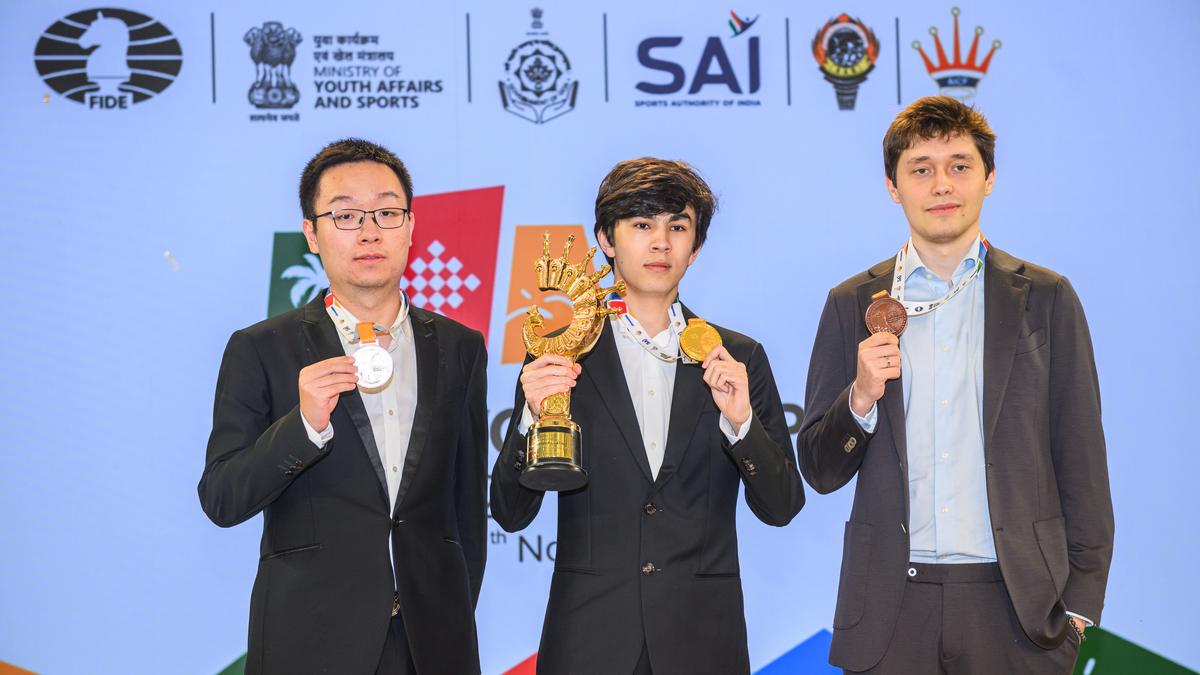
There are several routes to the Candidates, but among the most straightforward ones is the World Cup. In the Goa edition, Javokhir Sindarov of Uzbekistan, Wei Yi of China, and Andrey Esipenko of Russia claimed the honours as the three qualifiers.
Sindarov was a deserving champion. At 19, he became the youngest winner in the history of the World Cup after beating Wei in the final. He belongs to a golden generation of Uzbek chess, a group of players who could give India the biggest fight in the coming years.
The champion himself said as much shortly after his triumph. “I think India and Uzbekistan will fight for the Chess Olympiad and many other titles in the next 10 years,” he said. “India has some strong young players.” But none of them lived up to expectations in Goa.
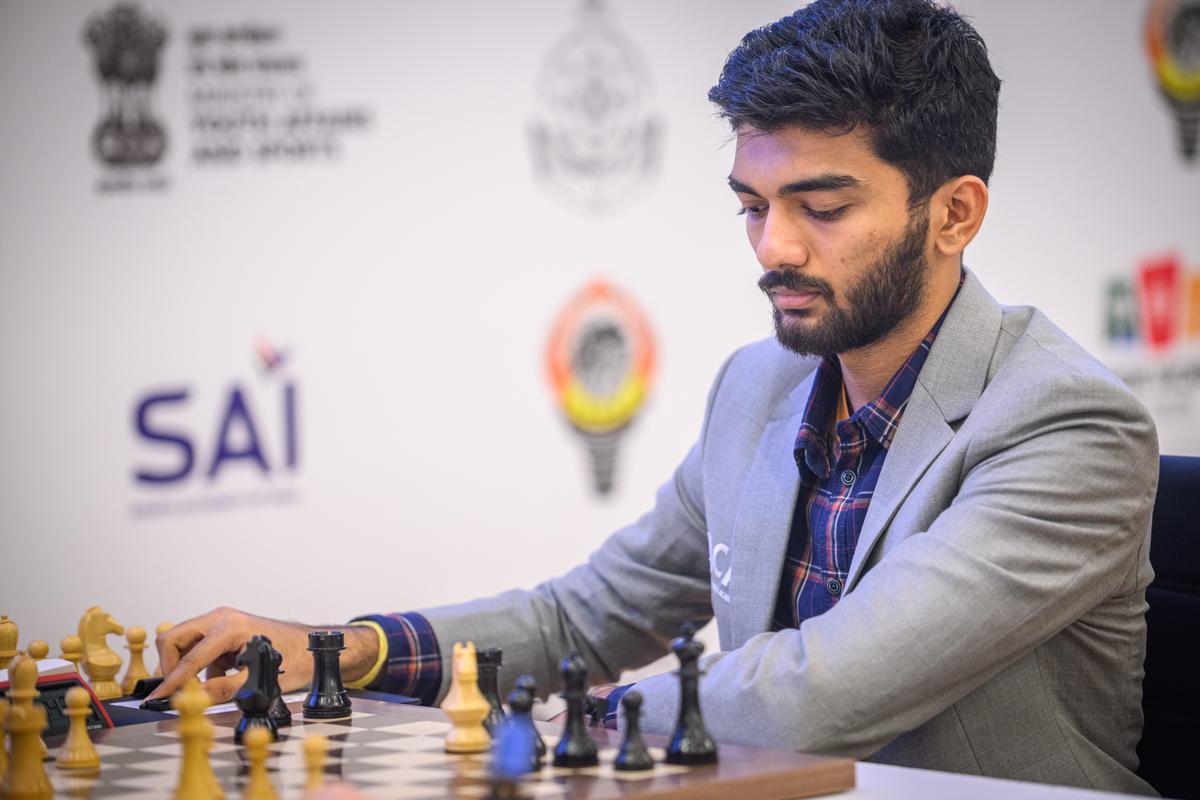
Ready for a bigger test: D. Gukesh bowed out in the third round. He now awaits the challenger for his World Championship title defence.
| Photo Credit:
Michal Walusza/FIDE

Ready for a bigger test: D. Gukesh bowed out in the third round. He now awaits the challenger for his World Championship title defence.
| Photo Credit:
Michal Walusza/FIDE
In fact, there was no Indian in the semifinals. Arjun Erigaisi reached the quarterfinals all right and always looked the best of the 24 home players, but he was knocked out by Wei. Their last-eight match was decided in the tie-breaks, after both their classical games were drawn. The 22-year-old from Warangal might have felt, in hindsight, that he could perhaps have pressed harder in the classical format.
He had begun his campaign in great style, after being seeded directly into the second round. He won his first three games back to back and had won all his matches without having to play the tie-breaks (1.5 points needed to be scored out of a possible two from the classical format) until he ran into former World No. 4 Peter Leko in the last 16.
The Hungarian took him to tie-breaks and then stayed on as a commentator for FIDE’s official broadcast. Leko is one of the most loved commentators and was glad when people recognised him in Goa just because of his voice.
The defeat to Wei was a heartbreaking moment for Arjun: the World Cup was his only hope of making it to the Candidates. And he missed it yet again, after coming close in the past.
Wei then made sure of his trip to Cyprus after winning his semifinal against Russia’s Andrey Esipenko. That match produced the tournament’s most dramatic moment.
The 23-year-old Russian was in a commanding position, but he made a terrible mistake: he overlooked his hanging rook while going for a pawn push on the other side of the board. Wei immediately grabbed the rook with his knight.
Esipenko realised his folly, resigned immediately and stared at the board for a few seconds before getting up and quickly walking out of the playing hall: he had just squandered a place in the World Cup final.
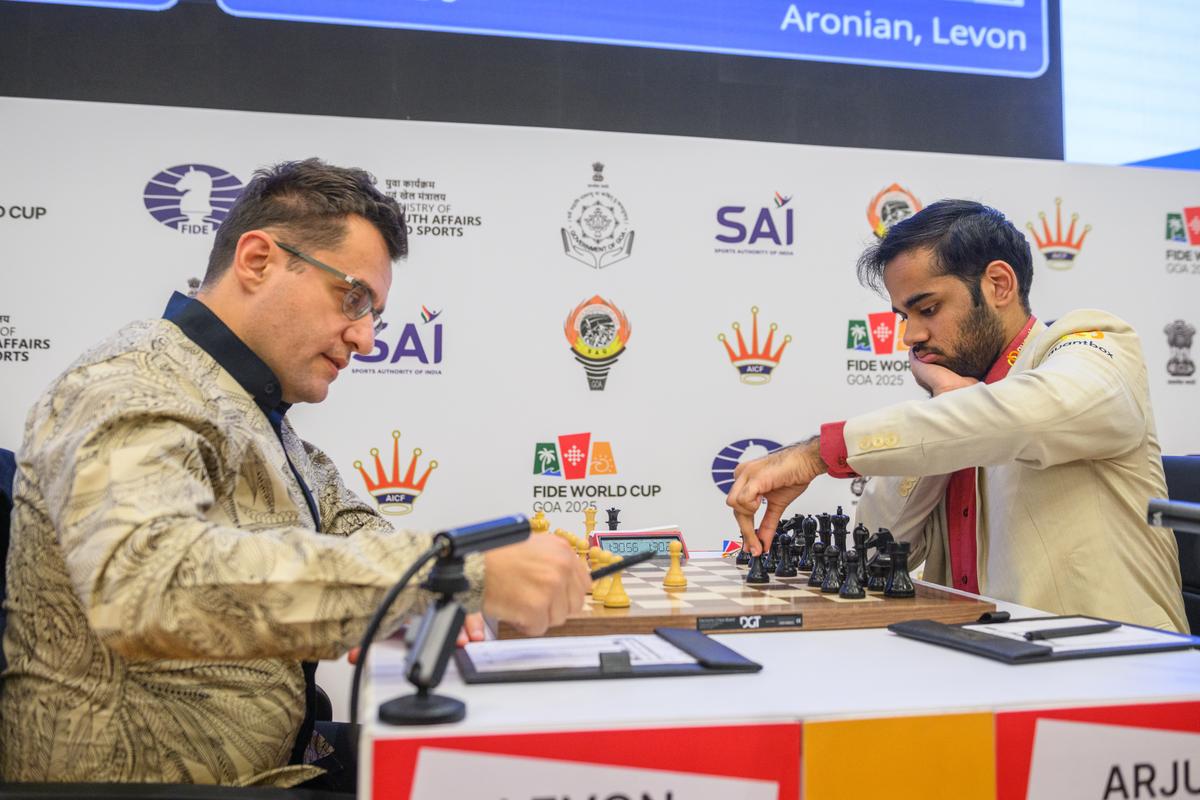
Tough luck: No. 2 seed Arjun Erigaisi (right) beat Levon Aronian (left) in a thrilling match.
| Photo Credit:
Michał Walusza
Tough luck: No. 2 seed Arjun Erigaisi (right) beat Levon Aronian (left) in a thrilling match.
| Photo Credit:
Michał Walusza
He, however, showed resilience, as he came back the following day for the third-place play-off against Uzbekistan’s Nodirbek Yakubboev. Esipenko won it convincingly, without having to play the tie-breaks. His victory in the opening game was enough. A couple of dubious moves had put the Uzbek in an inferior position from early on, and there was no coming back for him.
The second game was drawn, and thus Esipenko, one of the rising young stars from Russia — which is no longer the dominant force it once was — clinched the last available slot for the Candidates. “It is the best performance of my career,” he remarked.
The winning trio from Goa will be joined in Cyprus by Anish Giri and Matthias Bluebaum who had qualified for the Candidates by taking the two spots at the Grand Swiss tournament. There will also be Fabiano Caruana, the World No. 3 from the United States, who made it as the winner of the 2024 FIDE Circuit. World No. 2 Hikaru Nakamura, also from the USA, is most likely to qualify as the player with the highest average rating. Lastly, R. Praggnanandhaa is expected to complete the line-up as the winner of the 2025 FIDE Circuit.
Apart from Praggnanandhaa, Giri and Bluebaum were also in Goa for the World Cup, but they couldn’t last long. Giri was actually the highest-seeded overseas player in the tournament, at No. 4, with the top three seeds being Indians: D. Gukesh, Arjun and Praggnanandhaa.
Several other big seeds were all in for disappointments, such as Wesley So (No. 5), Vincent Keymer (6), Nodirbek Abdusattorov (8), Shakhriyar Mamedyarov (9), Hans Niemann (10), Maxime Vachier-Lagrave (11) and Ian Nepomniachtchi (12). Given the knockout format, the early exits of these stars weren’t all that surprising, really.
Perhaps the most popular player to be eliminated before the event reached its business end was Levon Aronian, but he ran into an in-form, higher-ranked Arjun. The Armenia-born American is not just a brilliant player and one of the highest-rated in history, but a favourite with chess fans. He greets everyone with a smile and doesn’t disappoint the autograph and selfie-hunters. He has a terrific sense of humour too.
He is also something of an Indophile: a huge admirer of Satyajit Ray’s films and also loves classical Indian music. “I have been listening to Kishori Amonkar a lot lately,” he told Sportstar, a day after his defeat to Arjun, someone he has great regard for.
Arjun’s loss to Wei was a setback not just for India but for the tournament. The lack of an Indian presence in the final stages, it was feared, would diminish local interest. And that was the case. The security men, who had to ensure stars like Gukesh, Praggnanandhaa and Arjun were not disturbed while they entered or exited the playing hall, witnessed a drop in attendance for the semifinals and the final.
That India fell way short of expectations is true. But the World Cup is like that. Nobody expected Divya Deshmukh to bring the women’s World Cup to India, and yet she did, a few months ago. That is the nature of such tournaments and why they generate a lot of excitement among chess followers.
Published on Dec 04, 2025