

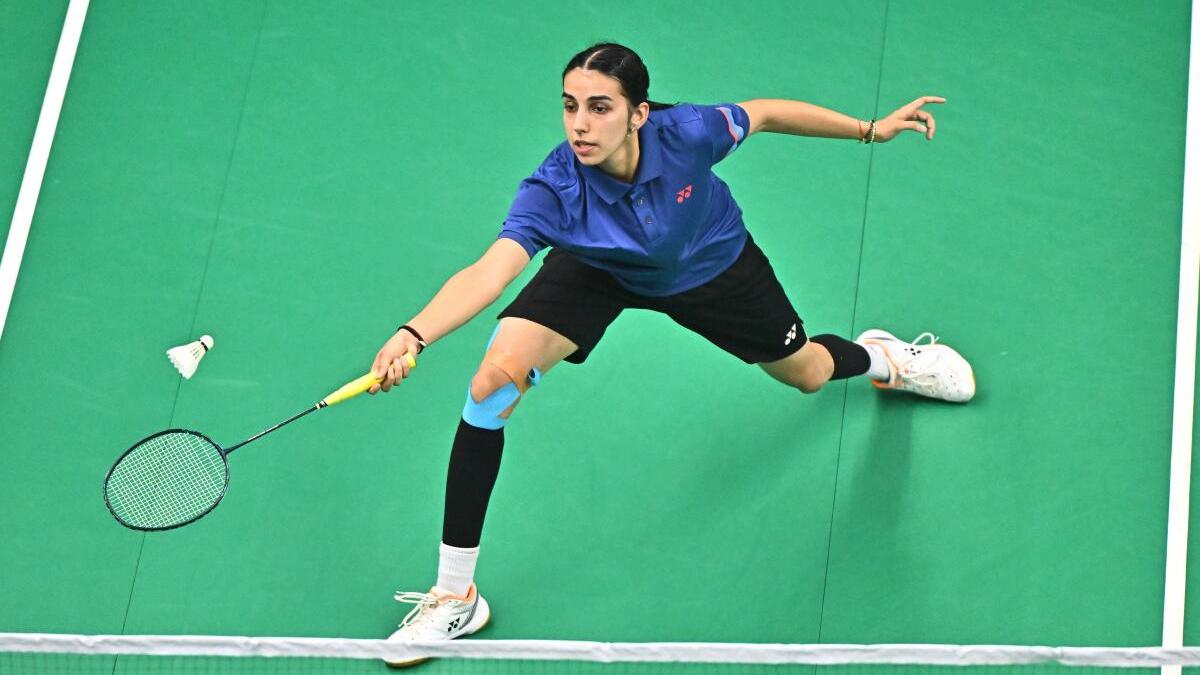
Devika Sihag, daughter of lawyer and teacher, charts unlikely path to emerge as India’s latest badminton sensation
In what was easily the biggest moment of her career so far, Devika Sihag showed very little emotion. One explanation could be the manner in which the 20-year-old won her first international badminton title.
Half-an-hour into the women’s singles final of the Thailand Masters World Tour 300 tournament, Devika’s opponent, Goh Jin Wei of Malaysia, indicated to the chair umpire that she was cramping up and was going to be unable to continue. Of course, with the scoreline already reading 21-8, 6-3 in the Indian’s favour at that point, the Malaysian’s retirement only hastened the inevitable.
As the retirement was announced officially, Devika shook hands with her opponent, then folded her hands and bowed to the audience at Nimibutr Stadium in Patumwan, Thailand. Coach Sayali Gokhale seemed to have the bigger smile on her face as she patted Devika on the shoulder.
Celebration or not, there’s no understating Devika’s achievement. By winning the Thailand Masters, Devika became only the third Indian women’s singles player, after PV Sindhu and Saina Nehwal, to win a World Tour 300 event—fourth in the hierarchy of badminton’s professional circuit, behind the World Tour 1000, 750 and 500 events.
Both Saina and Sindhu are all-time greats of Indian sport. Devika, meanwhile, had entered the tournament as a relative unknown. As the World No. 63, she is the lowest-ranked player to have won a title at this level since Indonesia’s Putri Kusuma Wardani, who was ranked 200 when she won the Spain Masters in 2021. Her triumph marks her out as the latest Indian prospect in women’s singles.
This was no fortuitous triumph for Devika. At no moment in the competition did she look like she didn’t have the quality to be the champion. Unseeded at the start of the tournament, she took out three seeded players en route to the title. In the quarterfinals, Devika beat the top seed and current World No. 17 Supanida Katethong after trailing 4-9 in the opening game. In the semis, she fought back from 15-20 down in the opening game to beat fifth seed Yu Hsun Huang, who only last week had beaten world bronze medallist Wardani in the semifinals. In the finals she toppled Goh, a former two-time junior world champion.
Even before the title win, Devika had known she was in the middle of a special run.
“This breakthrough means a lot. In the past three to four months, I was struggling, losing close matches in the third set. This meant a lot because I could convert,” she had said after reaching the finals.
After winning the title, she spoke about continuing her streak. “I’m very happy today. I’ve played very good matches here. I’ve learnt a lot. I’ll implement them in my game and rectify my mistakes,” she said.
Breakthrough moment?
A lot is promising about this title. While there are several young, talented players—Anmol Kharb, Tanvi Sharma and Isharani Baruah—waiting in the wings in Indian women’s badminton, their talent has often been tempered by a lack of intent. They might win a game against higher-ranked players, but are unable to close out matches. What stood out in Devika’s campaign in Thailand was that when she got the advantage, she pressed it all the way. In no match did she allow herself to be pushed to a third game.
She also has physical gifts. At 5’9”, she benefits from long levers, much like Sindhu. While her reach allowed her to get to the shuttles, she also used her height in developing powerful attacks and making fewer unforced errors.
Her coaches are optimistic about what this win means.
“After (World No. 1) An Se-young, there is a major drop in quality in women’s singles. There is a big opportunity for the new batch of players to make a mark. This win might be a breakthrough moment for Devika, and it has come early in the year. Devika would have got a lot of confidence from this win,” says Vimal Kumar, chief coach at the Centre of Badminton Excellence, where Devika has trained since 2017.
It’s a scenario Devika’s mother, Sunil Maan, says she could have hardly imagined. Although Devika was born in Haryana’s Hansi, her family moved to Chandigarh when her mother Sunil was working as a social science teacher. There, she took her nine-year-old daughter to the badminton courts at Panchkula’s Tau Devi Lal Stadium.
“Devika’s father is a lawyer and I’m a school teacher. We don’t have any sportspersons in our family. So, I never expected that Devika would become an athlete. I only started taking Devika to badminton class so that she would have something to do in the evening,” she recalls.
Dedicated start
Six months after she joined the class, Devika started winning matches at the district and then at the State level. Her parents might not have known much about the game, but they encouraged her.
“It was a completely new world for me. I had never even gone to Delhi by myself. But we started taking Devika to ranking competitions. One reason we also took an interest was that we could see she was devoted to the game. Most children like to play on the court but aren’t interested in doing the fitness work. From a very early age, Devika was very particular about doing her fitness work. If her coach told her she needed to do her running early in the morning, she was going to be up and running at 4 a.m.,” says Sunil.
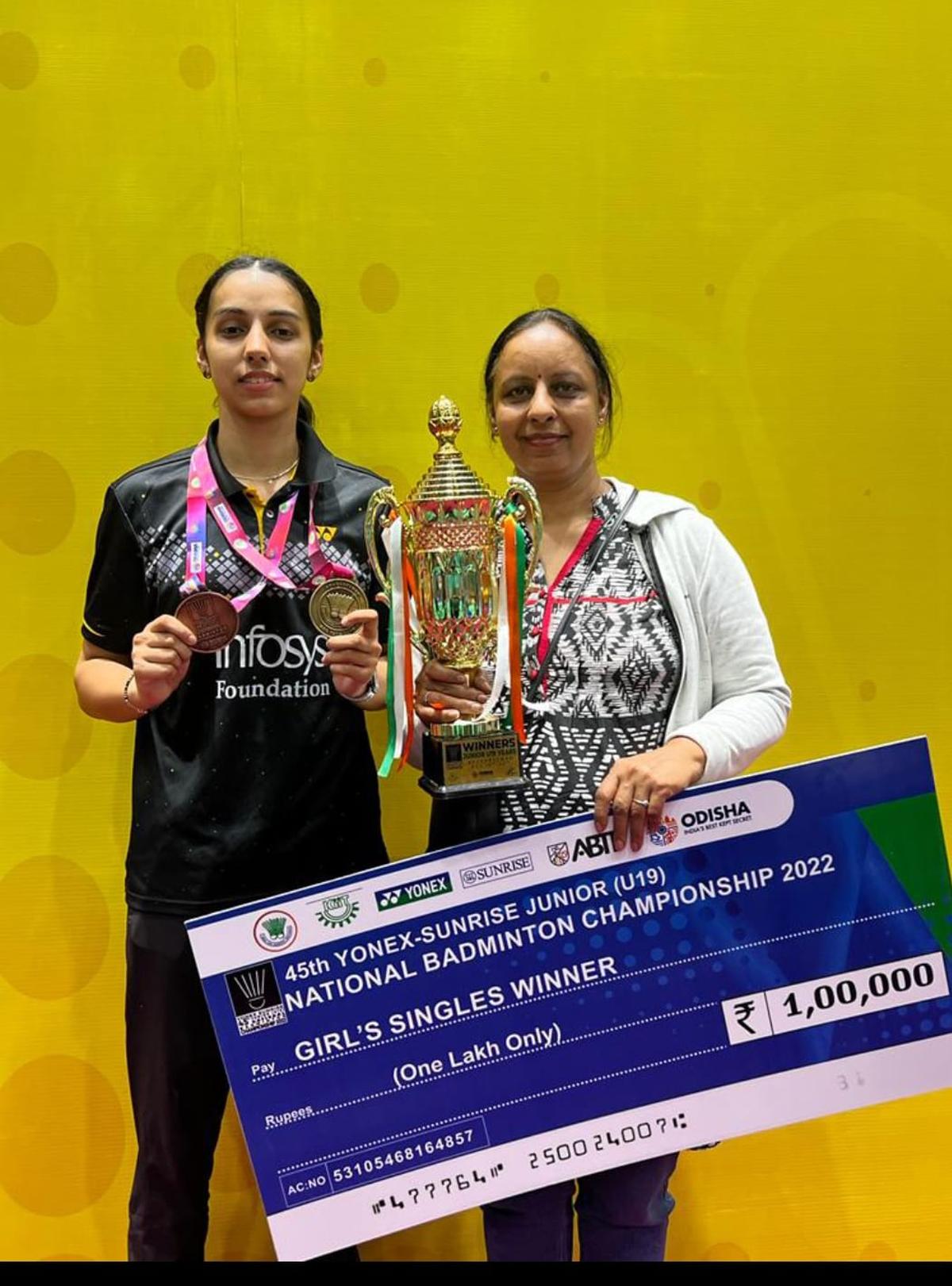
Devika with her mother Sunil Maan.
| Photo Credit:
SPECIAL ARRANGEMENT

Devika with her mother Sunil Maan.
| Photo Credit:
SPECIAL ARRANGEMENT
Devika was doing well enough, routinely making the quarters and semis of ranking tournaments, but soon her mother realised she could do better.
“After a point in time, I realised that she was not going to get the kind of training she needed in Panchkula and she would get frustrated if she had to stay here,” says Sunil.
When Devika was 12, her parents decided to send her to the residential academy at Bengaluru’s Centre for Badminton Excellence (formerly known as the Prakash Padukone Badminton Academy).
The move wasn’t easy for the 12-year-old.
“It’s not easy to be all by yourself in a new city. It’s especially hard when you lose close matches, and you want someone to talk to. We could only speak over the phone, but it’s not the same thing,” Sunil says.
While it was hard at first, Sunil feels that separation has benefitted Devika. “She’s become very independent. She knows how to take her decisions,” she says.
In Bengaluru, Devika honed her craft, winning her first junior national title in 2018, a year after she joined the academy. Her coaches noted she had obvious skill.
“She was, of course, very hard working, but she is also an immensely gifted player. She has a natural power in her hands. She had great push shots and was able to get very good length in her high tosses and clears. She also had excellent strokes at the net,” says Umendra Rana, who has been Devika’s coach since 2017.
Knee issues
But while she had all the qualities for success, Devika’s height often came with its challenges.
“A lot of these youngsters in Indian badminton are very skillful, but they lack strength and stability. It’s worse for Devika because of her height, which has resulted in a few knee issues. I would sometimes joke that she had long legs like a coconut tree! She has all the strokes, but very often she’s reluctant to play them because you have to approach the net very fast and that sometimes leads to pain in her knee. Because of this, she was always a little hot and cold as a junior,” says Vimal.
Although Devika qualified two times for the junior world championships, she never medalled at the event. However, as she made her way to the seniors and started developing more strength in her legs, she started to find more consistency. In 2024, she won her first senior national title.
It was a win that Vimal felt would set the tone for the 2025 season.
“I felt that her breakthrough would come last year. The plan was for her to make it to the top 50 last year. But she had knee issues with her patella (the bone in front of the knee). She got a few close matches but wasn’t able to win them,” he says.
Despite the disappointment, Devika continued to put in the hard work. Over the last few months, she has been training alongside Sindhu and Indonesian coach Irwansyah in Bengaluru. The effort has now started to pay off.
Not long after Devika won her title, two-time Olympic medallist Sindhu posted on social media about the joint training.
“I always get super excited when my training partners do well. Devika trains with me and coach Irwansyah in Bangalore and her dedication has been incredible to witness up close. She’s worked very closely with my team on strength and conditioning and I’ve personally seen her game grow, mature and evolve step by step,” she posted on X.
Though she already has a major title under her belt, Devika’s coaches have bigger goals for her season.
“The immediate goal at the start of the year was to break into the top 50, which she probably will after the Thailand win. Her target for the end of the year is to come inside the top 30. There are also physical goals. She needs to keep adding more strength which will allow her to take on the workload that Saina and Sindhu manage,” says Vimal.
One more change he hopes to see is in her temperament, which perhaps revealed itself at the end of her match against Goh.
“She’s very shy and quiet! Girls from Haryana are loud and confident. She’s very quiet and shy. I sometimes tease her by saying, ‘You are from the land of Saina Nehwal. You need to be much louder!’ I’d like to see more aggression from her. But we have many more tournaments this year, so there’s time for that to happen,” he says.
Published on Feb 01, 2026