

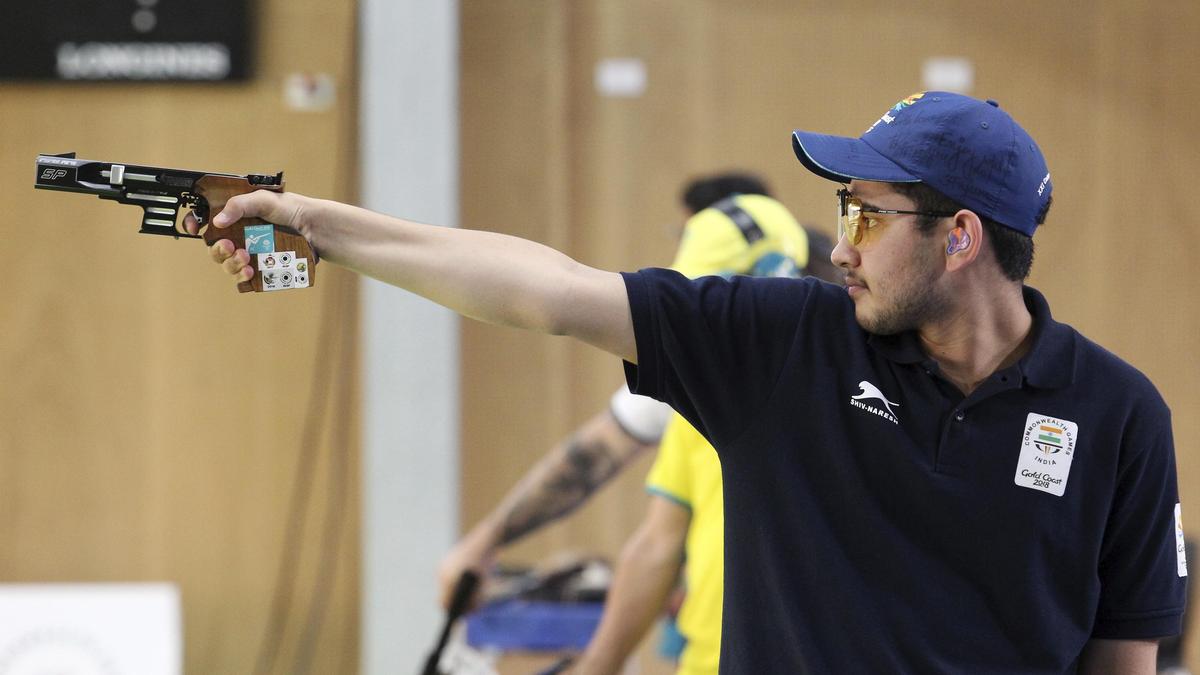
Despite Asian Championship bronze, Anish admits he’s still coming to grips with equipment change
Anish Bhanwala admitted he had mixed feelings at the conclusion of his competition in the men’s 25m rapid fire pistol event at the Asian Shooting Championships in New Delhi.
While he might have won a bronze, the medal, if anything, will serve as a reminder of a difficult competition and an experiment that has not paid off. “I respect the medal, but I’m not happy with how I performed,” he told reporters later.
He wouldn’t have expected this to be how his competition would have played out. On the back of an impressive 2025 season, which had seen him win maiden medals at the World Championships and World Cup Finals, Anish, already a two-time medallist at the Asian Championships, had entered the New Delhi edition as perhaps the favourite on paper in his event. At the Karni Singh Range, though, Anish struggled over two days of competition.
While he finished behind Dai Yoshioka of Japan and Nikita Chiryukin of Kazakhstan in the finals, his real pain came in qualification. He finished with a score of 574. “It’s honestly one of the lowest I’ve shot in recent times,” he said with an embarrassed smile. Indeed, the score is only his second lowest in the last three or four years and the sixth lowest of an international career that began in 2018.
This was a score that would be uncompetitive at any elite level (the qualification mark for the finals at last year’s World Championships was 582, while that at the Paris Olympics was 585).
Anish knows how far off that standard he was. “I’ve been part of the national team for so long, and I’ve played in so many major competitions. I know what the world standard is. I had a qualification score in my mind, but I didn’t come close to it,” he said.
ALSO READ: Persistence pays off – Aakriti wins maiden international senior medal seven years after debut
Indeed, Anish was seventh at the end of qualification, and it’s likely only the fact that some of Asia’s big names were skipping the competition, along with a recent rule change allowing for eight finalists instead of six previously, that enabled Anish to compete in the finals.
“I underperformed poorly in the qualification round, but due to less competition, I came into the finals. And in the finals, I was struggling a bit, but I had a fight with myself to give my best performance in any situation. So I managed to fire some good series. But again, a couple of bad shots, because of which I didn’t get a better medal. So when I look back, I don’t think I did what was expected of me, and so I’m sad for that,” he said.
Major fix
Anish has some plans on what he needs to do to fix his shooting. “There are things I’ll be working on with my coach,” he said. But the biggest change Anish reckons he has to make is to rethink a choice he made late last year. That’s when he decided to change the grip on his pistol, switching from a wood-plastic composite to solid wood.
This was not as easy a choice as it might seem.
The grip on a rapid-fire pistol shooter’s weapon is custom-made and a critical part of the equipment. This is particularly owing to the nature of the event, which is about firing five consistent, repeatable shots while swinging the gun across five targets over eight, six and four seconds.
A properly shaped grip locks the pistol into the shooter’s hand so that the recoil is consistent and the gun’s sight comes back naturally on the target with minimal muscle corrections. At the elite level, even a millimetre error in grip shaping means time lost in overcorrecting and subsequent errors under time pressure.
ALSO READ: I will never win everything, but I will never lose everything – Manu Bhaker
Anish had impressive results last season while shooting with a wood composite, but wanted to try out shooting with solid wood. “The mould grips can break easily if they aren’t handled correctly, so I wanted something stronger. Sometimes it suits you, and sometimes it doesn’t. The idea was to get a better one, which is more firm,” he said. He had sent the grip mould he had been using to Germany to get a wooden one made. While he has had the time to adjust to the new grip, Anish said it isn’t working out.
“I’m not very comfortable with my grip. It was proving to be a challenge in training as well. I shot the selection trials with this grip (where I shot a disappointing score of 567 and 582), but I think something is missing. A couple of days ago, a media person asked me how training was, and I said it’s going fine but not that great,” he said.
Necessary reminder
If there’s any silver lining for Anish, it’s that he has realised where he has gone wrong early in the season. “There’s no point trying to forget what’s happened today. Right now is when I have the maximum clarity of where I’m missing out and where I can improve. After winning, we are usually so happy that we forget about what has gone wrong. I’m pretty sure I need to change something before the major competitions, which are at the end of the year, like the Asian Games and World Championships,” he said.
Although he’s not taking things for granted — he admits he’s still going to have to work hard to qualify for the Indian team in these events — Anish said he knows where his level as a shooter is. And despite his age, having competed as long as he has, Anish isn’t sweating about getting his dipping scores back in order.
Anish said he is going to revert to his old grip. “I’ve already made plans to get my old mould back from Germany. I’ll get it in two to three days,” he said. But despite his drop in performance, Anish has no regrets over taking the chance with something new, even though he was already doing well. “It could have worked out, but it didn’t. But if I hadn’t, I’d always have a question mark inside me on whether I could have tried it,” he said.
Published on Feb 11, 2026