

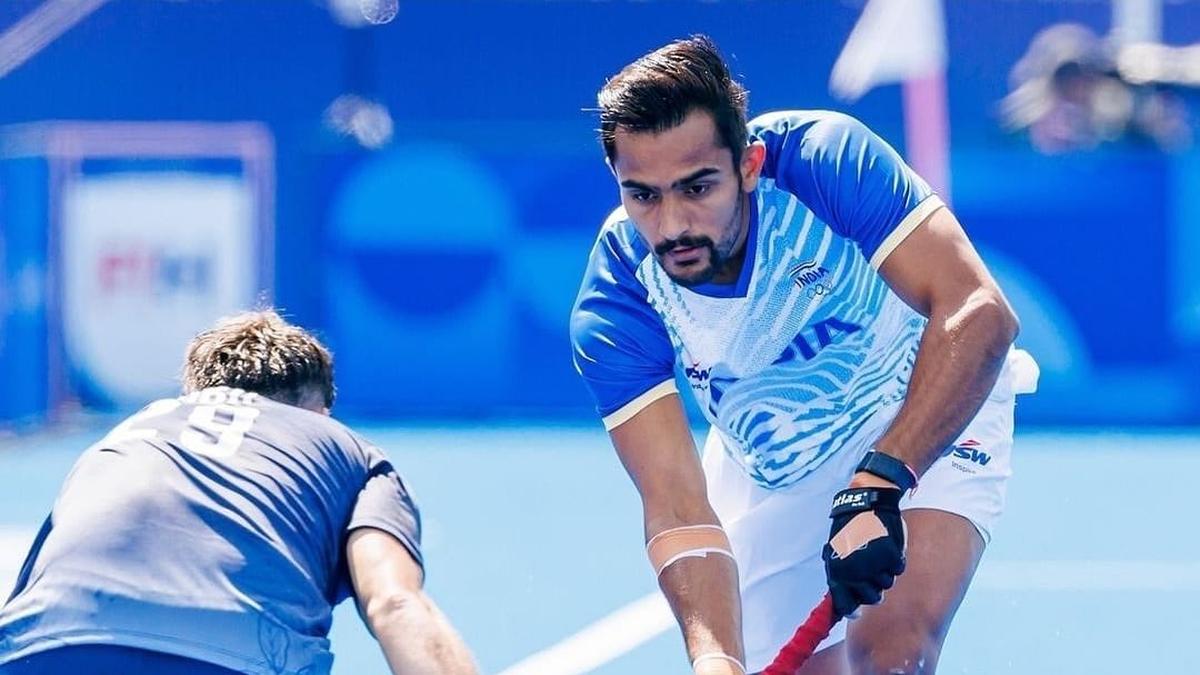
Backed by Fulton, shaped by patience: Sanjay ready to lead Indian hockey forward
By the time Sanjay completed his media commitments as Kalinga Lancers captain, a day before Hockey India League’s second season commenced in Chennai, his side engaged in a practice match. Sanjay was not on the pitch, but he was the most active player.
“There are some junior players who might not know the plan well. I discuss it with them. I talk to them openly. A lot of times, the players don’t understand what the coaches say. I guide them in such cases, as best as I can,” Sanjay told Sportstar after that game.
The 24-year-old will share the armband with Belgium’s Arthur Van Doren as the Lancers try to break into the playoffs after a sixth-place finish last year. This is not his first audience with leadership, and that is evident from how Sanjay has embraced the role with authority.
“I don’t know how the management decided, but when I was told that I will be co-captain with Arthur, I was happy. It is a matter of respect for me. I feel proud that I am leading a franchise. How do we co-ordinate? Arthur has a lot of experience. I am young, I bring energy. When experience and energy mix, your team becomes stronger,” he says.
The co-captaincy is the latest in a series of rapid strides that Sanjay has made in his not-so-long career. In 2023, he was part of the gold-medal winning Asian Champions Trophy side. In 2024, he was the youngest in the Olympic bronze-winning Indian team. In 2025, he was named captain of India A which toured Europe and South Africa for exposure tours.
In November, with the Sultan Azlan Shah Cup on the horizon, Sanjay received a text message from head coach Craig Fulton. It was at once the reaping of hard yards put in over the years, a journey that took him from Dabra in Hisar to Chandigarh, and earmarking what is to come for Indian hockey.
“He messaged me just before the tournament. A lot of senior players were rested. He informed me that I will captain the side and that he will be there to support me throughout. He said, ‘Whenever you need me, I’ll help. We want you to do well’,” Sanjay says. India made a run to the final, where it was edged out 0-1 by Belgium.
Sanjay is surfing on a wave of confidence now. Yet, his meteoric rise often overlooks how he had to bide time in the ranks.
Junior hockey was kind to Sanjay. It was a result of his sacrificing home comforts, he feels. At just 11, he moved to Chandigarh to train at the fabled Sector-42 hockey stadium which has produced international players.
“I started after watching my brother, his name is Vikram. I have four brothers, and all used to play hockey. One of them is younger to me, and he was also with me in Chandigarh. I cleared the trials when I was eight. Three others were selected from Hisar and two of them were my cousins,” the Arjuna awardee says.
It was here that Sanjay got a glimpse of what life could turn out to be. Coming from a family occupied in farming, sustaining away from home came with its challenges. Sanjay’s grand ambitions took form at this point.
“A lot of the players I have played with, Harmanpreet Singh and P.R. Sreejesh, used to play in the HIL when it started. Harmanpreet was in Mumbai, Sreejesh was in UP. When the league was played in Chandigarh in 2014, I was a ball boy. So, I used to watch them play. Since then, I used to feel that I should work so hard that one day I would play like them. They get a lot of respect. I felt that I should be like them, I lived so far from home, so I thought I should work so hard that I get something in return for all the sacrifices,” he adds.
Strong performances at nationals brought him under the Sports Authority of India umbrella and Sanjay was eventually enrolled at its centre in Bengaluru.
He led India to the School Asia Cup title in 2017 in Bhopal and was part of the side that won silver at the Youth Olympics in Buenos Aires the following year. At the Junior World Cup in 2021, he was India’s highest scorer with six goals.
However, the jump to the senior setup was far from seamless and took time. India already had defenders who could double up as Penalty Corner specialists. Harmanpreet was the best in business and indispensable as captain. Varun Kumar was his understudy. Jarmanpreet Singh and Surender Kumar were the other options, both reliable and vastly experienced. This was the defensive battery that made the cut for the World Cup in 2023.
“Not many know this, but when I came into the senior setup, I could not find a place for around a year and a half. It was when Craig Fulton came that I started getting chances in the Pro League. After that, the Asian Games. I worked hard while staying in the squad. I have a lot of patience. It is not that I got everything quickly. But when you work hard, you get paid,” he says.
The trust put in him by Fulton has lasted and paints a promising picture too. Sanjay has 78 caps in less than three years, an Asiad gold, an Olympics bronze. In Paris, he was preferred ahead of even his senior Jugraj Singh. The recent promotion as captain suggests he might have a bigger role as India sorts out its options in the new Olympic cycle.
The rigours have tested him beyond the field. Having to endure a waiting period has made him patient, he feels. That’s a desirable attribute for a leader. And this year’s HIL will be an exercise in tending to this quality. In a setup where players from vastly different cultures, speaking different languages, combine and seek cohesion as a unit on the field, Sanjay could not have a better challenge at his hands.
“I should know how my players feel when I am the captain of a team. I should know it based on their behaviour. When we had our first meeting, I had told them that not knowing English is alright. Even I don’t know it perfectly. But if I have to ask a question, if I need to convey something, I will do so.
“It’s not that you are a junior, so you sit quietly. I asked them to share the table with overseas players at lunch, at breakfast. Use your phone to translate. No problem, have fun. Ask about their schedule, how they train in their countries. We have to bridge that gap between senior and junior players, only then will there be a good team bonding,” he says.
His great interest in learning the ropes bodes well for India in the long run. In a year that packs the World Cup and the Asian Games in the space of less than a month, there’s little margin for error. India’s ambitions would also include an improved campaign in the FIH Pro League.
Harmanpreet assumed leadership at 26. While he is still the mainstay and going nowhere in the near future, nurturing another chief under his wings is only prudent as India moulds its combinations for Los Angeles and beyond. It is the best attempt at emulating what India achieved with Harmanpreet, once Manpreet Singh stepped away from leadership.
In Sanjay, India could have its talisman — a player to depend on, and one to take it forward when the time comes.
Published on Jan 04, 2026