

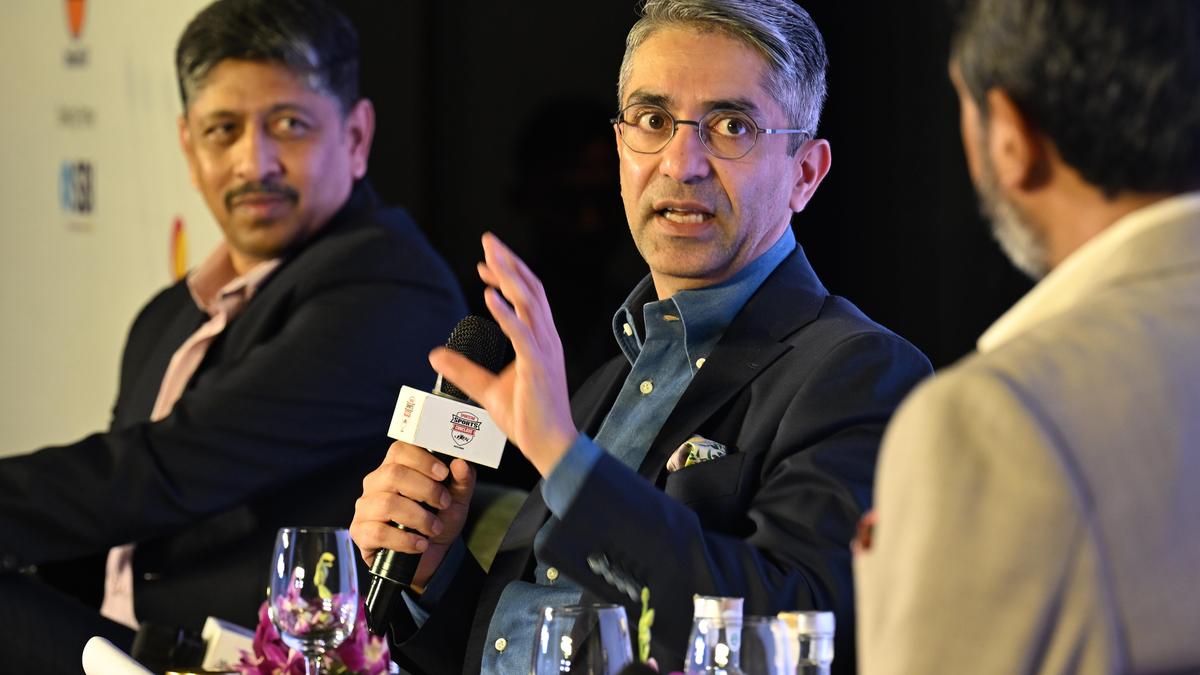
Abhinav Bindra: For Olympic success, develop athletes as humans first
Beijing Olympics gold medallist and former shooter Abhinav Bindra said that India needs a holistic approach that synergizes sports with education to improve its Olympic success.
At the Fireside Chat during the Sportstar Focus Bihar Conclave in Patna on Sunday, speaking with Sportstar Editor, Ayon Sengupta and Raveendran Sankaran, Director General cum CEO, Bihar State Sports Authority, Bindra shared what sport taught him, how India’s sporting aspirations can benefit from its Olympics bid for 2036, and what it takes to get sustained participation in sports.
Can an Olympic bid change a nation’s sporting culture?
The ambition is wonderful. We are seeing early signs of legacy of the bid. We had the National Governance Act enacted, it would not have been so quick otherwise. The funding has increased. There is enough money in sport in India. There is so much going into grassroots athlete training. That has been accelerated due to the bid and we can explore other areas as well. We can go beyond just sports performance with this, in terms of what it can do for the society and act as a catalyst for change.
So you are saying it can lead to more participation in schools?
It is great that the conversations are starting. We must put together a strategy thoughtfully, because otherwise it can go the other way. I will give you an example from the Milan-Cortina Winter Olympics. Norway won 41 medals. India has 41 medals across all Olympics. Norway has an interesting strategy, which is the childrens’ rights to play. The exact policy is, ‘Sport in childhood should be inclusive, enjoyable, development focused and not selection driven too early. In Denmark, for kids below 11, there are no rankings in sport’. What can we learn from this? We must ensure kids play sport. How many of our kids have access to play sports? That number is less. What is the first experience for a child? It is in school. If that experience in school is not pleasant, you have lost that kid. We have a shortage of physical education (PE) teachers in India. There are estimates of over a million but we do not have more than a couple hundred thousand in proper jobs. We need proper teachers in India. The PE teacher lies lowest in the hierarchy in a school in India. Children should look up to them. That is the fundamental start.
We can put in all the money but that is a top-down approach. But we have to ensure a greater participation and I hope the Olympic bid can change that and leave a generational impact. Sport should not be just for the Sports Minister or the Ministry, each person in power has to contribute. We have to look at it from a larger lens and not just elite performance. We are a young demographic but we lose one per cent of GDP in diabetes. How can sport play a role in making it a sporting country and create a synergy with health? When it is central in planning and policy, we will see more kids get into sports.
What you experienced as an athlete, in terms of challenges, has that changed over the years?
It is a new world from when I started. I started shooting under a mango tree. Now, the sort of infrastructure the young athletes have access to is unbelievable. We are working on improving capacity and quality of coaches, funding at the elite level in unbelievable. The amount of money spent on athletes’ preparation in India does not exist anywhere in the world. In terms of funding and capacity, there is a world of difference. Sport is much more mainstream now. It is a completely different ear. But that does not mean we are there yet. We should never be satisfied, we have a lot to achieve. We should work to get better and get closer to our future aspirations.
Why do we not have enough success despite enough facilities and backing?
It is not about difficulty. The sports performance can be a transaction. It is never going to be that you put in an amount of money and get a vending machine with assured returns. It is far more fundamental. We must not look at it from a lens of performance. We have to look at it from an aspect of change in society. We have to the improve the depth of participation and competition. The school structure has to work to get the kids to experience sport and be physically literal. That is the fundamental to sports performance. We are too focussed on the top level right now, but until we have the base of the pyramid strong, which is not based on results, and getting kids active, we won’t be able to make a difference. We are a large country and have aspirations. But the foundation has to be strong and cannot be results driven. We cannot ask kids at 10, 11 to get medals. It has to be about creating a relationship with movement.
I was an athlete but I was not strong, had no physical literacy. I had no access to it. so, we have to look at the base. Without it, you can create as much infrastructure but we will always be limited in terms of returns.
Is specialising in a sport at a young age a problem?
Research tells us that early specialisation does not work. Young kids must play multiple sports to build the motor capacity to later become athletes. We must work on creating the foundation to create an athlete. The transition is poor for us, we win at the junior level but they won’t translate at the elite level. Why? Because the work has not been put in, we are after success and want early early medals at age 13, 14, 15. It is not sustainable.
Was the Beijing Olympics gold medal built on your failures earlier in your career?
There are two aspects. The societal aspect; we look at failure in a very poor way. It is all about success. If you win, you are good. If you fail, you are useless. Our relationship with failure needs work. It has to be about letting go of the unwanted baggage and learning from each event. Because most athletes will fail. And there comes another point; we have come at a stage where more athletes are going to participate in sports. It is wonderful to see that. But that means more young people are going to fail in sport. So what are you going to do? So, a robust school and university system, a dual career, education are an absolute must. Right now, put everything on the line. I understand why it is that way. For a lot of them, it is a way to better life. But if we give them a chance to build some other skill, it may take longer, they will build some capacity for life after sport. This will build sporting success as well. The mindset is not just the athlete, it is also the human, if you put everything on the line you are not going to be balanced. When athletes fail, they have something to fall back onto.
A lot of foreign athletes in their other professions. Why not both — sports and studies in India?
That has to be a societal problem but it is changing. Sport is no longer looked down upon, parents now encourage it. We need to build opportunities for athletes can be students as well. The whole talent system in the United States comes from the Collegiate system. That is something we can replicate. It will require time, money and expertise, but that is the only way to create a supply chain of athletes. We all talk about 2036 Olympics but let us also create pathways for after that. This ambition gives us that opportunity.
You were entirely focussed on sport. Is seclusion a pre-requisite to become a champion?
Definitely, not. My way is not the only way. In fact, it was the wrong way. I do not even suggest it to anyone. I am an advocate for balance. While I achieved so much, I failed miserably in achieving my full potential. That is because I did not nurture the human in me. While being an athlete is a part, it is not everything. That is the base foundation. There will always be sacrifices, but the balance helps. When you are on the field, everything then is not dependant on just one moment. If you go my way, your self esteem depends on the ranking list of a competition. That is a slippery slope to be on.
Can India have a unified pipeline for talent instead of fragmented schemes like Khelo India?
It is an opporunity. Sport is always developed in silos in India. It has the potential to draw unified effort where priorities are set in place and everyone has to follow that. India has 30 odd States and every State is almost like a country. Sport is a State matter and it eventually comes down to that in how we develop sport. Maybe every State can adopt a sport but that will be challenging. Suppose, if Bihar picks shooting, but then what happens to shooters in Tamil Nadu or Telangana? Do they move to Bihar to develop further?
I believe there can be centres of excellence at some places. I believe that the role that different governments play is immense. It cannot, however, be about one or two sports. If we stick to the sports we are good at, we are not winning more than 15 medals. But if the aspiration is to win 50 medals, then we need to win at swimming, rowing, athletics, and so on. How do we achieve that is the question. Every government has to play a role in that.
How do you look back on your sporting career without the gold medal?
My worth is not dependant on that gold medal. I think is not the only aspect about me. I do not look back at my years in sport, I do not look back at that gold medal I won or the others that hang on my wall. I look back at the relationships I was able to build through sports, with my family, with my coaches, with competitors. I look back at what sports taught. It taught me a thing or two about winning and about losing, respecting outcomes and competitors and most importantly myself, dealing with internal conflict. Sport has given me some many memories and lessons. That left me in good stead to face the greater test called life.
The Sportstar ‘Focus Bihar’ Conclave is presented by the Bihar Sports Authority and Department of Sports, Government of Bihar. The Associate Sponsor is Indian Oil Corporation Limited, while State Bank of India is the Banking Partner.
Published on Mar 22, 2026