

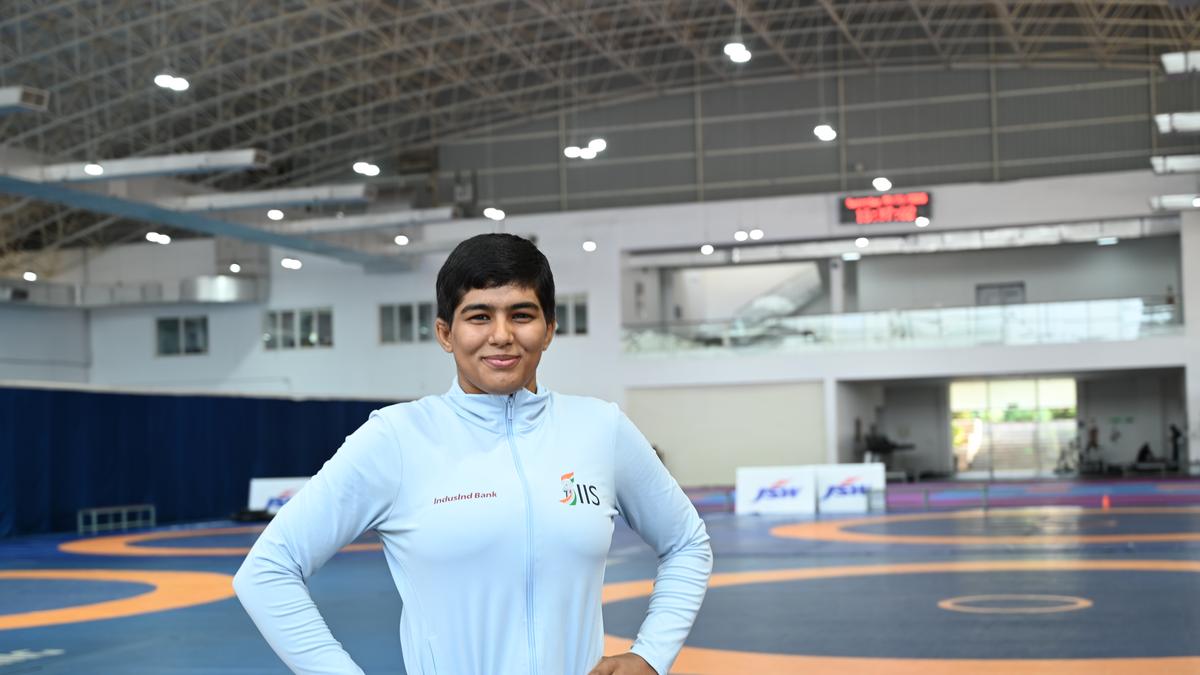
“Not maybe”: Inside 19-year-old wrestler Shiksha Kharb’s relentless LA28 pursuit
Shiksha Kharb did not need to say where she wanted to go. Her phone had already said it for her.
At the Inspire Institute of Sport earlier this week, while getting her photographs clicked, the young wrestler handed over her phone for a moment. On the screen was the LA 2028 Olympics logo, set as the wallpaper. For many, it may have been just another image. For Kharb, it looked more like a reminder she had chosen to carry with her every day.
The dream is still distant, but the immediate decision is clear. Kharb is preparing to move from 65kg to 62kg ahead of the women’s selection trials for the 2026 Asian Games, scheduled for May 30 at the Indira Gandhi Stadium in New Delhi.
The move is not cosmetic. Women’s wrestling at the Asian Games is contested only in Olympic weight categories, and 65kg is not among them. That leaves Kharb with two choices: cutting down to 62kg or moving up to 68kg. She has chosen the former, believing the field is closer to what she already knows.
“I mainly play in 65kg, so going from 65kg to 62kg is easier,” Kharb told Sportstar. “The players are almost the same. I have wrestled them before.”
There is another reason Kharb does not sound intimidated by the shift. Though still only 19 and Under-23-eligible, she has already spent time testing herself beyond her age group. She has competed across junior, U-23 and senior levels, and remembers being just 18 when she won a U-23 World medal. At that level, she said, the field often includes wrestlers with senior experience.
One of those bouts came against Moldova’s Irina Ringaci, the 2021 senior world champion at 65kg, in the semifinal of the 2024 U-23 World Championships. Kharb lost that contest, but later beat Japan’s Rin Teramoto in the bronze-medal bout.
“We get a chance to learn something,” Kharb said. “Our confidence level increases.”
That experience gives the 62kg move a different shape. The weight cut may be new, but the idea of facing older, stronger and more accomplished opponents is not.
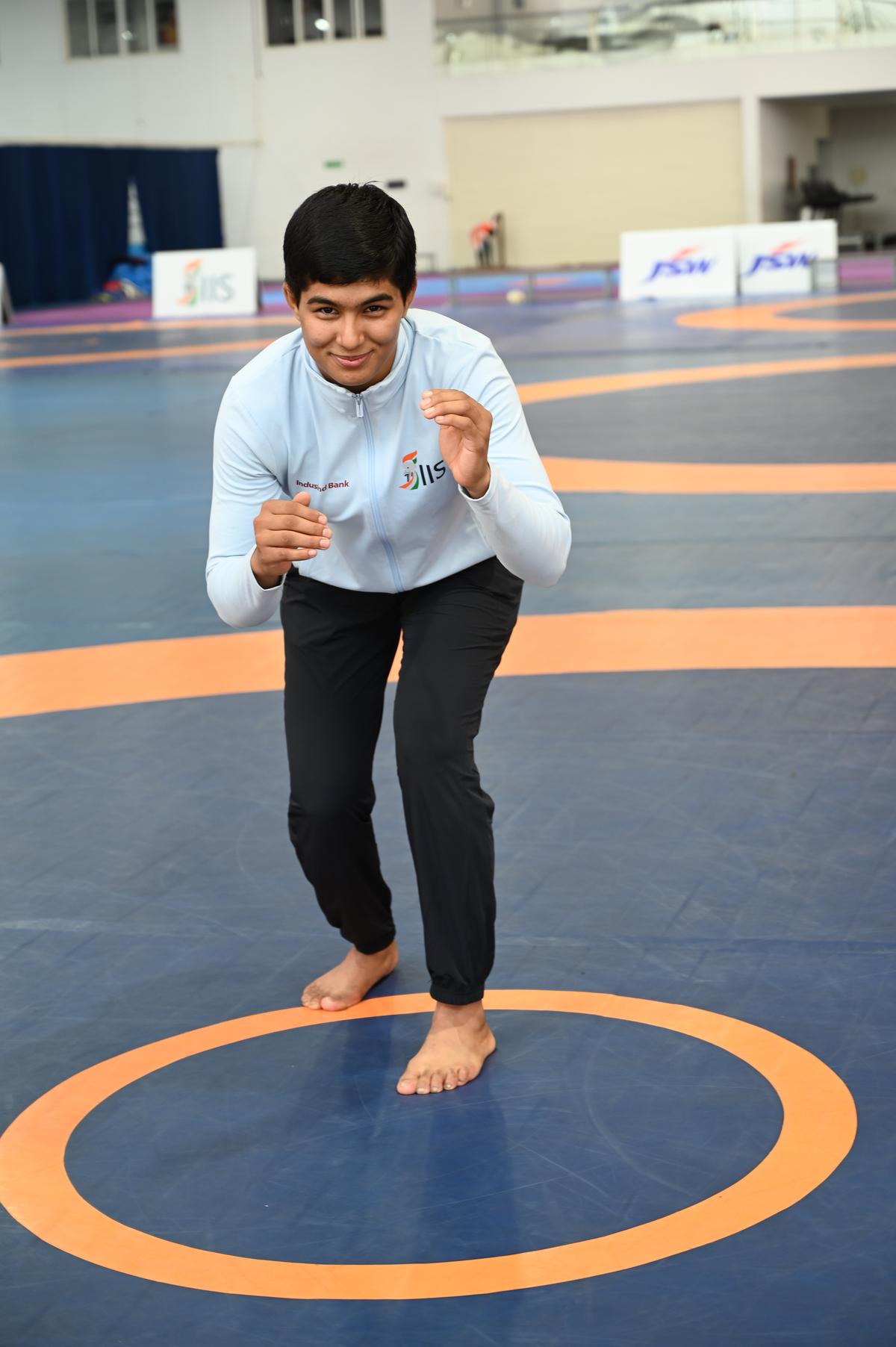
IIS has become more than a training base for Shiksha Kharb. It became the place where rehab slowly turned back into belief.
| Photo Credit:
Siva Sankar A

IIS has become more than a training base for Shiksha Kharb. It became the place where rehab slowly turned back into belief.
| Photo Credit:
Siva Sankar A
Kharb said her current weight is around 66 to 67kg, and the immediate target is to bring it down to about 64kg, referring to the two-kilogram tolerance allowed in some competitions.
It is a sporting decision, but also a physical and psychological test. For a wrestler coming off knee trouble, moving weight cannot be treated as a simple matter of eating less. It is about preserving strength, protecting the body and learning to trust it again.
At IIS, there is a diet plan, a gym plan and a wrestling plan. Her body has been assessed again to identify the areas that need work. The planning is detailed because the road back has not been simple.
Kharb comes from Barda Khera, a small village near Hisar in Haryana. Her father, Rammehar Kharb, is a Naib Subedar in the Indian Army, and her mother is a homemaker. Sport entered her life early, though wrestling was not her first choice. She played hockey in school, tried taekwondo, and then listened when her father advised her to take up an individual sport.
The reasoning was clear. In an individual sport, the responsibility would be hers. The decision-making, pressure and result would all fall on one athlete.
Her path to wrestling opened through family. Her cousin, Seema Kharb, and Seema’s husband, Kulbir Rana, took her to Sonipat, where her training began in 2018. A year later, she won her first national medal, a gold in the U-15 category.
Since then, Kharb has moved through the age-group circuit, winning at the national level and making her mark internationally. But reducing her story to results would be to miss its harder part.
Since 2022, injuries have kept returning to test her. The knee was the first warning. Then came more serious trouble. She spoke of ACL and meniscus issues, and later, an impact on her left knee that affected several structures, including the meniscus and cartilage. Surgery was discussed, but she chose rehabilitation instead.
For a wrestler, staying away from the mat is not just a physical break. It interrupts timing, contact, rhythm and confidence. Kharb spent months in rehab, away from competition, trying to get her body ready again. The longer the gap became, the more the mind had to be trained alongside the knee.
“Sometimes, I felt I would not be able to do it,” she said.
That is where IIS became central to her recovery. Kharb joined the facility in 2023 and repeatedly spoke of it not merely as a training base but as a support system. The coaches, physios, gym trainers and athlete management staff, she said, helped her through the period when doubt weighed heavier than pain.
“They supported me not only physically, but mentally too,” she said. “They kept telling me that I was strong, that I was the best, and that I could do it.”
Kharb calls that phase her “golden period”. It is an unusual phrase for a time marked by injury, rehab and uncertainty, but she uses it because that was when she learned how much support an athlete needs beyond the visible fight.
On the mat, a wrestler stands alone. Before that, Kharb realised, there is an entire system trying to put her back there.
Her return was not gentle. After months away, she won at the national level and then added a world bronze. The medal mattered, but the deeper significance was that she had learned to trust her body again.
Now, that trust is being tested in a different way.
The shift to 62kg gives Kharb a clearer route into the Asian Games weight structure, but it also demands discipline. She cannot afford to cut weight in a way that weakens her. She cannot rush a body that has already taken damage. And she cannot allow doubt to return each time training becomes difficult.
There is confidence in her answer, but not carelessness. Kharb knows what it is to be stopped by her own body. She also knows that the Olympic pathway will demand more than talent. It will require patience, planning and the ability to stay ready when selection opportunities arrive.
Her schooling followed a pattern familiar in Indian wrestling. Competitions often came first. She studied in Sonipat and later through the open system, appearing for exams when training and tournaments allowed. She is now enrolled at Punjab University and continues to compete at the university level.
That path has taken her from a small village in Haryana to international mats. But the phone wallpaper suggests she is not treating any of this as enough.
LA 2028 is still far away, and in wrestling, four years can contain several careers: injuries, trials, weight changes, selection battles, setbacks and sudden breakthroughs. Kharb has already seen enough uncertainty to know that ambition alone does not carry an athlete.
For now, the work is quieter. Rehab. Diet. Strength. Weight cut. Mat sessions. Belief rebuilt one day at a time.
Before the conversation ended, she was told that perhaps she would soon make it to the Asian Games stage.
Kharb did not accept the hesitation in the sentence.
“Not maybe,” she said. “I will show it.”
On her phone, Los Angeles is still a picture. In her mind, it is a place she has already started moving towards.
Published on May 12, 2026