

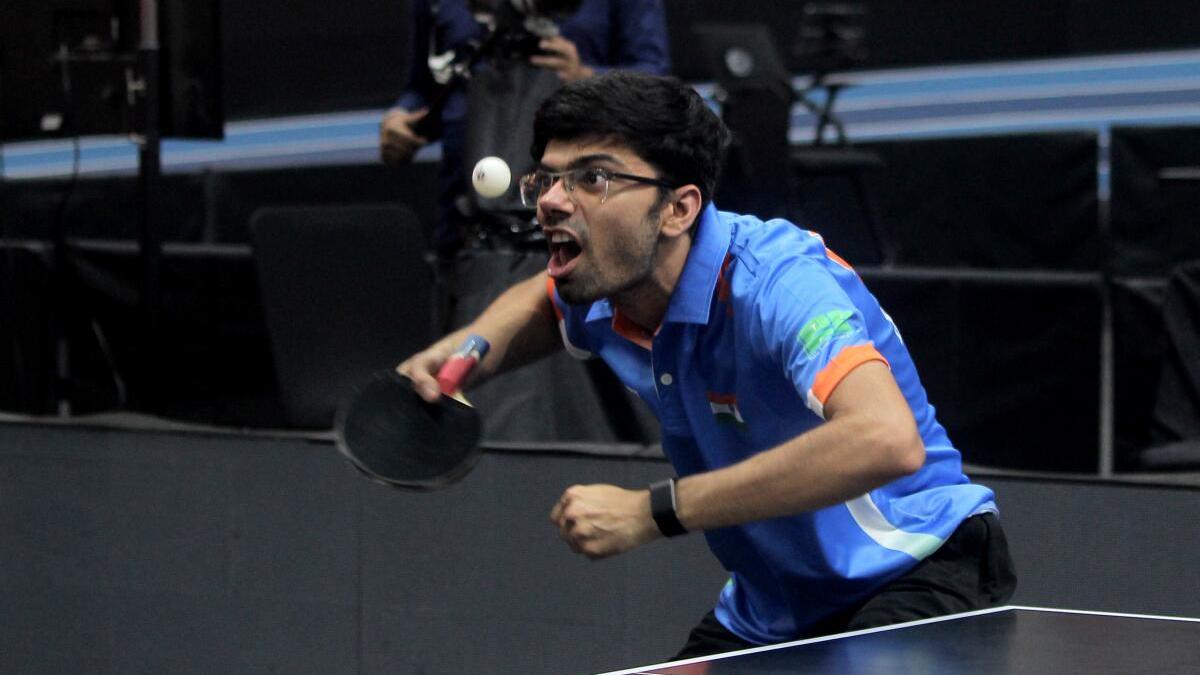
World Team Table Tennis Championships Preview: Indians target group dominance as new era begins
India’s men’s and women’s teams head into the 2026 World Team Table Tennis Championships, beginning in London on Tuesday, with a familiar mix of promise and pressure.
Placed in Group 7, the Indian men’s team—featuring Manav Thakkar (WR No. 38), G. Sathiyan (42), Manush Shah (51), Harmeet Desai (80) and Payas Jain (127)—will start as the clear favourite against Slovakia, Tunisia and Guatemala.
On paper, the rankings tilt heavily in India’s favour, particularly against a Slovak line-up led by Lubomir Pistej (149) and Yang Wang (184).
Yet, the absence of now-retired Sharath Kamal’s experience in crunch ties could test India’s composure, especially in tight five-match encounters.
The women’s team finds itself in Group 6, alongside Ukraine, Uganda, and Rwanda.
Led by Manika Batra (WR No. 49), India also has Yashaswini Ghorpade (88), Diya Chitale (92), Sutirtha Mukherjee (120) and Syndrela Das (175), who at 16 is the youngest from the country to play at the worlds.
Ukraine, spearheaded by Margaryta Pesotska (51), presents a more tangible threat, making the group a closer contest than the men’s draw.
India’s recent history at this event offers both encouragement and caution. At the 2024 edition in Busan, both teams advanced to the knockout stage but exited in the Round of 32.
The women’s team impressed with a second-place group finish that included narrow wins over Hungary and Spain, while pushing China in a close 2-3 loss.
The men, meanwhile, showed resilience with wins over Chile and Kazakhstan but faltered against stronger opposition, going down 0-3 to South Korea in the knockouts.
The format in London raises the stakes further.
Only group winners are guaranteed direct entry into the main draw, while second-placed teams face a complicated qualification route based on match ratios.
For the men, depth remains a strong suit.
Sathiyan and Thakkar bring consistency, while Shah’s upward trajectory adds firepower.
The women’s side, on the other hand, appears more balanced than before, with Manika’s big-match temperament complemented by a young core gaining international exposure.
If India can convert its numerical advantage into clinical performances and avoid slipping into the uncertainties of second place, a deeper run than 2024 is well within reach.
A century after the inaugural ITTF World Table Tennis Championships took place in England in 1926, the sport returns to where it all began for a truly historic centenary celebration.
Published on Apr 27, 2026