

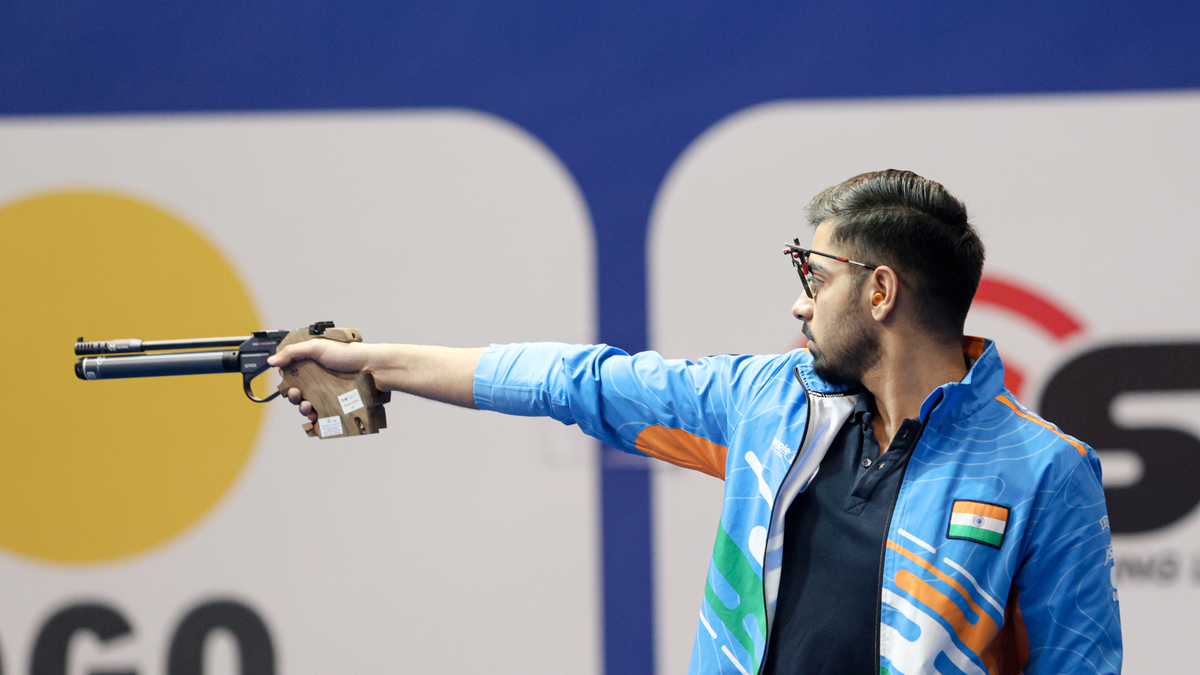
Samrat Rana: My toughest competition is myself
In the ashes of Ningbo, Samrat Rana found the spark that would, two months later, ignite his all-conquering run in Cairo.
In September 2025, the ISSF caravan set up camp in China for the fourth World Cup of the calendar. With one shot to go in the 10 metre air pistol qualification, Samrat was comfortably inside the top eight. In his head, he was already in the final of his debut World Cup. After all, this was a routine he had executed thousands of times, in practice halls, at his father’s makeshift range back home, and through endless dry firing.
Then came the unravelling. As the screen flashed 9.9 and his name slipped to 10th, Samrat says he could hear the range fall silent. It felt as if the world had caved in. But he regained his composure quickly.
“I realised I shouldn’t think too far ahead. My mind was already on the finals, which shouldn’t have been the case. What that failure taught me was that even if it is the last shot, I need to shoot it like my first and aim for as high a score as possible,” a worn but wiser Samrat tells Sportstar on the sidelines of the 2026 Aces Awards in Mumbai. Back at the drawing board, he realised time was not on his side with the World Championship looming. The preparation that followed involved long conversations, mostly with himself.
“Whenever I get low scores, I tell myself to step back and take deep breaths. I remind myself there will be opportunities to course-correct, and I should make full use of them. When the pistol aligns with the black circle, you have only a few seconds before releasing the shot. There should be no second thoughts when pressing the trigger,” Samrat says.
Whether he had second thoughts in Cairo on November 10, 2025, is something we will never know. But nerves would have been inevitable. After all, China’s Hu Kai stood between him and the Worlds title.
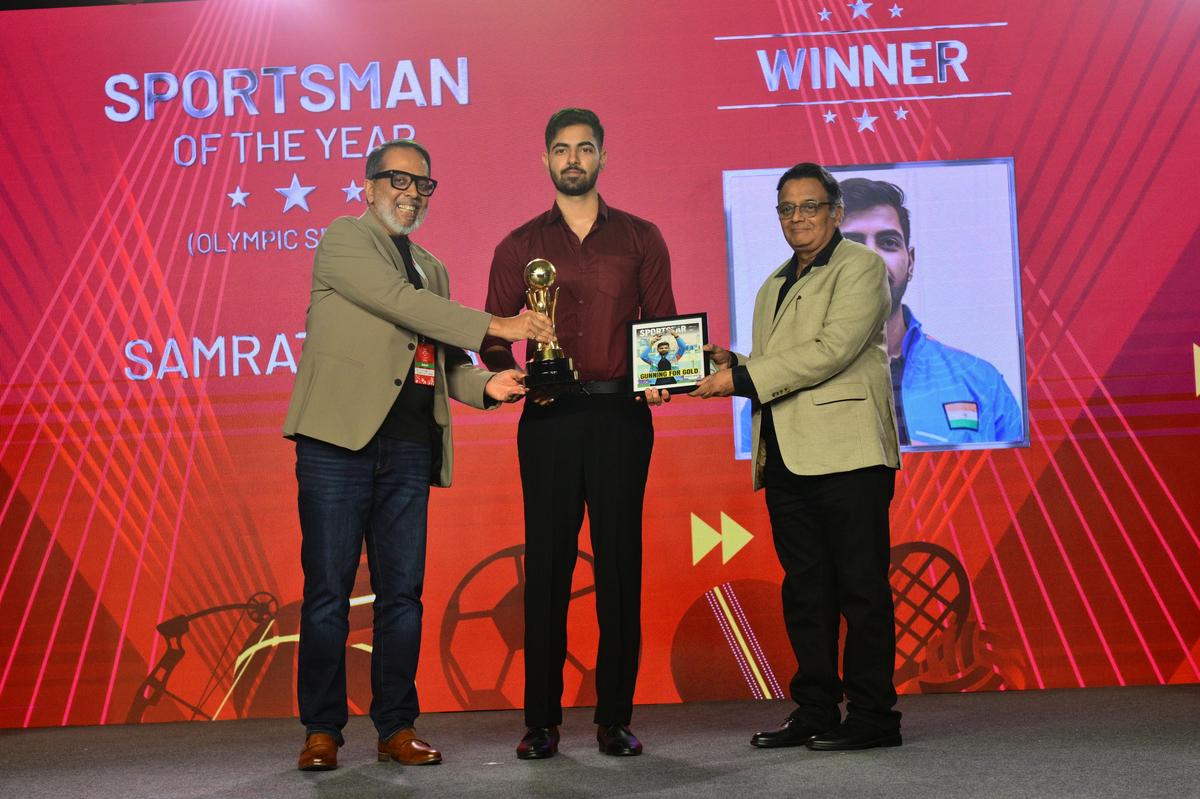
Shooter Samrat Rana was named Sportsman of the Year (Olympic Sports), receiving the honour from (left) Partha Sinha, Senior Advisor at McKinsey, and Suresh Balakrishna, Chief Revenue Officer of The Hindu Group.
| Photo Credit:
VIJAY SONEJI

Shooter Samrat Rana was named Sportsman of the Year (Olympic Sports), receiving the honour from (left) Partha Sinha, Senior Advisor at McKinsey, and Suresh Balakrishna, Chief Revenue Officer of The Hindu Group.
| Photo Credit:
VIJAY SONEJI
Kai had been unstoppable that season, sweeping the 10m air pistol at all four World Cups and topping the podium at the Asian Championships. To make matters worse, he held a slender 0.1 lead heading into the decisive two-shot series.
Ask Samrat, though, and he will tell you the current World No. 1 was never his toughest opponent.
“My toughest competition is against myself, and I feel my best is yet to come. Why should I look at others? If I am failing to better myself, then what is the point? That last shot was about executing as well as I could,” he says.
He is referring to the 10.6 that carved his name into history. A 9.5 from Kai on his penultimate shot only strengthened the Haryana shooter’s position. India finally had its first pistol world champion in an Olympic discipline.
Overnight fame, however, can be a double-edged sword. It brings rewards, but also scrutiny. Samrat seems acutely aware of this dichotomy.
“You cannot avoid pressure entirely. The moment you do well on a big stage, expectations rise. But I keep asking myself if I have done enough in training. These external factors do not matter during a match. When I am on that lane, I need to replicate what I have done thousands of times in training. That’s it. The lane is no place to think about what others expect,” says Samrat, who was included in the Core Group of the Target Olympic Podium Scheme (TOPS) on March 13.
Perhaps this clarity has sharpened his appetite for podium finishes. At the season-ending World Cup Final in Doha, he again tested himself against the world’s elite and emerged with bronze, his first medal at that stage. Such results are forged in monotony, hour after hour at the range, shot after shot, in a grind few witness.
“I fire around 100 shots per day on average. That is the first session. The second is more about dry firing and meditation. Shivam, an OGQ (Olympic Gold Quest) psychologist, works with me. Before matches, if I am overthinking, I call him. Sometimes I meet him beforehand. He guides me on how to approach the day. Even during matches, he observes how much time I take between shots. Later, based on the readings, he tells me what I was feeling. He tracks my heart rate as well, which helps identify pressure or anxiety,” Samrat says.
His routine also involves close analysis of shot patterns, both during and after competition.
“If I start well, I try to note what is working. If I am shooting 9s, I try to identify the problem. You need to hold your confidence even when a series is not going as expected. I think about how to recover in the next series. I trust myself and adjust my technique on the go. I also study my shots after matches,” the 21-year-old says.
It was in 2019 that Samrat first caught attention. At just 14, he competed in an Open Championship organised by the Manav Rachna Foundation in Faridabad and won the top prize, a Renault Kwid. He became the owner of a car before he was even eligible for a driver’s licence.
From there, the trajectory was upward, though not without refinement. Some habits stayed.
“One thing I have maintained is that I never rest during a match. From the sighters to the final shot, I do not take a break or change position. I follow what I call a ‘robotic movement’. Whether it is the first or last shot, I stick to the same routine, the same preparation time, the same follow-through, and the same gap between shots,” he says.
Certain adjustments were also necessary.
“Earlier, I used to keep my face too close to my shoulders while lining up a shot. That increased the risk of injury. Gradually, I have straightened my neck.”
The Samrat of a few years ago would, by his own admission, “crumble under pressure”. Now, he sees things differently.
“Earlier, I used to get stressed thinking I was at a World Cup, that it was a big stage. I would forget that because it is a big stage, I should enjoy it more. Not everyone gets to be here. Now I see it as a chance to represent my country, something I should cherish.”
Is it too early to talk about the Olympics?
“Of course not. Olympic gold is the ultimate aim. I don’t consider team event medals, or even bronze and silver, as enough. For me, there is only one goal. When you win silver or bronze, it feels like consolation. Because someone was better than you. You are not a silver medallist, you are a gold medal loser.”
The lesson came in Ningbo. The proof arrived in Cairo. As the road bends towards Los Angeles, the pursuit is far from over.
Published on Mar 26, 2026