
Goa embraces Indian Racing Festival as championship demonstrates signs of progress
In a state more associated with beaches and holiday itineraries, motorsport isn’t usually part of the schedule.
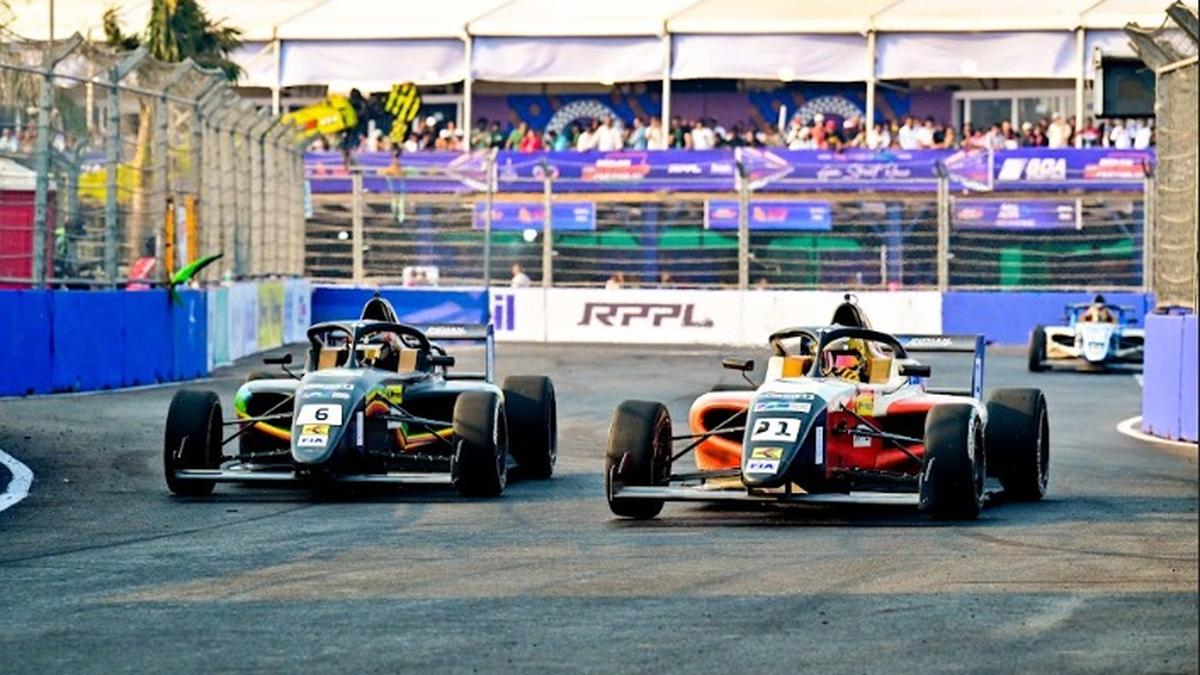
But for a February weekend in Goa, a stretch of road outside the Manohar International Airport hosted a round of the Indian Racing Festival (IRF), a franchise-based single-seater racing platform that also conducts a gender-neutral championship.
The temporary 12-turn, 2.064-kilometre circuit, cut into the red terrain, took shape under clear skies and persistent heat, with lap times constantly clocked under a minute. The round was run using Formula 4 cars, which is one of the two championships under the IRF umbrella, alongside the Indian Racing League (IRL) (The F4 season concluded in December, while the IRL still had two rounds remaining).
The race marked the series’ second street event after its earlier outing in Chennai, which drew attention for both its under-the-lights action and its organisational hurdles. In comparison, Goa ran more smoothly, suggesting lessons had been learned.
Grandstands, paddock zones and fan enclosures created a compact but efficient venue. Racing played out alongside everyday movement—traffic on nearby roads and aircrafts approaching in the distance.
Curious locals and a ‘home’ element
Attendance reflected timing and location. Hospitality and paddock areas stayed active, while general stands thinned during peak heat. Sunday saw a noticeable rise, with locals lining hillsides for a view of track action.
“People in Goa love vehicles. A lot of bikers come here, and many new vehicles are launched here. It attracts a lot of people. Four-wheeler racing is here for the first time, and we are excited to watch,” one peering spectator said.
A home team presence added to that interest. Goa Aces JA Racing had some local backing, and race wins only amplified it.
Race 1 on Saturday saw Aces’ Raoul Hyman seize control early, overtaking the pole-sitter into the first turn and holding the lead to become the first winner at the venue. Later, Race 2 went to Speed Demons Delhi’s Alister Yoong, who capitalised on early chaos to drive to victory.
The weekend’s feature race on Sunday took on a relay format, requiring teams to execute a driver swap during a pit stop to complete the two-leg contest.
Goa’s team again came out on top, set up by Hyman’s opening stint in which he built a strong cushion before handing over to teammate Fabienne Wohlwend, who managed the second half and steered the car to the finish. The rounds were not without incidents, and the narrow track made mistakes costly.
Challenges beyond the racing line
The red soil, though visually striking, made track conditions tricky. Dusty sections reduced grip, while sand near the racing line contributed to lock-ups and slides that kept sessions unpredictable.
One unexpected challenge was a dry-grass fire on the surrounding cleared land. Shifting winds carried soot through the air as thick smoke rose behind the fan lounges.
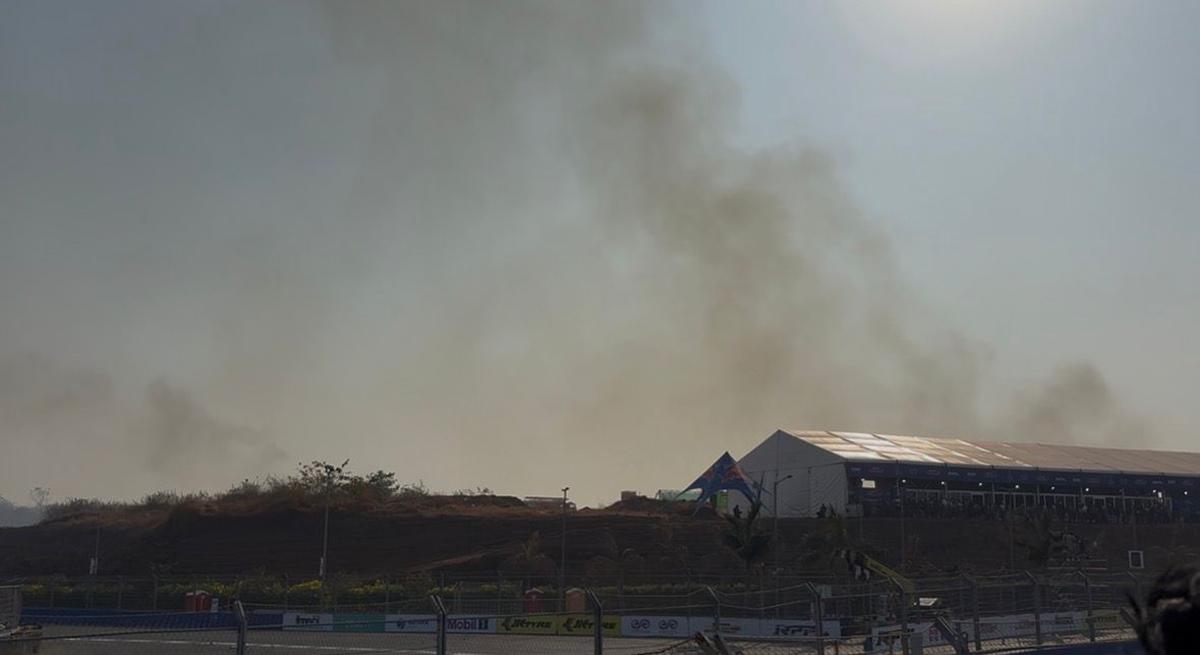
Smoke rising behind fan lounges following a dry-grass fire at the Indian Racing Festival in Goa.
| Photo Credit:
Kavita Menon

Smoke rising behind fan lounges following a dry-grass fire at the Indian Racing Festival in Goa.
| Photo Credit:
Kavita Menon
Event officials said precautionary measures were already in place to keep the flames from reaching the tents. Fire crews stationed both on site and at the airport responded quickly and brought the situation under control without major disruption.
Barring the occasional Safety Car and track clearances, the three-race event was a more organised affair than its predecessor, with some entertaining action and racing.
Building something bigger
Such interruptions are not unusual for an event requiring heavy investment, multiple permissions and coordination across civic bodies, an undertaking as complex off track as the racing on it.
That reality was echoed by former Indian cricket captain Sourav Ganguly, an IRL team owner, who acknowledged the scale of the undertaking. “It’s not easy organising such a big event. We organise cricket matches in stadiums, which are dedicated areas. But to come into a city and create such an infrastructure and try to make something happen is absolutely special.
“Motorsport around the world is big, but it’s a very young sport in India. It needs a bit of patience; it needs a bit of support,” he added.
The broader objective remained clear. Street races like this are intended to build visibility for Indian motorsport by bringing competition directly to public spaces. Celebrity team owners and guests added to the atmosphere, while the sound of engines proved a draw in itself.
By the end of the weekend, the Goa round had done what it set out to do: show that the concept can travel, adapt and function beyond a single city. It may not have drawn the largest crowd or the loudest spectacle, but it demonstrated progress.
That momentum now carries into the title-deciding round in Navi Mumbai this March, a second street circuit this season and another test of whether the series can sustain that growth. For a championship still establishing its footprint, continuity may matter as much as results.
RESULTS:
RACE 1: 1. Raoul Hyman (Goa Aces JA Racing); 2. Aqil Alibhai (Chennai Turbo Riders); 3. Ishaan Madesh (Speed Demons Delhi).
RACE 2: 1. Alister Yoong (Speed Demons Delhi); 2. Sohail Shah (Kolkata Royal Tigers); 3. Ruhaan Alva (Kichcha’s Kings Bengaluru).
RACE 3 (Feature): 1. Goa Aces JA Racing (Raoul Hyman & Fabienne Wohlwend); 2. Kichcha’s Kings Bengaluru (Sachel Rotge & Ruhaan Alva); 3. Speed Demons Delhi (Alister Yoong & Caitlin Wood).
STANDINGS: 1. Goa Aces JA Racing – 145; 2. Speed Demons Delhi – 144; Kichcha’s Kings Bengaluru – 119.
[The reporter was at the event on invitation by the Indian Racing Festival]
Published on Feb 16, 2026