

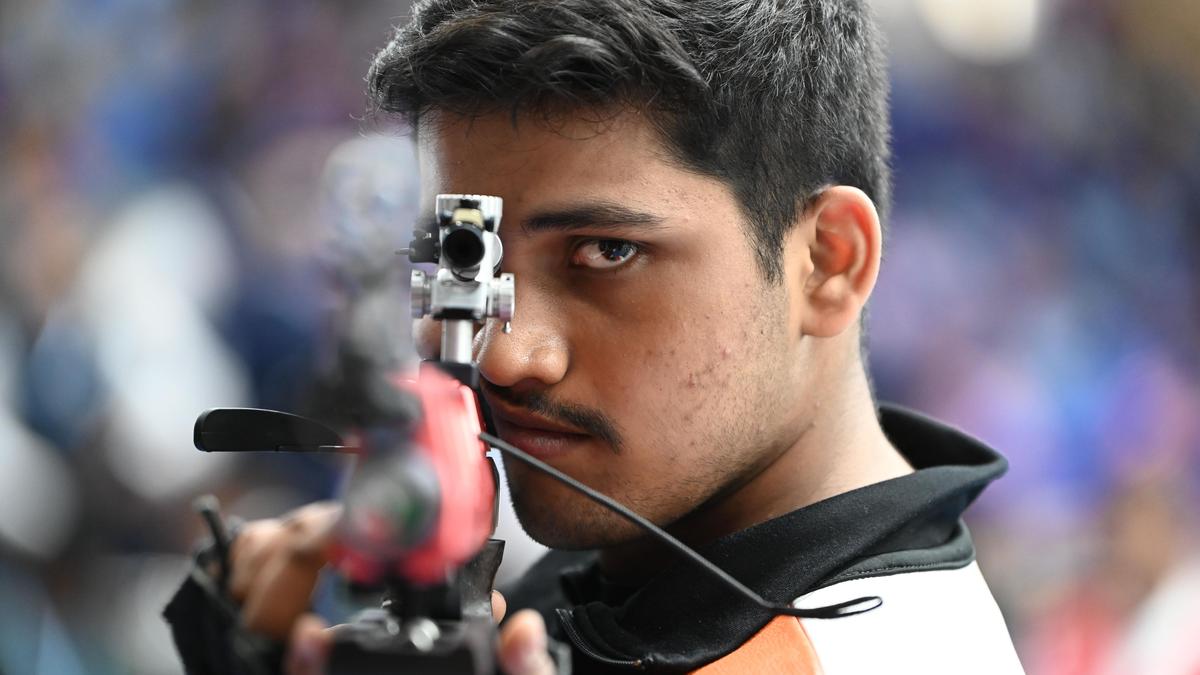
I can shoot even when the match isn’t going my way: Rudrankksh Patil on Asian Gold
When one begins their international career as Rudrankksh Patil did — with World Championship gold as an 18-year-old back in 2023 — it is difficult to find another moment to compare.
While a win in an understrength field at a continental championship — which Patil achieved when he won gold in the 10m air rifle competition at the Asian Shooting Championships in New Delhi on Friday — may find it hard to stand up to that magical debut, Patil says there is value in his accomplishment.
It is his first gold medal at the Asian Championships in three attempts and sets the tempo at the start of an important year. Most importantly, it serves as a reminder that Patil has what it takes to pull out a win even when he feels he is not shooting well.
For long parts of the competition, that is exactly how Patil felt.
So much so that after completing his fourth series of ten shots in the qualification round, Patil left his position on the firing line at the Karni Singh Range.
The 22-year-old later noted that he spent nearly seven minutes trying to clear his head — a significant break considering shooters have just 60 minutes to shoot six series, or 60 shots in all. But Patil felt he had no real choice. He was frustrated.
He had shot scores of 104, 106.2, 104.4 and 105 at that point. In his own mental calculation, Patil reckoned he was likely to finish with a total below 630.
Over the past few years, with qualification scores nudging ever higher into the 630s, there was no guarantee that would be enough to qualify for the final of the competition (the last qualifier for the final of the 10m air rifle competition at the 2025 Asian Championships scored 629.5).
ALSO READ: Asian Shooting Championships — India’s breakout star Suruchi targets consistency
“There are usually two ways in which shooters struggle,” Patil would explain later. “There’s one way in which you aren’t able to find a stable base and shoot, and the other is when your stability is good but you still aren’t able to find good shots. In my case, it was the second thing. No matter what I was doing, I felt I wasn’t shooting well,” he said.
Perhaps if Patil had looked up at the overall scoreboard, he might not have felt as bad. “I thought I was just having a bad day. I wanted to shoot a certain qualification score and I wasn’t able to do that. But I didn’t realise at that point that I wasn’t the only one,” he would say later.
Every shooter in the competition was finding it hard. Some chalked it down to the fact that with a diminished field — China and Iran were not taking part, and Japan and Korea had not sent their strongest teams — it was harder for shooters to push themselves. Others felt that the ISSF’s ruling on reduced stiffness for shooters’ jackets and trousers was taking a toll.
Patil is not sure exactly what it was, but he knows he was struggling. Initially, Patil thought about giving up, but when he stepped back onto the firing line, his resolve stiffened.
“At first I thought, let me just finish my round quickly. But when I took my position again, I became calm. I was not getting the right feeling when releasing my shots, but I thought, let me just try again. Suddenly, things started falling into place,” he said.
In his fifth series, Patil shot 105.4 and then followed it up with his best series of 107.1. That took his total to 632.1 — a result that stands out, especially when compared to the rest of the field.
Patil was the only shooter to score over 630. Olympic fourth-place finisher Arjun Babuta shot 628 — later laughing when trying to remember the last time he had shot such a low score. Olympic bronze medallist Islam Satpayev of Kazakhstan shot just 623.4, while the last qualifier for the final — India’s Vishal Singh — scraped through with a score of 624.6.
The final followed a similar pattern. Patil was tied for sixth place after the first series of five shots but slowly clawed his way back as the contest progressed. After 12 shots, he was in second place. He took the lead after 16 shots and held on until the end, finishing ahead of compatriot Babuta.
With the gold medal wrapped up, Patil said it was a result that was significantly more than what it promises in the future. “I was having a bit of a dry spell in international competition,” he said.
“I finished fourth at last year’s Asian Championships and the season-ending World Cup Finals. This has also given me the belief that I can perform under pressure situations.
“Even in the final, there were moments when I wasn’t in control. In my first series, there were two shots that landed high on the target. I can’t explain why that happened. But I dealt with it. I can shoot even when the match isn’t going my way. This has always been my strong point.”
Patil knows that this gold medal does not mean all that much in the larger scheme of his shooting career. As a former world champion, any result will inevitably be compared to the medal he won in Cairo in 2023.
“No result will really match up. Most juniors start with smaller medals and then win bigger and bigger medals. In my case, I started directly with a win at the world championships. That’s my baseline for success,” he said.
More than the gold medal, what is equally important for Patil is the fact that the strong qualification score he posted will boost the running average that will determine whether he is picked by the NRAI to compete in major competitions this year.
Indeed, the big events are what Patil has set his sights on. “I think my only goals left are the Asian Games gold and the Olympic Games gold,” he said. Another world championship is also in his crosshairs. “I want to be India’s first two-time world champion. When I won it for the first time at 18, I think I was the youngest to do so. Now I want to create history by winning it for the second time,” he said.
Published on Feb 06, 2026