

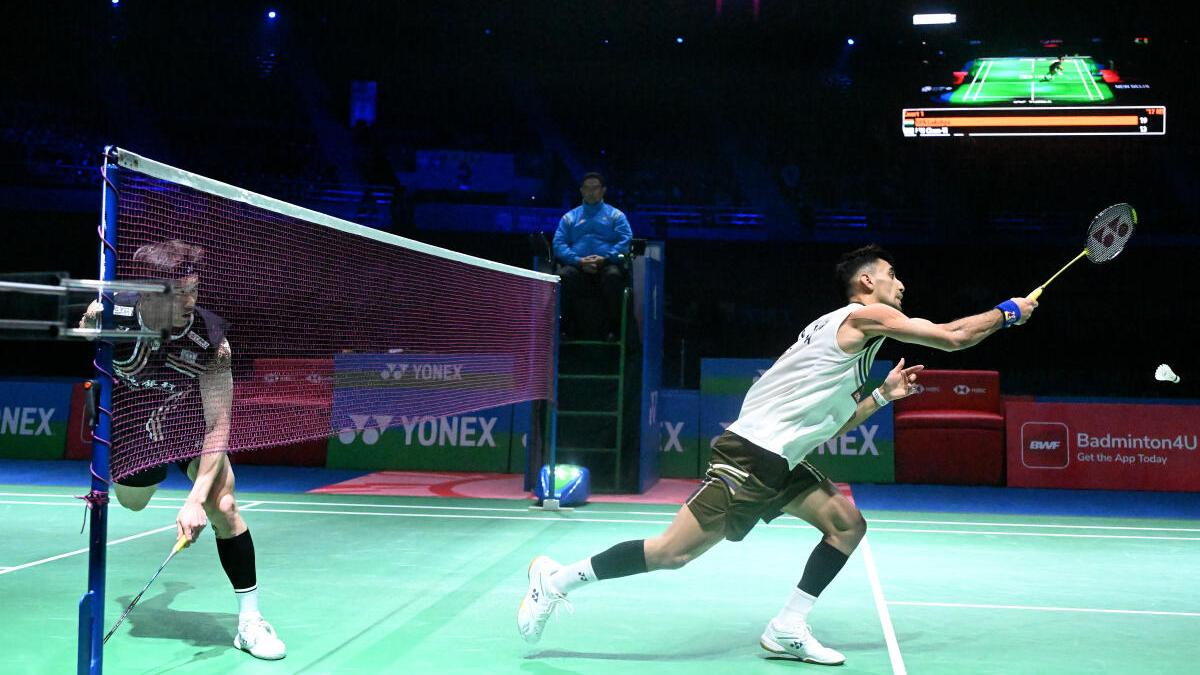
India Open 2026: Host’s campaign ends after Lakshya Sen fails to control drift
Lakshya Sen knew he was in trouble halfway into the rally to save the first of two match points in his men’s singles quarterfinal match at the India Open.
He had stayed too long in front of the court, and his opponent, Lin Chun Yi of Chinese Taipei, had spotted the mistake. A perfectly weighted clear, destined to land on the boundary tape, sent the Indian scrambling, his back to the net. He tripped and stumbled even as he desperately swatted the shuttle back. As Lakshya fell over, he didn’t even look back as he buried his face into the mat. Lin was waiting at the net and pounded the return into the mat. And that was that.
ALSO READ | Vimal Kumar urges BAI to organise series against Asian teams to improve India’s depth in doubles pool
In a tournament that’s mostly made headlines for events unrelated to matters on the court, it was perhaps fitting that a variable off the court played a part in the last Indian exiting the competition. Lakshya lost to Lin 21-17, 13-21, 18-21 in an hour and eight minutes, and later admitted he failed to adjust to the drift on the court at the Indira Gandhi Indoor Stadium.
‘Drift’ is an unavoidable mystery factor in indoor badminton, much like swing movement in cricket. It’s the unpredictable way air currents (from AC, windows, or even humidity)—imperceptible until acting on a five-gram shuttlecock—push the shuttlecock off its intended path, making it float or curve, significantly affecting shot control, speed, and trajectory, especially for clears and drops.
All stadiums have it. The Indira Gandhi Stadium has a lot of it, certainly far more than the KD Jadhav indoor hall, a few hundred meters away, where, until recently, the India Open was held.
There are multiple reasons for increased drift. The Indira Gandhi Stadium is far more cavernous, allowing currents to build in intensity. The drift inside the stadium blows both sideways as well as along the length of the court.
What this means is that on one side of the court, players can never be comfortable lifting the shuttle high, to where they think the back line of their opponent is. Hit it as you normally would, and the drift invariably carries the shuttlecock long. Try to check the stroke and the shuttle often sits ripe to be smashed. From the other side, the same players can hit the shuttlecock with a lot more assurance that their stroke will likely stay within the boundary line.
Throughout the tournament, the players have known that there’s a good side and a bad side. Should a match go into a decider, players hope they open up enough of a lead while playing on the good side before they swap sides once they reach the 11-point mark.
That’s what happened to Lakshya. “I was not prepared for the wind. There was a little bit more wind than yesterday, so it took me some time to realise. I was a bit shaky from the net to lift the shuttle, and I made so many errors just from the front,” he admitted after the loss.
ALSO READ | Get stronger, stop chasing easy points: Vimal Kumar’s advice to Lakshya Sen
Lakshya started on the favourable side of the court against his opponent, ranked 12th in the world. In that first game, everything the Indian touched seemed to turn to gold.
Early on, he started controlling the front court, probably aided by the fact that Lin couldn’t lift with any confidence. A 54-shot rally made it 11-17 for the Indian, who defended impossible shots from both forehand and backhand before Lin eventually lifted long.
Lakshya had won both his matches at the India Open easily in straight games and it looked like the quarterfinal was going along similar lines. But Lin, who had never lost to Lakshya, still had to have a say. If he had found the going hard on the bad side of the court, Lakshya was going to find it next to impossible.
The Indian started the second game well, opening a three-point lead early. That was the high point for him, though. Lin started hitting shots behind Lakshya, forcing him to make high clears in return. Lakshya couldn’t find his length. He lost nine straight points to fall from 5-2 to 5-11. Lakshya closed the gap to 11-14, but he was never comfortable. Lin eventually trusted that every time Lakshya hit a clear, it was going to go out. A 56-shot rally ended up making it 18-14 for Lin, as a weak Lakshya clear only set up a smash winner.
Lakshya knew exactly what Lin was doing, but he didn’t have the answers on the day. “I tried being more patient from the back. I knew he was trying to make me lift. I kept trying to keep the shuttle down. But it didn’t happen,” he said.
Lakshya started the third game on the ‘good’ side, but only for the first half. He had to give himself breathing room, knowing he would be on the wrong end after the halfway mark. He never got that buffer. The last game wasn’t just about adjusting to the drift but about dealing with pressure. Lakshya simply couldn’t.
At the change of ends, Lakshya had the lead, but it was just a solitary point. He managed to extend that lead, but the errors while making clears were around the corner. Six straight points were lost, and 15-12 became 18-15.
A moment of magic raised hopes of a comeback as Lakshya hit a behind-the-back defensive shot to close the gap to 18-17. This was the kind of shot that got the crowd on its feet, and which, on another day, might have inspired a stirring rearguard, but it was not to be.
Lin acknowledged the shot. “Enjoyed it!” he would say after the match.
Then he got back to pressing his advantage. One more point for Lakshya made it 18-18 before Lin nicked three straight points in quick time to close the door on Indian hopes in a competition the home side would want to forget as soon as possible.
Published on Jan 16, 2026