

From Shooting to Chess: Five Indians Who Ruled World Sport in 2025
In a year when India’s sporting landscape cracked open to reveal perhaps its most ambitious generation yet, five athletes stood tall—carrying not just medals and milestones, but transcending their craft to make stadiums feel like movements.
From turfs and chessboards to shooting ranges and boxing rings, India in 2025 did not simply participate in the global arena to make up the numbers. It dictated its own era.
And at the heart of this shift beat the stories of a few gamechangers who showed us what transpires when destiny meets drive.
The Samrat who claimed the Worlds throne
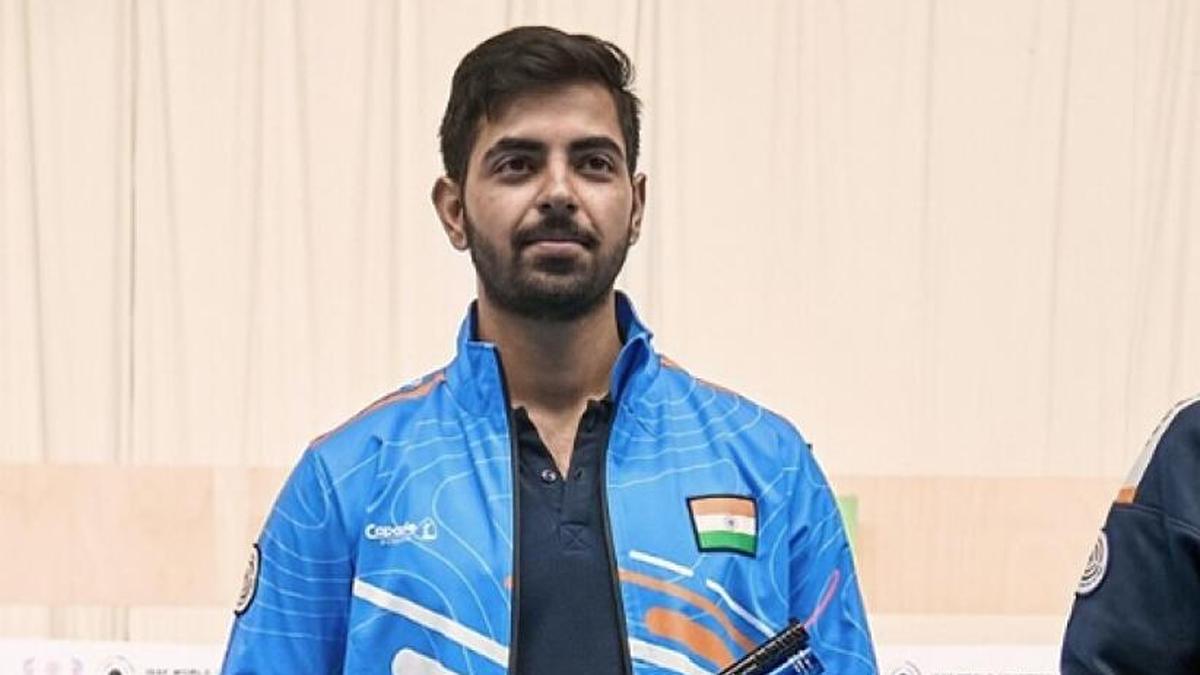
Samrat Rana, all of 20, barely broke a sweat as he became the first Indian pistol shooter to be crowned world champion in an Olympic discipline, in Cairo.
That he first topped qualification and then edged the sensational Hu Kai of China by 0.4 points in the 10m air pistol final only heightened the triumph.
Hu Kai had been virtually unstoppable this season. He had swept gold at all four 10m air pistol World Cups and topped the podium at the Asian Championships. Rana, by contrast, had featured in just one World Cup prior to Cairo, finishing 10th in qualification.
Yet, in the eight-man final, Rana appeared possessed, cruising to a clutch 243.7. Heading into the final two-shot series, Kai held a slender 0.1-point lead. Usually ice-cool, the Chinese shooter faltered under pressure, firing a 9.5. Rana responded with a 10.2, opening up a 0.6-point advantage with one shot remaining. Kai struck back with a near-perfect 10.8, leaving Rana needing a 10.3 or higher to seal the title. In his previous 23 shots, he had crossed that mark only six times.
But fortune smiled on the young shooter from Karnal, who may have quietly summoned the discipline Roman emperor Marcus Aurelius once praised: “A man’s worth is no greater than his ambitions.” Rana delivered a 10.6 to clinch the crown. His individual brilliance also powered India to team gold in the men’s air pistol event, alongside Varun Tomar and Sharvan Kumar.
Rana further teamed up with Esha Singh in the mixed event, where the Indian pair dominated qualification, dropping just seven points apiece to reach the gold medal match. They had to settle for silver, however, as Hu Kai and Yao Qianxun fired a relentless stream of 10s to hand India a 16–10 defeat.
Rana’s appetite for podium finishes carried him to the season-ending World Cup Final in Doha, where he again tested himself against the world’s elite. At one stage, he appeared poised for another title run, but a perfect 10.9 for his 20th shot was followed by a costly 8.4 on the 21st. The lapse saw him bow out at the 22-shot mark with a score of 221.5, earning bronze and his first medal at a World Cup Final.
Those performances have lifted Rana to world No. 6 at the time of writing. The boy who began shooting in a makeshift home range has come to embody the scale of India’s emerging promise in the sport. His rise is a microcosm of a talent pipeline that is no longer just deep, but increasingly world-ready.
The new hitman
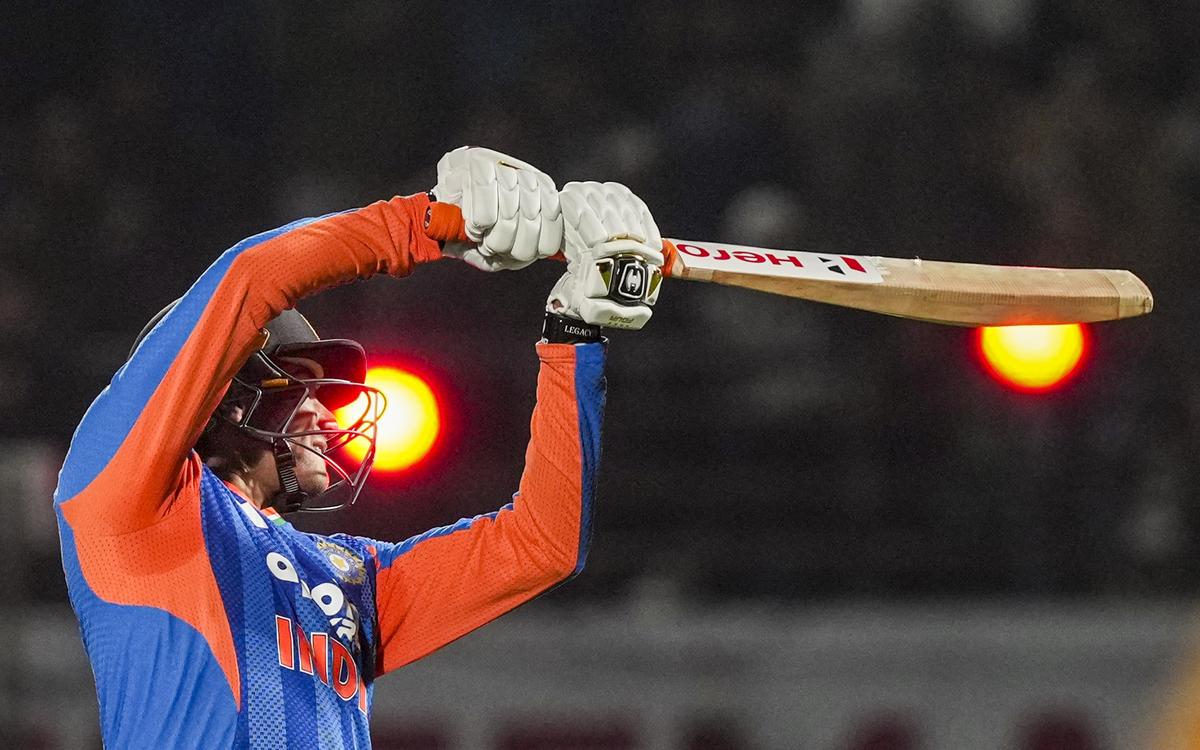
The defining thread of India T20 opener Abhishek Sharma’s year was his appetite for clearing the ropes.
| Photo Credit:
PTI

The defining thread of India T20 opener Abhishek Sharma’s year was his appetite for clearing the ropes.
| Photo Credit:
PTI
Looks can be deceiving, and Abhishek Sharma is a classic example. With his neatly cropped hair and easy smile, he could pass for a college heartthrob, not a cold-blooded run machine. But judge him by appearances and the punishment is swift. Once he feels the bat in his hand, the softness vanishes, replaced by a ruthless clarity of intent that has made bowlers pay repeatedly.
In 2025, Abhishek set the tone early.
In February, against a formidable England attack featuring Jofra Archer and Mark Wood, during the fifth Twenty20 International at the Wankhede Stadium, Abhishek tore into pace and spin alike to smash a 37-ball hundred. He came within touching distance of Rohit Sharma’s national record of a 35-ball century, set in 2017.
He eventually walked back with a colossal 135 off 54 balls, laced with 13 sixes and seven fours. The innings powered India to a 150-run victory, its second-biggest margin in T20Is, and vaulted Abhishek to the No. 1 spot in the ICC T20I batter rankings. In the process, he displaced Sunrisers Hyderabad teammate Travis Head to become only the third Indian, after Virat Kohli and Suryakumar Yadav, to reach the summit.
His dominance carried into the Asia Cup, where he was named Player of the Tournament after amassing 314 runs, the most by any batter in a single edition.
In the Indian Premier League, Sunrisers Hyderabad retained him for Rs. 14 crore, and Punjab Kings bore the brunt. Abhishek announced himself with a ferocious 141 off 55 balls, the highest individual score by an Indian in IPL history and the third-highest overall, behind Chris Gayle and Brendon McCullum. He finished the season with 439 runs from 14 matches.
The defining thread of Abhishek’s year was his appetite for clearing the ropes. On December 6, during a Syed Mushtaq Ali Trophy match against Services, he crossed 100 T20 sixes in a calendar year, surpassing his own Indian record of 87 set in 2024.
As the year drew to a close, it was fair to say Abhishek, the second-highest run-scorer of 2025 in T20Is among ICC full-member nations, had quietly shifted the boundaries of what constitutes a safe total in the format.
The Gambit for Grandmaster
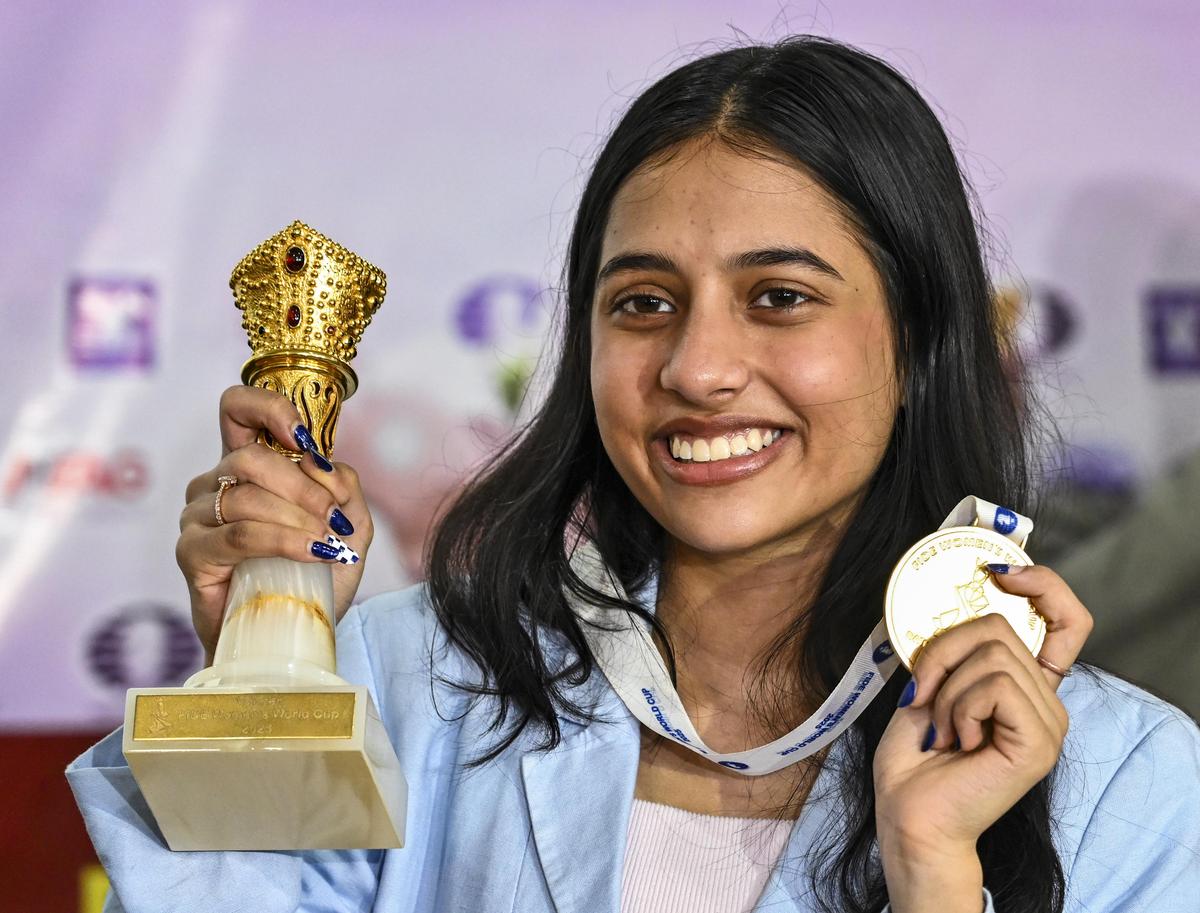
The World Cup win gave Divya the title of Grandmaster without even having to earn a single norm.
| Photo Credit:
PTI
The World Cup win gave Divya the title of Grandmaster without even having to earn a single norm.
| Photo Credit:
PTI
Indian chess is a gift that keeps giving. In 2025, it delivered Divya Deshmukh, a teenager who forced her way into chess’s highest tier by winning the FIDE Women’s World Cup and, in the process, earning the Grandmaster title.
Entering the tournament in Batumi, Georgia, as the 15th seed, Divya was very much an outsider in a field of 107 players that included nearly every leading name except reigning world champion Ju Wenjun. But Divya navigated it with remarkable composure. She eliminated a succession of seasoned opponents to set up an all-Indian final against Koneru Humpy, but the warning signs were visible much earlier. In the fourth round, she knocked out China’s Zhu Jiner, the second seed, before dispatching compatriot Harika Dronavalli in the quarterfinals.
Another giant fell in the next round. In the semifinals, Divya produced the result that truly shifted the narrative. Arriving without a single GM norm to her name, she defeated former world champion Tan Zhongyi 2.5–0.5, a scoreline that underlined both control and confidence.
The final against Humpy became a study in nerve. The two classical games ended in draws, pushing the contest into rapid tiebreaks. There, Divya seized her moment. In the second rapid game, Humpy faltered under mounting time pressure, and Divya converted calmly to secure a 2.5–1.5 victory.
The title brought a $50,000 prize (approximately Rs. 43.35 lakh at the time) and a berth in the Women’s Candidates, the eight-player event that decides the challenger for the world championship. More significantly, it confirmed Divya as India’s 88th Grandmaster.
She was not done. Later in the year, at the FIDE Grand Swiss, Divya held reigning men’s world champion Gukesh Dommaraju to a hard-fought draw, another marker of how quickly she was closing the gap at the very top.
The message was unmistakable. In modern chess, reputation offers no protection, and India’s newest names are no longer content to wait their turn.
Long reach, large impact
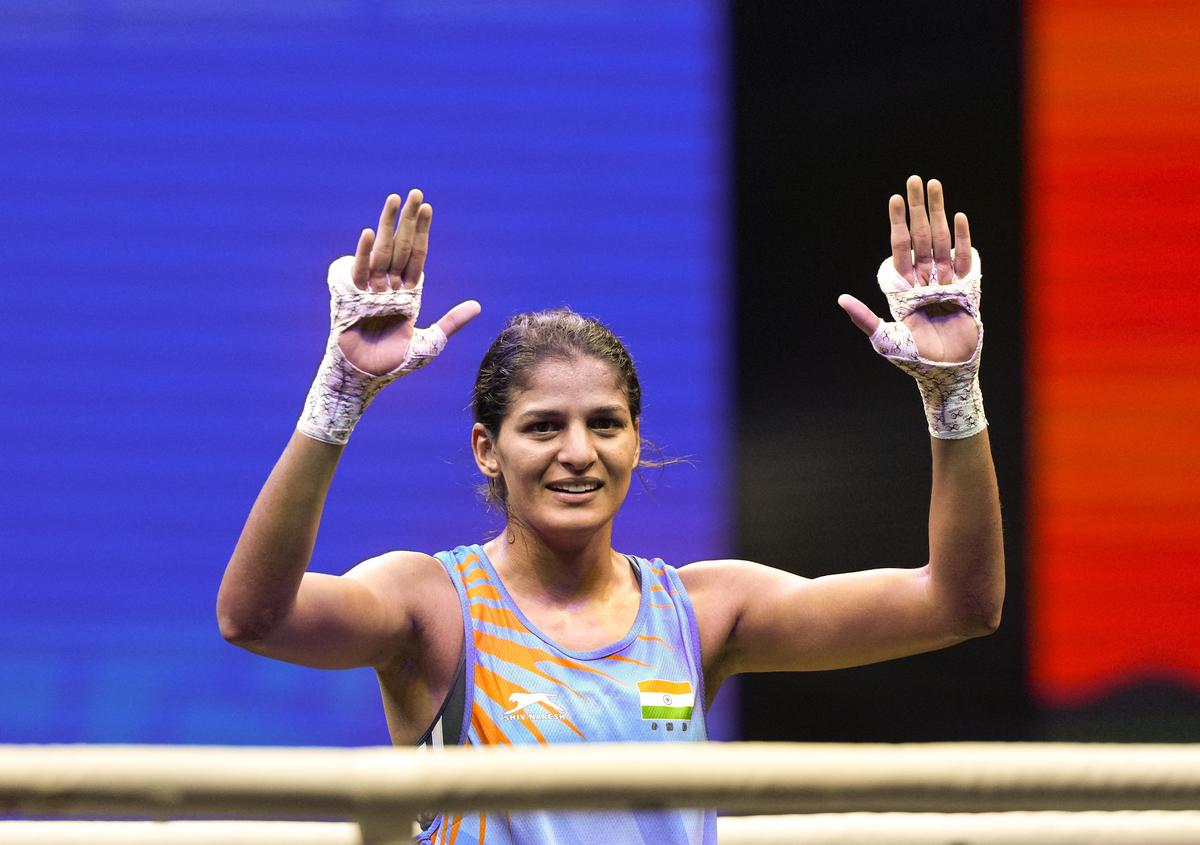
Jaismine Lamboria etched her name into history with a golden flourish, clinching the coveted featherweight title at the World Championships with a stirring victory over Paris Olympics silver medallist Julia Szeremeta of Poland.
| Photo Credit:
PTI
Jaismine Lamboria etched her name into history with a golden flourish, clinching the coveted featherweight title at the World Championships with a stirring victory over Paris Olympics silver medallist Julia Szeremeta of Poland.
| Photo Credit:
PTI
The bitter aftertaste of a first-round exit at the Paris 2024 Olympics became the crucible in which Jaismine Lamboria’s true mettle was forged. Parveen Hooda’s 22-month suspension for whereabouts failures, handed down by the World Anti-Doping Agency just ahead of the Games, opened a door for Jaismine. It also forced a decisive shift from the 60kg lightweight division to 57kg featherweight, a move that would soon redefine her career.
Any sense of reprieve, however, was fleeting. At the Olympics, Jaismine ran into 2019 world champion and Tokyo 2020 silver medallist Nesthy Petecio of the Philippines and was comprehensively outboxed. Petecio would go on to claim bronze. Jaismine returned home with something less tangible, but ultimately more valuable. Despite standing nearly five inches taller, she struggled to land clean punches or sustained combinations. The post-mortem was clear. Against shorter opponents, she needed to abandon caution, step into exchanges, and use her reach as a weapon rather than a buffer.
The adjustment was evident when she was selected for July’s World Boxing Cup in Astana. After two evenly matched rounds, Jaismine began asserting control with her long jab and straight punches, edging past two-time Olympian Jucielen Romeu of Brazil 4-1 in the final.
Two months later, at the World Championships in Liverpool, she delivered a lesson in control and consistency. Four successive 5-0 unanimous victories followed, including a commanding win over Venezuelan Olympian Omailyn Alcala.
The sternest examination arrived in the final against Poland’s Julia Szeremeta, the Paris 2024 silver medallist. Even after conceding the opening round, Jaismine stayed composed, using superior footwork and crisp counters to wrest control and seal a 4-1 split decision (30-27, 29-28, 30-27, 28-29, 29-28). The win made her the ninth Indian woman to claim a world title.
There was little pause. In November, at the World Boxing Cup Finals in Greater Noida, Jaismine fought through intense pain in her left shoulder to defeat Kazakhstan’s former Asian youth champion Ulzhan Sarsenbek 5-0. That victory set up a marquee final against Paris Olympic bronze medallist Wu Shih Yi. Unable to deploy her favoured left hook, Jaismine adapted again, relying on disciplined right jabs and straight lefts to record a 4-1 win.
By the end of the season, Jaismine Lamboria’s body of work stood as a reaffirmation of Indian women’s place in global boxing, built not on hype, but on adjustment, resilience, and control.
A rare hat-trick
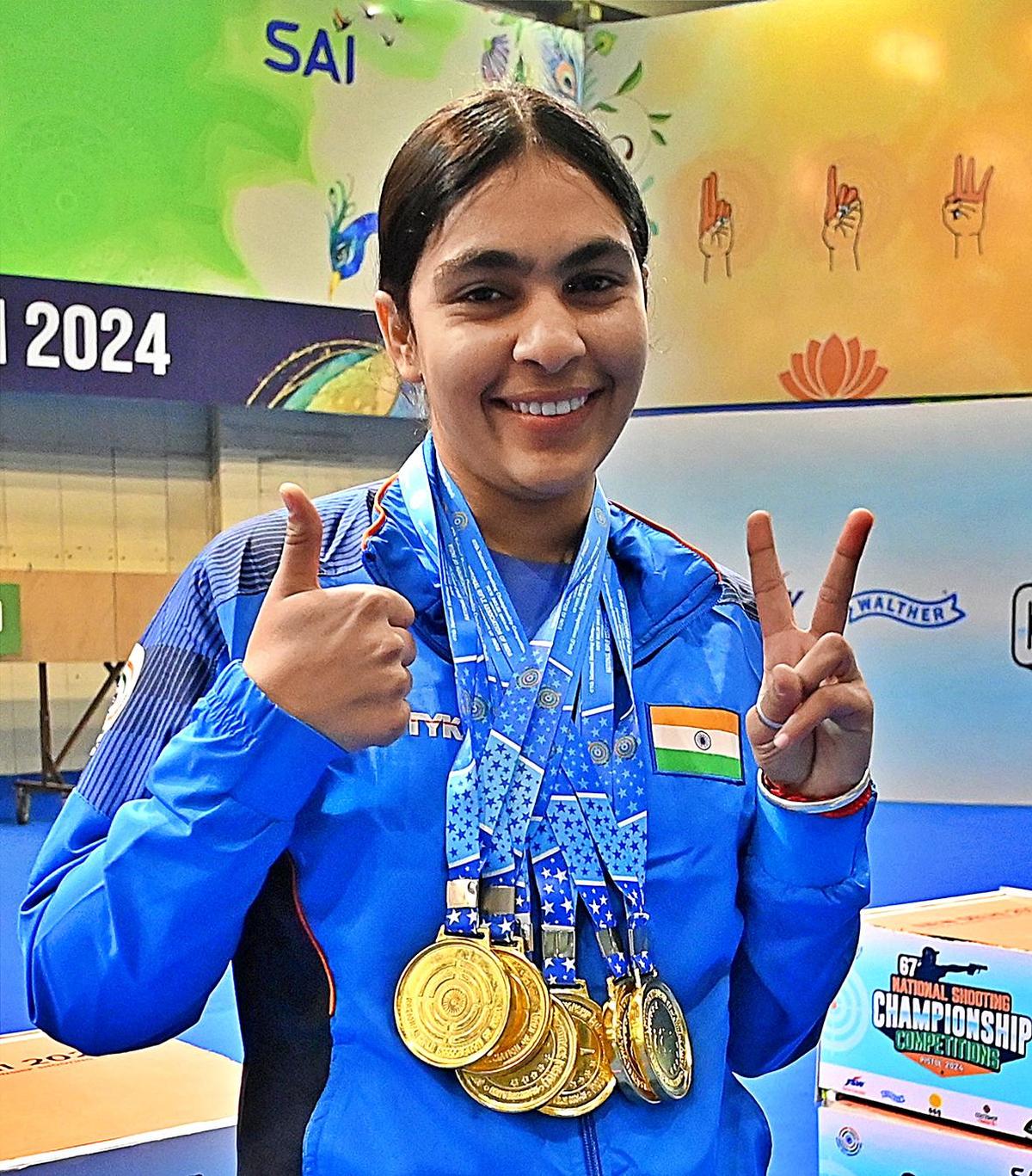
It was a stunning breakthrough year for Suruchi Phogat in women’s 10m air pistol in 2025, as she consistently outshot higher-profile rivals, including Manu Bhaker.
| Photo Credit:
Special arrangement
It was a stunning breakthrough year for Suruchi Phogat in women’s 10m air pistol in 2025, as she consistently outshot higher-profile rivals, including Manu Bhaker.
| Photo Credit:
Special arrangement
Suruchi Singh is another shooter who fashioned a landmark 2025. Few athletes announce themselves at the senior international level and rise to World No. 1 in under five months, but the 19-year-old from Haryana’s Jhajjar did precisely that.
From the same district that produced double Olympic medallist Manu Bhaker, Suruchi’s ascent has been startling not just for its speed, but for its scale. She became the only Indian shooter to win three consecutive individual World Cup gold medals in a single season, a feat that eludes many across entire careers.
Her run began in April in Buenos Aires, where she clinched her maiden senior individual World Cup gold and paired with Olympian Saurabh Chaudhary to win mixed team bronze in the 10m air pistol. The momentum carried seamlessly to Lima. There, Suruchi outshot Bhaker to take individual gold and then overturned a deficit to secure mixed team gold alongside Saurabh.
By the time the circuit reached Munich in June, Suruchi was the shooter everyone was chasing. In a tense final against France’s Camille Jedrzejewski, she held her nerve to fire a 10.5 with her 23rd and final shot, sealing a third straight individual World Cup gold.
The Asian Championships proved relatively subdued by her own standards, yielding two bronze medals: one in the mixed team event with Saurabh and another in the women’s team competition alongside Bhaker and Palak.
Suruchi saved her most emphatic statement for December’s ISSF World Cup Final at the Lusail Shooting Complex. Against the sport’s elite, she produced a junior world record score of 245.1, surpassing the long-standing mark of 244.7 set by Bhaker in 2019. It felt less like symbolism and more like succession.
Senior teammate Sainyam, also a finalist, finished 1.8 points behind to claim silver. Together, they ensured India recorded a double podium in the same event at the World Cup Final for the first time, underlining the country’s growing depth in shooting.
Published on Dec 31, 2025