

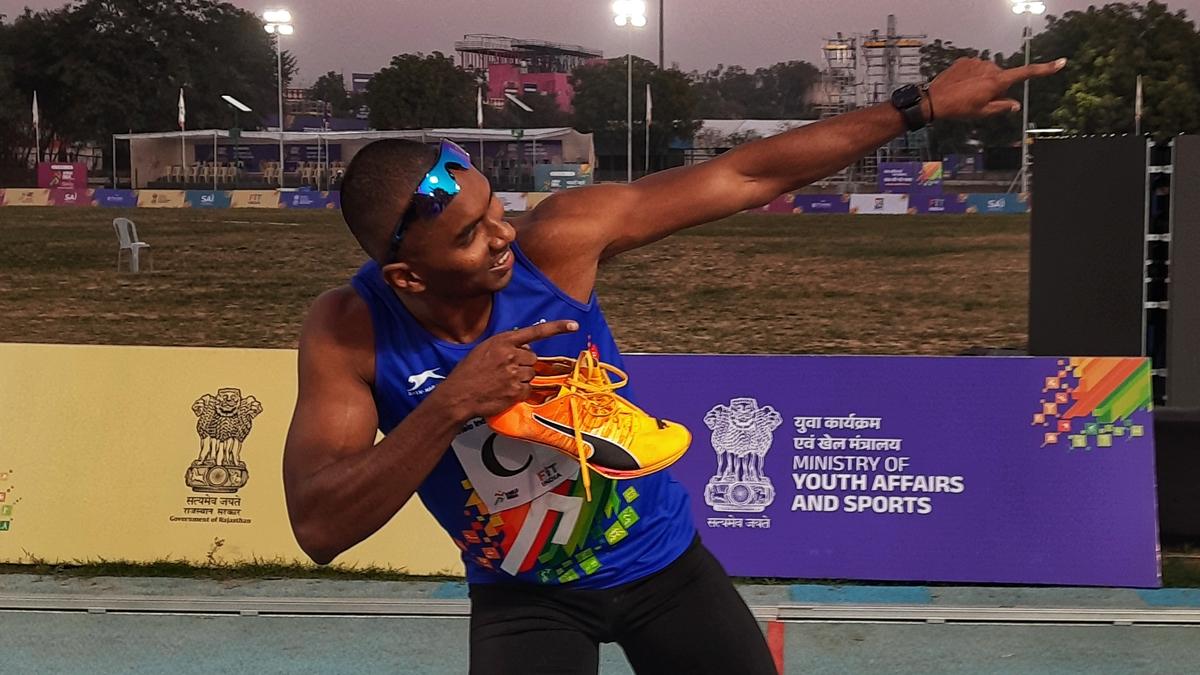
With lessons from Usain Bolt and Bednarek, India’s fastest man, Animesh Kujur, looks to scale new heights
One could sense a flicker of excitement as the teams for the men’s 4x100m relay final were announced at the Khelo India University Games (KIUG) in Jaipur on Thursday.
As the groups arrived one by one, all eyes remained fixed on the quartet from the Kalinga Institute of Industrial Technology (KIIT), who struck the famous kamehameha stance from the Japanese anime Dragon Ball Z for the cameras before dispersing to their respective zones. Among the four was Animesh Kujur, India’s fastest man and the one the spectators, mediapersons and even KIUG athletes edged closer to see.
As expected, KIIT blazed to victory with a meet record (40.09s), powered by a blistering second-leg run from Kujur. “KIUG’s meet record was not with KIIT, so we came just for that,” Kujur, who is in his off-season, said candidly.
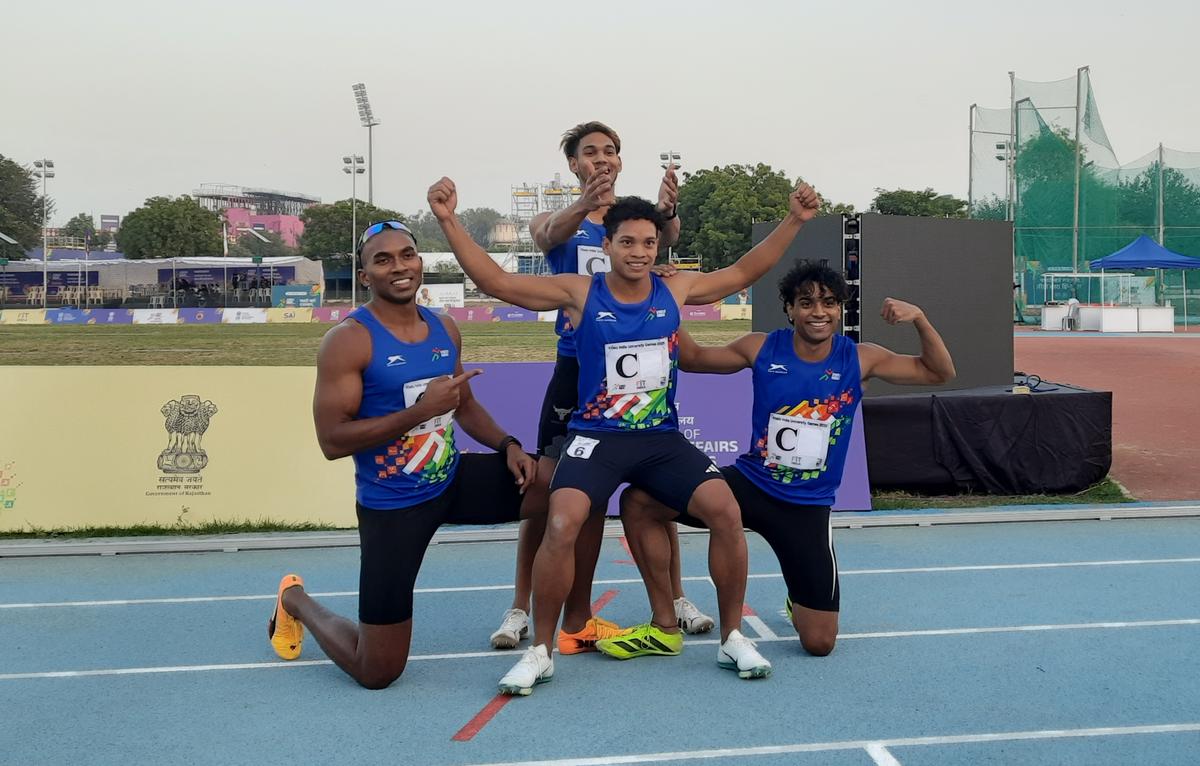
The Khelo India University Games 2025 men’s 4x100m gold medal-winning team from Kalinga Institute of Industrial Technology, comprising Animesh Kujur (left), D. Mrutyam Jayaram (back middle), Santa Mahendra (front middle) and Abhay Singh.
| Photo Credit:
Joan Mathew Jacob

The Khelo India University Games 2025 men’s 4x100m gold medal-winning team from Kalinga Institute of Industrial Technology, comprising Animesh Kujur (left), D. Mrutyam Jayaram (back middle), Santa Mahendra (front middle) and Abhay Singh.
| Photo Credit:
Joan Mathew Jacob
For him, though, the KIUG meet record was only a small victory in what was otherwise an encouraging year.
Earlier this year, Kujur broke the 200m national record, clocking 20.32s en route to bagging bronze at the Asian Athletics Championship in Gumi, South Korea. He then became the first Indian male sprinter to qualify for the World Athletics Championships, finishing high enough in the rankings for the 200m event.
Despite securing a spot, he said the Worlds were not his priority this year. Instead, his focus was on the FISU University Games held in July in the Rhine-Ruhr metropolitan region of Germany.
He later confessed that a bit of complacency cost him a medal by a tenth of a second.
“In the semifinals, it was my own mistake. I took it a little easy, thinking that I would qualify for the finals. But it was a lifetime mistake. I ended up getting Lane 1 in the final, and that cost me a medal,” Kujur said.
Armed with those lessons and the hunger to grow, he carried his spikes to Tokyo, where he faced the big leagues. Kujur recalled sharing space with current elites of the sport like Noah Lyles, Kenny Bednarek and Sydney McLaughlin-Levrone, taking note of how they carried themselves.
“When they were warming up, I used to go and sit near and observe their techniques and how they prepared before a race. I ended up learning a lot,” Kujur said.
Lining up for a race in front of 55,000-odd spectators, their cheers booming down, also made him realise that he had a lot of ground to make up.
“It was the first time I saw so many people. The stands had multiple floors, and each floor seemed like a stadium by itself. Even after my event, when I watched the other races, I used to go up to the top among the crowds and see from there. The athletes running used to look so tiny,” Kujur explained.
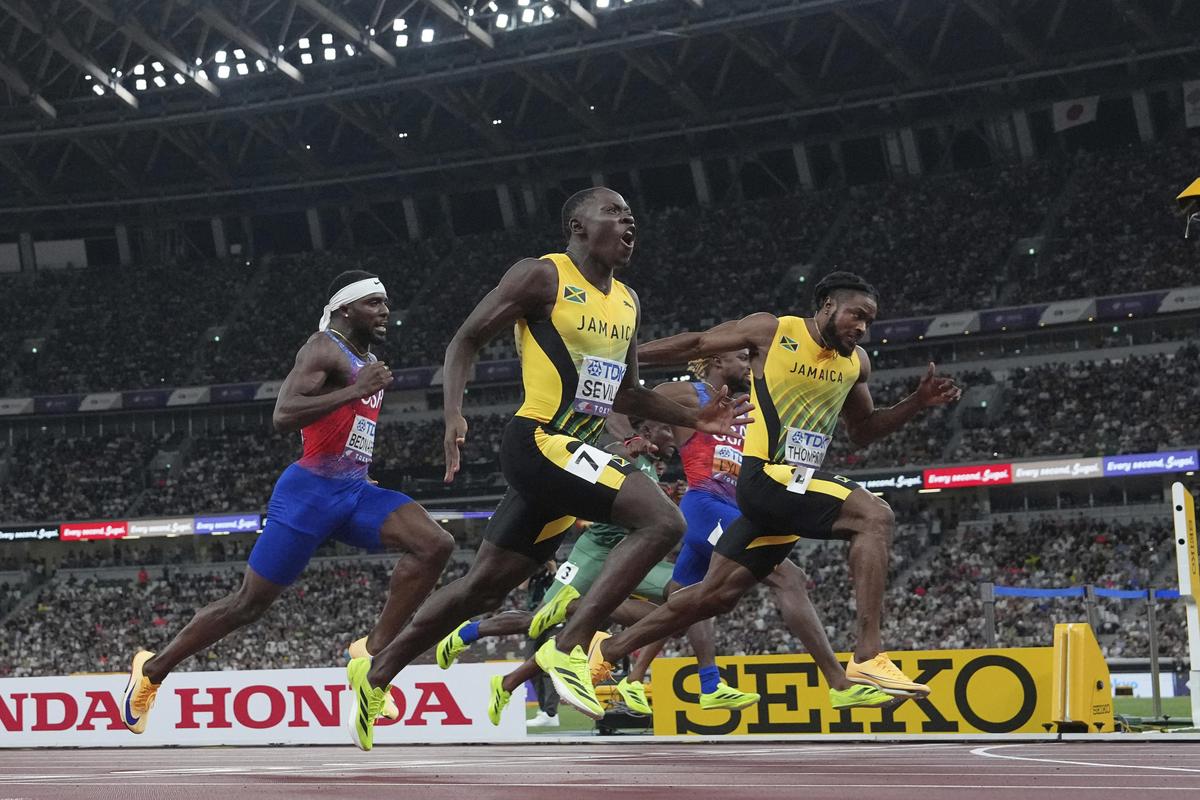
A packed house at the Japan National Stadium watches the men’s 100m final at the 2025 World Athletics Championships.
| Photo Credit:
AP
A packed house at the Japan National Stadium watches the men’s 100m final at the 2025 World Athletics Championships.
| Photo Credit:
AP
Speaking about his heats race, which also featured eventual silver medallist Bednarek, Kujur said, “I did feel energetic after seeing and hearing the crowd, and it boosted me once the race started. I finished with a time of 20.77s while Kenny (Bednarek) qualified first with 19.98s.
“It was very much a learning experience, and I understood the difference between me and someone who performs regularly at the top level is.”
While he has tasted success over the past year, Kujur noted that one of his best moments came off the track when he met his idol, Usain Bolt, at a promotional event in New Delhi in September.
Kujur said the legendary Jamaican sprinter, whose trademark lightning-bolt celebration pose he has started mimicking, gave him valuable insights into how he could pump up his pace.
“When I saw him for the first time, I was like ‘oh god, he’s so tall’,” Kujur recalled with a wide smile.
“I showed him (Bolt) videos of my races, and he ended up taking the time to give me tips and pointed out places where I was leaking energy and how to improve,” he added.
Published on Dec 05, 2025