

Khelo India University Games faces a reality check
The storied state of Rajasthan added another chapter to its history as it welcomed young sportspersons from far and wide across the country for the fifth edition of the Khelo India University Games.
Adding to the crowd from the peak tourist season, over 12 days, 4,448 athletes from 222 universities flocked to seven cities — Jaipur, Ajmer, Udaipur, Jodhpur, Bikaner, Kota and Bharatpur — which served as hosts.
And while the numbers set it up for a big spectacle, in reality the competition found itself questioning its relevance in the calendar, being slightly marred by shallow turnouts in some disciplines.
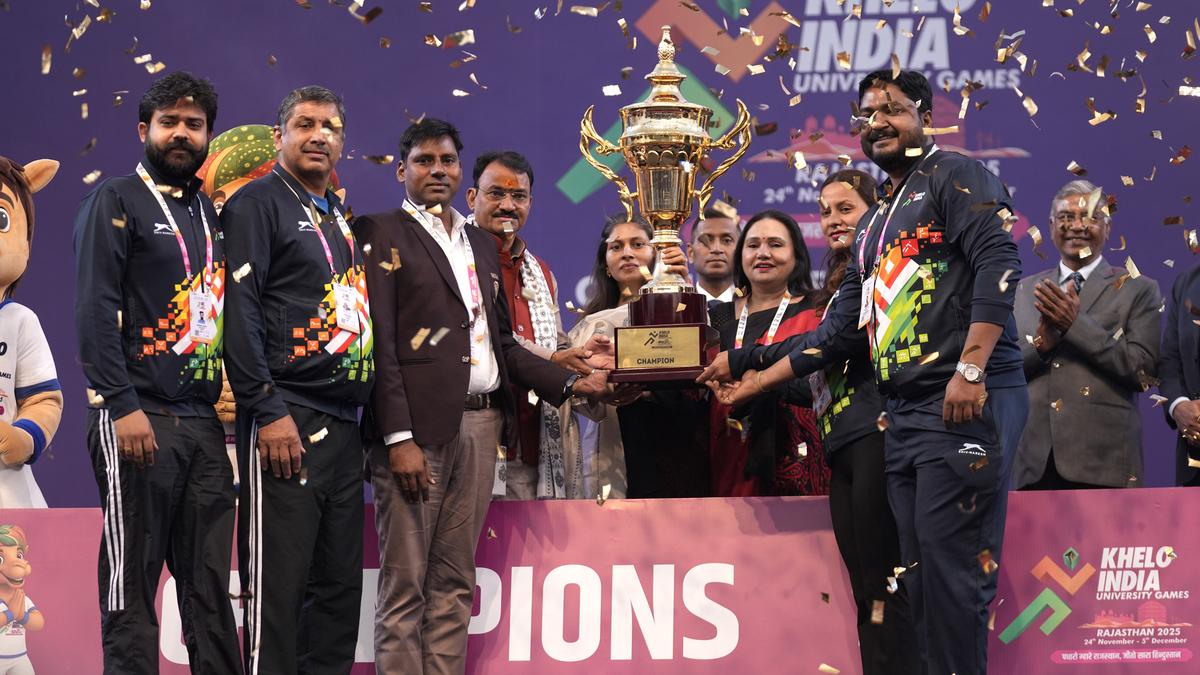
With an all-time high of 23 events held, it was Chandigarh University that retained its crown with a commanding haul of 67 medals (42 gold, 14 silver and 11 bronze). A chunk of the institution’s success was due to its prowess in the newly added event of canoeing and kayaking, where it bagged 23 gold medals, one silver and one bronze each.
Lovely Professional University (32 gold, 25 silver and 22 bronze) and Guru Nanak Dev University (32 gold, 22 silver and 18 bronze) completed the podium, with the former edging out as runner-up.
While the competition lacked the pomp and show compared to earlier Khelo India events in the year, there were still some seasoned faces around. Champion swimmer Srihari Nataraj was the cream of the crop and the best individual performer, securing 11 medals (nine gold and two silver) for Jain University, helping it settle into fourth place in the overall tally. Elsewhere, the shooting events were headlined by Asian Games medallists Sift Kaur Samra and Ashi Chouksey. While the two combined to secure a bronze for GNDU in the women’s 50m rifle 3 positions team event, it was Ashi who came out on top in the individual event for her fourth straight gold in the competition, while Sift had to settle for silver.
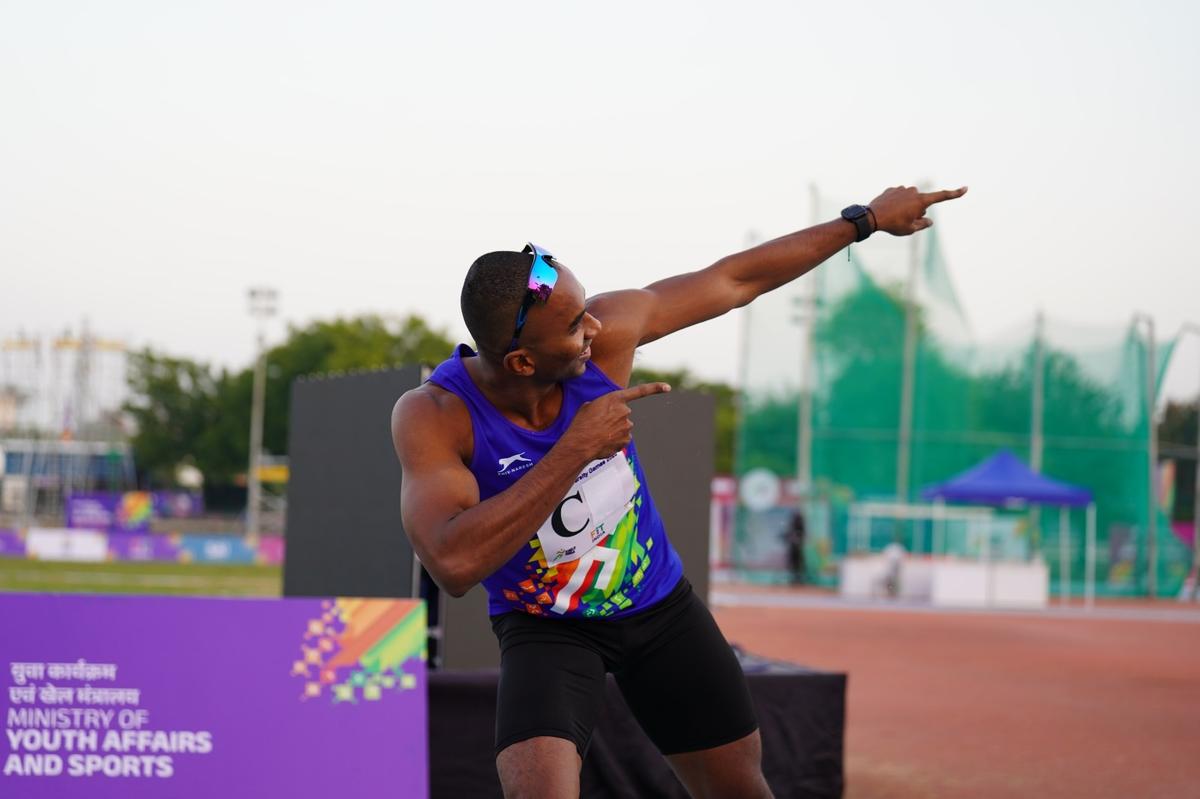
Charging ahead: Animesh Kujur (in pic), along with D. Mrutyam Jayaram, Santa Mahendra and Abhay Singh, set a meet record time of 40.09s in the 4x100m final.
| Photo Credit:
Special Arrangement

Charging ahead: Animesh Kujur (in pic), along with D. Mrutyam Jayaram, Santa Mahendra and Abhay Singh, set a meet record time of 40.09s in the 4x100m final.
| Photo Credit:
Special Arrangement
In the men’s competition, Olympic medallist Sarabjot Singh too had a fruitful outing, winning bronze in the men’s 10m air pistol, silver in the men’s 10m air pistol team event and gold in the 10m air pistol mixed team category for Panjab University.
Meanwhile, the choice to stage the Games in the middle of winter in the region came with its own set of challenges. Early sunsets and temperatures dropping to close to 10 degrees Celsius discouraged many individuals from participating and disrupted their time off, with athletics bearing the brunt.
“The first reason for a lot of events missing participants is that the meet is being held during the off-season for the athletes,” KIUG athletics competition manager Rakesh Save explained.
“Even the athletes who are in camp will not be allowed to participate now because this is an off-season for them. They have to get trained for the next season,” he added. Numerous events witnessed a lack of participants, to the extent that the men’s 400m hurdles final and the women’s 400m final were run by Swarnim Gujarat Sports University’s Ruchit Mori and Kurukshetra University’s Manisha, respectively, on their own.
Moreover, he noted that the Association of Indian Universities’ (AIU) directive not to allow jobholders to participate was another major blow. And with the government announcing last year that all Khelo India medal winners, across all disciplines, will be eligible for government jobs, the admissible bracket for KIUG has been severely narrowed. “These are the two main causes, because we have a limit of eight athletes qualifying for the competition. So if three or four of them go out because of these reasons, then we are obviously faced with a problem,” Save noted.
However, despite the shortage of participants, the track and field events produced a fair share of memorable moments. A total of 12 meet records were set across the 45 events that took place in the men’s and women’s categories.
And perhaps the best was saved for last as India’s fastest man, Animesh Kujur, lined up for Kalinga Institute of Industrial Technology (KIIT) in the men’s 4x100m final, much to the excitement of spectators and participants alike.
And, true to expectations, Animesh, along with D. Mrutyam Jayaram, Santa Mahendra and Abhay Singh, hurried to the finish line in meet record time (40.09s) to bring the curtain down on the athletics events at the Games. After the race, Animesh admitted that breaking the meet record was the only reason that motivated him to run, while also highlighting the importance of such university competitions, adding that “It is a very important platform for young athletes to be identified.”
But with KIUG not acting as a qualification event for any next step, but rather as an extensive talent-hunt programme, the question remains as to whether it is — or ever can be — enticing enough to draw in the biggest athletes, who in turn could provide the rest of the field with tougher competition and the drive to do more.
For now, it remains an event conducted as a formality, with too little at stake to push aspiring athletes to the limit.
Honour board:
Chandigarh University: 42 gold, 14 silver, 11 bronze — 67
Lovely Professional University, (PB): 32, 24, 22 — 78
Guru Nanak Dev University, Amritsar: 32, 22, 18 — 72
Jain University, Karnataka: 30, 9, 11 — 50
Guru Kashi University: 15, 15, 18 — 48
Panjab University Chandigarh: 14, 33, 19 — 66
Kalinga Institute of Industrial Technology (Deemed to be University): 10, 3, 8 — 21
Savitribai Phule Pune University, MS: 9, 17, 12 — 38
Shivaji University: 4, 3, 13 — 20
Maharshi Dayanand University: 4, 2, 5 — 11
Published on Dec 09, 2025